
February 9, 2026
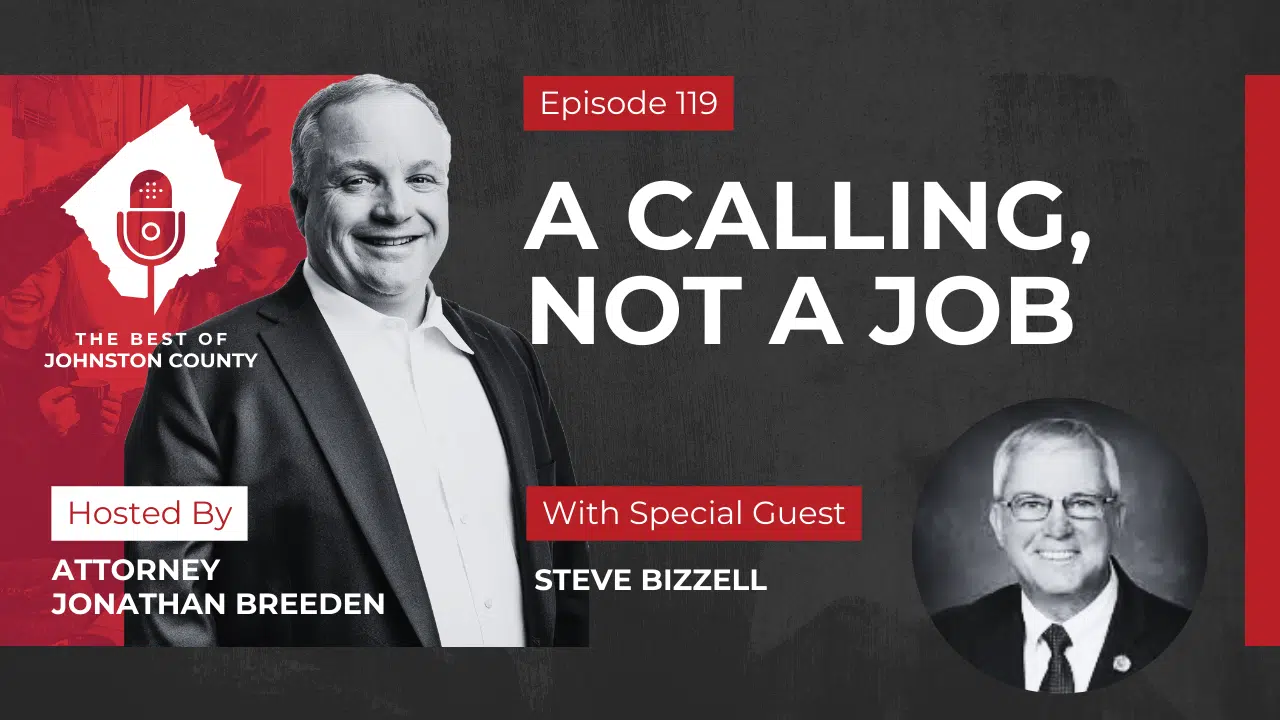
A Calling, Not a Job with Sheriff Steve Bizzell
Jonathan Breeden: [00:00:00] On this week’s episode of the Best of Johnston County Podcast. Our guest is Johnston County, Sheriff Steve Bizzell. He is part of our candidate series as he’s running for reelection for Johnston County Sheriff in the March 3rd, 2026 primary. We talked to him about why he ran for Sheriff originally in 1998.
What he has done as Sheriff? A day in the life of the Sheriff and why he would like the voters to give him another four year term. So if you’re interested in the Johnston County Sheriff’s Department, what it does, what it is, and how he wants to keep moving it forward, listen in.
Welcome to another episode of Best of Johnston County, brought to you by Breeden Law Office. Our host, Jonathan Breeden, an experienced family lawyer with a deep connection to the community, is ready to take you on a journey through the area that he has called home for over 20 years. Whether it’s a deep dive into the love locals have for the county or unraveling the complexities of family law, Best of Johnston County presents an authentic slice of [00:01:00] this unique community.
Jonathan Breeden: Hello and welcome to another edition of The Best of Johnston County Podcast. I’m your host, Jonathan Breeden, and on today’s episode we have Johnston County Sheriff Steve Bizzell. We’re here to talk to him about his a little bit his career in law enforcement. He has been the Sheriff of Johnston County since 1998, and he is running for, this will be his eighth term as Sheriff of Johnston County.
And we’re gonna talk to him a little bit about why he wants to run one more time or maybe more, but at least this time, and a little bit about what the Sheriff does because I don’t think a lot of people understand it. I have a decent idea, but I don’t completely understand it as well. And why he thinks you should vote for him in the March 3rd, 2026 primary.
But before we get to that, I’d like you to like you to like follow and subscribe to this podcast wherever you see it, whether it be on Apple, Spotify, YouTube, TikTok, LinkedIn X, or any of the other social media channels of The Best of Johnston County Podcast. The Best of Johnston County Podcast comes in every single Monday and has now [00:02:00] for over two years, well, actually over 28 months, we’re well over 110 episodes now. We’ve had a lot of great guests, including the vast majority of the county commissioners, several county commissioners, twice. We’ve had county manager Rick Hester, we’ve had county parks Director Adrian O’Neal. We had Congressman Brad Knott. If you love Johnston County as much as I do, this is the podcast for you. Welcome Sheriff Bizzell.
Steve Bizzell: Thank you, Jonathan.
Jonathan Breeden: I’ve been trying to get you booked since I came up with the concept of a podcast.
Steve Bizzell: It’s an honor to be with the mayor of Cleveland today
Jonathan Breeden: and the mayor of Cleveland. I wish I was the mayor of cleveland.
Steve Bizzell: And like you, Jonathan, I love Johnston County too. Thank you for an opportunity to be here today to meet your staff. Got an awesome staff out there. They make you look good, Johnathan.
Jonathan Breeden: Well, they definitely do all the work now. I don’t do a whole lot of practicing law now, but yeah, it’s, it’s fun. I started this podcast back when because it was really because of the mess with Ronald Johnson and Dickie Braswell and the media was just pounding Johnston County because you know, both those men ultimately went to [00:03:00] prison, committed a felonies, they were elected officials. And I’m like, I’m gonna tell the positive story of Johnston County.
And so that’s why I started doing this podcast and I’ve met so many great people and I’ve gotten to have so many great conversations that I’d almost rather do the podcast than eat.
Steve Bizzell: I hear you and Jonathan, I would tell you in Johnston County, we are blessed. The board of commissioners are good people. They understand the number one priority of government.
The number one responsibility of government is public safety, and they understand that. And that’s true from the White House to the State House, to the courthouse, to your house and to my house, right? And the commissioners have always been good to me. I’ve never been before to commissioner and asked for anything that I needed as the elected Sheriff to provide public safety of our citizens, that they didn’t find a way.
And I’m blessed. Our county manager, as you earlier mentioned Rick Hester, the county finance director, the county attorney, we all work together for the good of the people. We are friends, but when we’re on the job, it’s about the people’s business. But I am [00:04:00] honored and blessed to be here today. It’s an honor to be Sheriff as a young boy.
It was a dream I wanted I always wanted to be Sheriff as a young boy. And I was elected in 1998 and have been elected every four years since that time and on the ballot again. And I just want to thank the people Johnston County for putting their faith. Their support, their vote and their prayers. Being sure it’s a tough job.
But I will tell you, I got the best Sheriff’s office in the state of North Carolina. It’s not me, Jonathan, it’s the people behind the scenes that we can talk about that if you’d like.
Jonathan Breeden: Yeah, no, no, you’re right. And I’ve always thought you were one of the best Sheriffs in North Carolina and very professional organization.
Not all Sheriffs or as professional as other ones. And you know, you have been Sheriff through a tremendous amount of growth. The county is more. Oh my gosh. I mean, you become Sheriff. There’s 150,000 people
Steve Bizzell: probably so,
Jonathan Breeden: right. And now there’s close to 300,000 people.
Steve Bizzell: Yeah, we lower. Yeah, we have doubled.
Jonathan Breeden: Right. I mean, it’s almost doubled in the time’s been,
Steve Bizzell: and [00:05:00] we’ve had shared growth. You know, if you look at the crime rate in Johnston County, you don’t have to look real far down I 40. It’s a whole lot worse. We’ve been blessed here. Our deputies do a good job. Our detectives do a good job investigating the crime.
But anyhow, Johnston County. Everybody wants to move here. I don’t know if it’s because I’m Sheriff or what, but I’m joking, but a lot of people are, continue to move here.
Jonathan Breeden: Right.
Steve Bizzell: And, you know, I live on the other side of Smithfield in Eastern Johnston County, and we are beginning to experience the growth.
This crossed I 95 now. And it’s hitting Brogden and it’s beginning to hit Pine Level in Princeton and Micro and Kenly. We are beginning to get the growth. Now it’s crossed the interstate ninety five.
Jonathan Breeden: Well, and you’ve got adventure development
Steve Bizzell: Yep.
Jonathan Breeden: And the North State food hall and
Steve Bizzell: That’s right.
Jonathan Breeden: That whole entire development East field. Right. I mean, it’s. It’s gonna continue to happen. Now you can have Volcan building you know, the magnets for defense for the Defense Department in Benson.
Steve Bizzell: BJ’s is opening up in Selma this week.
Jonathan Breeden: Right. Well, and Clayton’s gonna get a Costco in the next three years.
So, yeah, I mean, it’s, it’s, [00:06:00] it’s absolutely crazy about the growth. But let’s just talk about you may not remember this. Why did you originally want to be Sheriff? You ran against the sitting Sheriff that had been Sheriff forever. You were a young man. You were a special deputy at the time. Why did you run? What did you want to do 28 years ago?
Steve Bizzell: You know, as a young guy, well, lemme back up. My dad was a minister and we farmed. My dad’s primary job was a farmer. We raised vegetables for the Winn-Dixie stores back then, which was comparable back then to the food Lion today. I always wanted to get in law enforcement.
My granddaddy was a deputy Sheriff back in 1928. And but anyhow, growing up I always used to hear the stories and I thought, you know, one day I’m gonna run for Sheriff, you know?
Jonathan Breeden: Right.
Steve Bizzell: My daddy’s brother ran for Sheriff in late 50’s, like 58 or 60. Back then it was a two year term. And he lost the election. He ran as a Republican back then. And I would tell you when I was elected Sheriff in 1998, I was the first Republican [00:07:00] Sheriff in Johnston County in almost 70 years. But it’s something I always wanted to do. I wanted to make a difference, but I would tell you I worked for Sheriff George Johnson.
Sheriff Johnson, was the Sheriff and died in office in the parking lot. Sheriff Narron was appointed to finish out his term. Sheriff Narron ran and was elected on three different occasions. If I recall correctly. I worked for Sheriff Johnson as a reserve deputy. Back then, it was called a special deputy.
Jonathan Breeden: Right. A special deputy. I heard that.
Steve Bizzell: A part-time deputy.
Jonathan Breeden: Right.
Steve Bizzell: Our job was to serve the civil and the criminal documents of the courts, and then I went to work with Sheriff. After Sheriff Johnson died, I went to work with Sheriff Narron as a reserve deputy, later on, as a full-time deputy, and decided to run for Sheriff in 1998 again.
You know, I thought I could bring something to the department. And, you know, it was challenging the first six months as Sheriff I could write a book almost. Just a lot of change and we had to update a lot of stuff. We’ve come a long way. Over those years we’ve seen a lot of growth. We’ve been through the you know, Floyd we’ve been through you know, the COVID [00:08:00] era. I’ve seen a lot of stuff and, the people have always been there for me. I’ve always been there for them. This job is not that it’s a calling for me. I really feel like I am in the calling. I’m doing what I was supposed to be doing.
Jonathan Breeden: Well, that’s great. I I feel like I’m doing what I was supposed to be doing.
Steve Bizzell: There you go.
Jonathan Breeden: Helping families in Johnston and Hardaway County. So I, I get it. And so it’s not really work when you sort of really enjoy it and you feel like you’re helping people.
Steve Bizzell: But Jonathan, you won’t believe the people that I get to help. Behind the scenes, whether on the telephone that walk into my office and there’s things, a lot of times they’re embarrassed about something going on with their family. Grandparents are calling me, Hey, my grandson’s in jail. Can I send a minister over to the jail to minister to him? And I find a way to make that happen.
Well, we got, I’m a person in jail. I don’t care what they’re charged with murder. And I get a call from the the Chief General to say, Hey. Johnny’s in jail. We got a call his mom died, his dad died. His granny, grandpa, whoever, [00:09:00] stepdad, stepmom or whatever. I always make a way to get that inmate out two decades ago, get him, carry him down to the funeral home to visit with the loved one.
Jonathan is about doing what’s right. That’s the way I was raised as Sheriff, I’ve tried to run the Sheriff’s office like the people would be proud. It’s not mine. It don’t belong to me. I’m blessed to be there and I just love helping people.
Jonathan Breeden: Well, and, and it’s. I mean, you have 238 employees,
Steve Bizzell: 238 employees,
Jonathan Breeden: and a budget of how many million?
Steve Bizzell: 140 deputies, and our budget’s just over $32 million a year.
Jonathan Breeden: Right? I mean, the last thing you’re doing is law enforcement. I mean, you’re basically running a $32 million enterprise.
Steve Bizzell: I tell folks, a lot of times I’m the banker at the Sheriff’s office. My job is to spend the taxpayer’s money that the commisioners have approved to be spent to operate the office. Sure. And I’m not bragging, but I do a good job with that because I look at, I know what it is to be a farmer. And I look at it like the farmers, the electricians and the [00:10:00] plumbers and the painters, the people that are in business, the HVAC guys, I look at, you know, they’re out here working and they’re, I’m a paying their taxes and every citizen in the County that owns the property or paying their taxes to run the county government. The money that is allocated to the Sheriff’s office comes to me. It’s my job to spend it wisely, and I’ll be honest with you, I always think about. Whose money am I spending? There’s been years that I’ve sent back 1.2 million 1 year, 1.6 million 1 year. I remember specifically 800 something thousand dollars that I operated all year, was able to send that money back.
I don’t just spend it because I can, but I’ll be honest with you. I operate the Sheriff’s office as far as the expenditures, just like it was mine.
Jonathan Breeden: Right, but there is some thought that we should have more deputies than 140 and that maybe 140 is not enough. And you’ve not gone and asked commissioners for new deputies in several years, but yet the [00:11:00] County keeps growing.
Steve Bizzell: Yep.
Jonathan Breeden: Why not? They would give it to you.
Steve Bizzell: You know, I remember years ago Sheriff John Baker from Wake County went before the commissioners up there and asked for a bunch of position to hire deputies. And I remember one of the commissioners asked the Sheriff in Wake County at that time, how many vacancies do you have now?
And I remember he said 32. And he said, I’ll tell you what. Why don’t you go back and fill those first and then you come to see us. And for the last four years, I think it is. I’ve not asked for any deputies.
Jonathan Breeden: Right.
Steve Bizzell: And I’ll tell you why. We had after George Floyd, we had people that were getting out of law enforcement, not only at our office, but across the state, across the nation, across this county.
Look at the highway patrol. I don’t know how many vacancies they got now. I can tell you today at at the Sheriff’s office, we only got nine vacancies for deputy Sheriff’s. I talked with the Sheriff the other day out west in North Carolina. They had 43 vacancies. But I will tell you, I don’t go ask the commissioners for positions when I was [00:12:00] sitting there with 12 positions that were unfilled.
Jonathan Breeden: Okay?
Steve Bizzell: I know when I get at a point, which I, to be honest with you, I’m gonna be asking the commissioner for some position this year. I’m beginning to see a lot. The community college has got people that are in the BLET. Again we just hired five new deputy at one time three outta five were, were right outta BLET.
I’m beginning to see people getting back into law enforcement and so once I began to get fully staffed. I’ll go ask the commissioner for some more.
Jonathan Breeden: Okay.
Steve Bizzell: And I can tell you they will fund it.
Jonathan Breeden: Absolutely.
Steve Bizzell: They know how I operate.
Jonathan Breeden: Right? No, they absolutely will. And, and I didn’t even really think about that.
I just know that I think we should have more deputies. You know, I know there are eight patrol zones. There’s been eight patrol zones for years. Why do we not have more patrol zones to shrink the coverage areas that they have to cover?
Steve Bizzell: Lemme tell you this when I was elected Sheriff, there was four zones. I increased that to six and later to eight. So instead of continuing to increase the zones, I’m [00:13:00] increasing the number of deputies that serve that zone. So right now we got the zones that are the most active with the most of the calls that we got the two deps assigned to it.
One is the primary and the other one is the secondary. And but, you know, people can say, you know, we need more deputy. We need this, we need that. They need to come and sit where I’m sitting and look at the dynamics of how we operate. But you said earlier, let’s talk about the Sheriff’s office. Let me tell you about the Sheriff’s office. Here’s what I see.
I see the ladies walk in the side door every morning and walk down the hall. They go to the front office. They get their receipts. They start answering the phone greeting the public fingerprint, the applicants issuing the concealed weapon or permits. I walk on down the hall, I see the deputies in the patrol room that are getting their assignments and the warrants and orders for arrest to, you know, to be served out the door.
I see the civil deputies that are coming in, and we’re getting about 60 to 65 civil documents a day to be served. I walk on down the [00:14:00] hall, Jonathan, and I see the detectives four or five are huddled up in the hallway. I say, boy, is everything going good, Sheriff, I’m gonna tell you, you know, last week when we had those four kids that we had to take outta the trunk of the car up under that were murdered.
It’s really worked on us. Well, lemme back up to that. When that occurred, I got the chaplain to come in. I got some folks from NC Leap to come in to talk with our with the detectives and other deputies that were on the scene, but you know, I walk on down the hallway across over to the jail. I walk in and I see the jailers over there that are doing the, you know, the rounds Every 30 minutes I see the special watch that they’re having to do the jailer or having to do these special watch every 15 minutes.
I walk back into the kitchen and I see the ladies back there that, that are cooking meals, feed sometime 900 meals a day, and I walk through the jail. I see the medical staff. I mean, it’s just, it’s more than the public sees the public, sees the [00:15:00] white vehicles with the star on, run it up and down the road behind the scenes at sure Sheriff, I get to see what’s really going on. I go up at the 9 1 1 Center. We got 15 of the telecommunicators that work for the Sheriff’s office. That are inside of the 9 1 1 center. I seen a 9 1 1 operator sitting in there that are, I’m gonna take into calls from the public that need not only a deputy, but need a police officer into town that need an EMS, that need a firetruck.
So behind the scenes I see what really goes on and I’ll tell you this, what I can work with HR and I can work with the finance director and, and the county manager and I can get our debt a 8% salary increase. Because we’re, we’re behind on starting salaries. We’re behind on de been with us a long time.
And the commissioners, I will tell you, they support us with a cost of living raise that they give us an opportunity to get a merit. The commissioners have been good to law enforcement. They’ve been good to county employees, but as Sheriff, I take a lot of [00:16:00] pride. It’s not mine. I don’t own it. Right? I want to be there for the men and women that put on the badge, that put on the gun, that come to work every day to put their life on the line, not knowing that they’re gonna go home to see their wife and their kids tonight, or their husband and the kids.
Just yesterday in the jail we had a a detention officer. I called a jailer that was walking through and one of the the inmates that is in jail for murder. Slapped her up against the head and knocked her down and went and punched her. The staff came running. Other inmates that were out at that time they come running.
You know, that’s what the public don’t see, so I just wanted to tell you.
Jonathan Breeden: No, I mean, look,
Steve Bizzell: a day in the life of the operation of the office of Sheriff.
Jonathan Breeden: Well, and you know, I did criminal defense for a long, for seven or eight years
Steve Bizzell: you’ve been in jail.
Jonathan Breeden: I went to the old jail. You know, three or four days a week and gotta know the jailers.
Most of those jailers are retired now. But one of the things is it’s hard to get jailers. It’s a hard job. You’re working with very difficult human beings. You are. I mean, do you have the jailer positions filled? [00:17:00]
Steve Bizzell: We do not.
Jonathan Breeden: Okay.
Steve Bizzell: Jailer positions is one of the hard finding folks that want to be a detention officer.
And I talk to the Wake County Sheriff. I talk to the Hornet County, the Wayne County. It’s the same thing everywhere. Look at the state of North Carolina, the prison system,
Jonathan Breeden: right? No, it’s very hard.
Steve Bizzell: They’re having to shut down one, all the prisons, put all the inmates in one, bring all the staff together to have enough to run one. I was told the other day. In our jail. We do have vacancies in the jail. But lemme tell you what a day in the life of a detention officer is, we got folks in jail that really need to be in a mental facility,
Jonathan Breeden: right?
Steve Bizzell: We got folks in the jail that are throwing feces and urine. I mean, it, it is really sad.
Jonathan Breeden: Oh, fights.
Steve Bizzell: But we, everybody wants to talk about mental health,
Jonathan Breeden: right?
Steve Bizzell: We need somebody to not only talk about it, do something about it. We need a facility for these people to go to.
Jonathan Breeden: Right.
Steve Bizzell: They don’t need to be in jail. They need to be getting mental treatment. It’s really sad. So our detention officer are exposed to that urine and these, the assault yesterday [00:18:00] where this young
Jonathan Breeden: Right.
Steve Bizzell: You know, detention officer was knocked down and punched in the face.
Jonathan Breeden: Right.
Steve Bizzell: You know,
Jonathan Breeden: I mean Right. Just for being there,
Steve Bizzell: but that’s what the public don’t see
Jonathan Breeden: right now. I understand that.
Steve Bizzell: Yep.
Jonathan Breeden: Well, what have you done to try to create career paths for jailers detention officers to maybe become deputies?
Is there a program for that?
Steve Bizzell: You know,
Jonathan Breeden: or there, I mean, I’m just curious ’cause I mean that would be a promotion in my mind.
Steve Bizzell: Well, it is hard to take a detention. Lemme just give you an example. We got one guy in our jail. And he came to us and wanted to be a reserve deputy. And I said, well, where are you working at?
He said, well, nowhere right now. He said, I’d like to be a deputy one day. So I said you know, we did the interview process, we did the background of physical drug screen, the psychological, and we put the guy to work. I kept him on as a reserve deputy and he’s still a detention officer. He got over there and, and he likes it.
Jonathan Breeden: Well, good.
Steve Bizzell: But as far as being a detention officer and promoting two deputy. Going the BLET now is almost six months.
Jonathan Breeden: Okay.
Steve Bizzell: but we just sent four recently, the [00:19:00] BLET and we, we hired ’em and we paid ’em to go.
Jonathan Breeden: Right? That’s what I’m asking. Were you paid for BLET, I mean is a career
Steve Bizzell: path, but lemme tell you this, everybody that walks in to be interviewed to get a, what they call a free of a job to BLET. We don’t hire just anybody. Jonathan. No. There you they more folks that we sat down with that interview to be a detention officer. Or a deputy Sheriff. We don’t hire just anybody. And I think that’s why we’ve been so successful, right? I sat in on all the interviews and but anyhow, we got some good deputies.
We got some good detention officers, right? But government can’t do everything for everybody, right? Sometimes you got to do what yourself. But I will tell you this, we do a lot of training and this is stuff that people don’t know about. I don’t have anybody that goes to their supervisor that wants training.
That is relevant to the job they do. Now, sometimes we, I get some stuff to come to my desk, you know, deputy so and so wants to go to this and it has nothing to do with the job that he’s doing or the job he may be promoted to. We don’t approve [00:20:00] that. When you take somebody off the road to go to training, you got be able to have somebody to fill in that vacancy.
And but we, our deputies get to training. We send ’em to Florida, we send ’em to Kentucky, we send ’em to Virginia. I’m not talking about training, I’m talking about advanced training.
Jonathan Breeden: Right, right.
Steve Bizzell: So, right. Our detectives, we don’t have to rely on the SBI much, my friend, SBI director he would do anything I ask him to do if we need, what I mean by that, if we need help, he’s gonna be there for us. The four kids that were murdered.
Jonathan Breeden: Yeah, that was awful.
Steve Bizzell: They were there to help us. Never Flint Sheriff, whatever you need. But I just wanna tell you the training that our detective division has got, we don’t need the SBI much because our deputy, our detectives have got the training that they need to do their job.
Any advance training Don comes to me and the chief deputy all the time said, Hey, there’s a class you know, we would like to send three to it. I find a way I budget for that and we have the money for that.
Jonathan Breeden: You used to [00:21:00] have. A drug interdiction team working the interstate. Crocker and Johnson.
Steve Bizzell: Yep.
Jonathan Breeden: The best on the East coast. I know they’ve retired now.
Steve Bizzell: Well damn retired,
Jonathan Breeden: right?
Steve Bizzell: Yep.
Jonathan Breeden: But that team doesn’t exist anymore. Why not?
Steve Bizzell: Let me tell you. We started that and it worked well. And then when Danny and Jason were promoted each, each one of ’em ended up getting a promotion to lieutenant from lieutenant to captain.
But Jonathan, I got so many complaints from the public. People would call me and say, Steve. My barn was broken into and they stole my lawnmower and my tiller, and you got two deputies sitting out there crossways in the median on the interstate waiting for somebody to come by. How about taking them and putting them, working the county, looking for the thugs that broke in and stole my lawnmower?
And you know what, I got so many complaints on it that we finally said, you know what? When Danny and Jason are promoted up. We’re gonna do away with interdiction. And we took those deputies and we put ’em [00:22:00] on the patrol. Patrol. That’s what the people I went to meta to a church. They had a, like, I think it was on my barbecue.
And man, they killed me up there. You know,
Jonathan Breeden: I’m glad I’m not the only one. I thought I was the only one that gave you a hard time.
Steve Bizzell: But they were, but I mean, no, what they were saying is take those de off of I 95 and put ’em in our communities. And as I got to going places, everywhere I went, I got to hearing that they didn’t want to see ’em sitting on the interstate.
Jonathan Breeden: Well, mean they did other stuff too.
Steve Bizzell: They county,
Jonathan Breeden: I mean, they did other stuff too. I mean, they did work the interstate, but,
Steve Bizzell: but that was at that time there primary duty.
Jonathan Breeden: Right. Right. I mean, You do have the safe team, and I sort of thought they did some of that, but I mean, they’re more traffic enforcement. But you’ve had it for 20 years. What’s the safe team do?
Steve Bizzell: The safe team, lemme tell you that the safe team is a part of the patrol division. They got a lieutenant and they got a deputy that are assigned onto the safe team. They work the traffic enforcement. If I get somebody to call me, Hey, there’s [00:23:00] vehicles that’s leaving this address all hours of the night.
I gave it I was, I will give that over to the captain. He get it over to the safety team. They work the troubled areas of the County. I will tell you, U.S 70, which is going to becoming I 42. Man, they are out control out there. The safe team have clocked motorcycles, 138 miles an hour clock, vehicles 115, 120 miles an hour.
The back roads of our County the safe team. Works the back roads of our County enforcing the motor vehicle laws. They’re backing the deputies up on the calls. Sometimes if we got, just like, this morning the captain said, I got two on a squad that’s fixing to be out on maternity leave with their wives.
And so, I mean, what are we gonna do to fill in those vacancies? We got the safe team is a catchall. They’re gonna follow up on the complaints that I get. They’re gonna work the traffic. They assist the highway patrol and they are just patrolling the County also.
Jonathan Breeden: Right. So what
Steve Bizzell: And drunk drivers. Lemme talk about them. Just a second.
Jonathan Breeden: Oh [00:24:00] geez. Yeah.
Steve Bizzell: If you go to Joco report or you can go to our website and look up everybody that’s arrested the 24 hours before, look at the number of people that’s still brought into our jail for driving drunk. It’s really sad. What I, everyone I see, I think of a young mother. Going down the road on the, on the way from the daycare, got her kids in the back.
Here comes a drunk, running a stoplight and running into ’em and killing all three of ’em. But I’m gonna tell you people are still driving drunk. I mean, it’s, it’s unreal. Some Sunday mornings I go on, look who’s in the jail, and I’m seeing that nine people were brought in, 11 people were brought in for driving drunk. I don’t understand that Jonathan.
Jonathan Breeden: I don’t either. and the drunk driving arrest went down after George Floyd. But I don’t know that people stopped driving drunk. I think the enforcement went down.
Steve Bizzell: Yep.
Jonathan Breeden: Because officers didn’t want to wanna bother with it. But you know,
Have family law questions? Need guidance to navigate legal challenges? The compassionate team at Breeden Law Office is here to help. Visit us at [00:25:00] www. breedenfirm. com for practical advice, resources, or to book a consultation. Remember, when life gets messy, you don’t have to face it alone.
Jonathan Breeden: so why do you want to run for another four years? You’ve been Sheriff by the end of this term, 28 years. You could have long since retired, you got grandkids. Why do you wanna be Sheriff again?
Steve Bizzell: You know, on the grandkids? I got a our first grandchild was born 13 months ago.
Jonathan Breeden: Right.
Steve Bizzell: Another one, almost four months old now. But Jonathan, I still think I’m making a difference, and it’s the things I’m doing behind the scenes that you don’t know about, you don’t see in the news.
You don’t see on WRAL channel 11 JoCo report. It’s the things where I get to help folks, like I mentioned earlier.
Jonathan Breeden: Right.
Steve Bizzell: I get to help so many people.
Jonathan Breeden: Right.
Steve Bizzell: I mean, you wouldn’t believe it, I could write a book on that alone.
Jonathan Breeden: Right.
Steve Bizzell: But I still enjoy it. I think we’re making a difference. We got good employees and I want to be there for them. I wanna be there for our people. We’ve made a lot of progress and, you [00:26:00] know, I just.
Jonathan Breeden: Do you have any specific changes you wanna make in the next four years? Any projects that you want to get completed?
Steve Bizzell: You know, I think now that we’re beginning to get full of staffed again I think now we can look at adding deputies. Why ask for positions again until they get the vacancies fulled outta got.
Jonathan Breeden: Right.
Steve Bizzell: So my goal is to start adding deputies once we get fully staffed or right there about it, and to start adding on to the patrol, adding on to the detective division. But I’m not just for adding on for the sake of adding on. I’m looking at the needs and the duties and responsibilities, but just for growing government, I’m against growing government.
Jonathan Breeden: Well, I mean, I understand that.
Steve Bizzell: But I’m for growing government when there’s a need.
Jonathan Breeden: Right. But I mean, this area’s growing. Like, I mean there’s, there’s some people that say that the Sheriff’s office doesn’t patrol. It, just runs calls.
Steve Bizzell: Lemme tell you
Jonathan Breeden: because there’s so many calls because there’s so many people that we don’t have enough deputies to patrol,
Steve Bizzell: and that is untrue.
Jonathan Breeden: Okay,
Steve Bizzell: we’re driving over 6,500 miles a day answering the calls of the public. We utilizing over 530 gallons a gas a day. [00:27:00] And we ain’t just riding around from your house to my house.
We’re answering the calls of the public. We are patrolling 24 hours a day, seven days a week. So, you know, it is easy to set back and say what I think I would do or what I would do when you don’t know really what’s going on. But lemme tell you, I know what’s going on.
Jonathan Breeden: Right.
Steve Bizzell: And I know we need more deputies, but I mean. You gotta be able to hire ’em.
Jonathan Breeden: No, I understand that.
Steve Bizzell: I’ll tell you that
Jonathan Breeden: I understand that.
Steve Bizzell: I am beginning to see folks. Even this morning the chief deputy came to me and said, Hey, these two other officers in the county that are wanting to come over here. And I said, set up an interview with ’em. Well, that don’t mean I’m gonna hire ’em.
We going to decide if we going to hire ’em. I don’t make all decisions. We do it as a team. And but I, and again, I’m beginning to see the law enforcement beginning to come back. Some of these agencies have got so many vacancies. I don’t know how long it’s going to take them to come back. We’ve had a four year slug.
I mean, we, we’ve been down, but I’m beginning to get back on the plateau now and I think get these nine hired and get ’em to go and ask the [00:28:00] commissioners for more and start putting the resources where they’re needed. I will tell you, we recently increase the number of the telecommunicators that worked for the Sheriff’s Office and Jonathan right behind that. I got three that’s retiring. Two February the first one, March the first. So you know right behind. So we got nine. Yeah. Those three to it. We’re back to 12 and we hire four. You know, we’re back to eight, so it’s
Jonathan Breeden: Right.
Steve Bizzell: But it ain’t only us. I mean, people can, you know, set back and I’m gonna criticize. You got nine vacancies? Yeah. What, in a few weeks we’re gonna have 12.
Jonathan Breeden: Right.
Steve Bizzell: But we just hired five.
Jonathan Breeden: Right.
Steve Bizzell: So, but anyhow, it ain’t only us. It’s in law enforcement.
Jonathan Breeden: Right.
Steve Bizzell: Look at highway patrol.
Jonathan Breeden: Yeah, no, I understand. It’s tough. Law enforcement is tough and, you know, we’ve had, you know, well, it’s sort of starting to wrap this up.
I could talk to Sheriff Bizzell all night, but. But there has been, or at least there is the perception out here in Cleveland McGee’s Crossroads, that there’s been an increase in car break-ins. Are, are y’all able to solve those car break-ins or, [00:29:00] most of them tell, because we see that. We know when people, but we don’t know if they ever get solved
Steve Bizzell: and lemme tell you this the car break-ins, here’s what we see. A couple young folks get together at night. They get to smoking a little marijuana, they get to feeling good, and they start roaming in the subdivisions and they walk in the driveway. They’ll, they’re going to open the doors and if there’s something in there, they’re going to pifer through whatever they can get.
They going to get we say all the time, lock your door. Even I was raised when we went to bed, we didn’t even lock the door.
Jonathan Breeden: I know, I remember
Steve Bizzell: but I locked my own vehicle doors in my yard now. It ain’t because crime’s on the right, it’s just a society we live in. It’s everywhere. Let me ask you this. If you go to the food line and you get out and run in and get a loaf of bread, you lock your car.
Jonathan Breeden: Yes,
Steve Bizzell: I do too. A lot of people don’t.
Jonathan Breeden: Right,
Steve Bizzell: right. But, but, but lemme tell you to say that there are just the outpouring of crime. That is not true. There’s an outpouring of vehicle break-ins. It’s sporadic when them little thugs walk through the neighborhoods and they break into 23 vehicles. [00:30:00] Yeah, we start getting calls when they get up to go to work the next morning.
Hey you know, my door was left open. I left a laptop in. My husband left a gun in the console. It’s gone. I took my diamond ring off yesterday. I was putting lotion on my hands and, and I laid it on the console. It’s gone. I mean, that’s just the reality. That’s the reality of life.
Jonathan Breeden: Right.
Steve Bizzell: But I would say to people that are watching. Folks lock your doors. Even if you go to church down near meta. We had a guy to walk in the parking lot at the church while church was going on. I’m talking about a country setting and start going through the vehicles. I mean, it’s these people that are addicted. They got mental issues
Jonathan Breeden: Right.
Steve Bizzell: And they’re roaming.
Jonathan Breeden: Right.
Steve Bizzell: We gotta be smarter than
Jonathan Breeden: they’re right. Well, and, and you know me, I’m all about Cleveland. This is a city.
Steve Bizzell: Yeah.
Jonathan Breeden: We’re in the county, but this is a city. This I can, we got a hundred businesses, we got thousands of cars every day going up and down the road, veterans Parkway, whatever you wanna call it.
We got a Walmart making 10 calls a day for service. Like, [00:31:00] are you able to serve this little city here? As a Sheriff,
Steve Bizzell: we are doing it. What do the commissioners say about this? As you just said, a city.
Jonathan Breeden: It’s basically a city.
Steve Bizzell: It’s basically a city.
Jonathan Breeden: And it’s not incorporated. It’s not gonna be incorporated. We’re not having that debate. But
Steve Bizzell: yeah,
Jonathan Breeden: it’s your responsibility
Steve Bizzell: and
Jonathan Breeden: we’re doing, and this is a city.
Steve Bizzell: We are doing it, we’re on it. We are patrolling it. We are riding from the Walmart we are riding, I call it I 36 now.
Jonathan Breeden: Right.
Steve Bizzell: But 36, you know what I’m saying?
Jonathan Breeden: 30, 36, better. 42,
Steve Bizzell: but it’s almost I 36 with the traffic.
Jonathan Breeden: Yeah, no that’s true.
Steve Bizzell: Yeah. But yes, we’re patrolling, we’re answering the calls at the, at the Walmart. We’re answering the calls to these businesses. The food line. There’s somebody in the parking lot at the food line that’s walking around. I don’t feel comfortable. We are coming up here checking that guy out, stuff like that, but
Jonathan Breeden: Right. Alright, well that’s cool. That’s cool. Well, the last question we ask everybody.
Steve Bizzell: Yes sir.
Jonathan Breeden: Well, how can people get up with your campaign? They learn about what you’re doing, your history, what you want to do. You got a website?
Steve Bizzell: BizzellForSheriff.com but Jonathan, I just wanna say this before we go off the air [00:32:00] today. I love being your Sheriff. It’s a calling to me. It ain’t a job. I can get a job. I’ve been offered jobs.
Jonathan Breeden: I’m sure you have.
Steve Bizzell: I was offered a job this morning from a vendor that called and said, look man, we’re expanding. We’ll pay you this. You don’t have to supervise anybody, Steve. If you’ll come to work with us, we’re gonna give you a vehicle.
We’re gonna pay you this. And I said, you know what? I’m not done here. I think I’ll know when it’s my time. I may know on March 3rd, but seriously. I think when the good Lord is finished with me on my calling, that I’ll know it. I’ll know when it’s time to move on.
Jonathan Breeden: I got you.
Steve Bizzell: But I look forward to four more years. I look forward to getting re-elected on March the third. I want to thank the people that have put their faith and their trust in me and have voted for me. The only thing I would leave you with today to the people that are watching, keep us in your prayers. It’s a tough job out there.
Jonathan Breeden: It is.
Steve Bizzell: These deputies out there put their life on the line and you know, I’ve heard that you’ve heard that for 40 years, law enforcement officers put their life on the line every day. Well, that’s never been as true as it is today.
Jonathan Breeden: For sure.
Steve Bizzell: It’s a dangerous world out there.
Jonathan Breeden: Well, it is and very dangerous world.
Steve Bizzell: And I’ve blessed. I’ve [00:33:00] been blessed. Every deputy Sheriff to have come to work has went home since I’ve been elected Sheriff. We’ve been blessed. There’ve been some close calls of one right down here at the hospital about three years ago. But anyhow, keep us in your prayers. Keep us.
Jonathan Breeden: Yeah. No, I, I agree. It’s a dangerous job.
Steve Bizzell: It’s a dangerous world.
Jonathan Breeden: Yeah, it is. It is dangerous and it’s getting more dangerous.
Steve Bizzell: Yep.
Jonathan Breeden: The last question we ask everybody, what do you love most about Johnston County?
Steve Bizzell: I love Johnston County because it’s home. It’s where I live, it’s where I work, it’s where my grandkids are being raised. It’s where our neighbors their kids go to school. Johnston County is, is a unique place. And I think the secret’s out ’cause everybody’s wanting to move here, Jonathan.
Jonathan Breeden: Oh, they, no, it’s, they’re gonna keep moving here and it’s gonna keep growing. So anyway, we’d like to add thank Sheriff Steve Bizzell for being our guest on The Best of Johnston County Podcast
He has promised to come back after the election.
Steve Bizzell: Absolutely.
Jonathan Breeden: We’ll do another podcast. ’cause I had talked to him for hours. I got 20 questions I didn’t even get to, but if this thing was an hour and a half, I’m not Joe Rogan. You wouldn’t listen. But anyway, I would like you to like, follow, subscribe to this podcast wherever you see [00:34:00] it, whether it’s on Apple, Spotify, YouTube, TikTok, LinkedIn.
Give us a five star review down below, Sheriff Bizzell will be on the ballot March 3rd, Republican Primary against Randy Ackley. There is no Democrat. The winner of the primary will be the winner and be your Sheriff from December the seventh, 2026, until the first Monday in December, 2030. If you are a Republican in Johnston County, or you’re an unaffiliated.
You can vote in this election. If you’re unaffiliated, you go to your local polling place early voting starts February 12th. There’s four early voting sites and you can ask for a Republican ballot and you can vote for Steve Bizzell or whoever you want for Sheriff. And there’s county commissioner’s races and all the county commissioner’s races and the Sheriff’s race are solved in the Republican primary.
So if you wanna have a say in your county. Okay, you’re unaffiliated and that’s the majority of voters. You need to go and ask for a Republican ballot and vote for your citizens.
Steve Bizzell: And Jonathan, don’t fizzle. Vote Bizzell,
Jonathan Breeden: Don’t fizzle, vote Bizzell. Right? And early voting starts [00:35:00] February the 12th. So it’ll be going on all the way up until the March 3rd primary.
So anyway, if you have any questions, BizzellForSheriff.com . The Johnston County Board of Elections website is out there as well. Tons of information. There’s no reason why you should not be educated. On who your Sheriff is, who’s running, or your county commissioners, which is why we’re running this candidate series right now.
Until next time, I’m your host, Jonathan Breeden.
That’s the end of today’s episode of Best of Johnston County, a show brought to you by the trusted team at Breeden Law Office. We thank you for joining us today and we look forward to sharing more interesting facets of this community next week. Every story, every viewpoint adds another thread to the rich tapestry of Johnston County.
If the legal aspects highlighted raised some questions, help is just around the corner at www. breedenfirm. com.
When I sat down with Johnston County Sheriff Steve Bizzell, I wasn’t just talking to a long-serving elected official. I was talking to someone who sees the role of sheriff as a calling, not a job.
Steve has been sheriff since 1998. If reelected, this will be his eighth term. But what struck me most in our conversation was not how long he has served. It was why he continues to serve.
“I Always Wanted to Be Sheriff”
Steve told me he always wanted to be sheriff. That desire goes all the way back to childhood.
He grew up with a father who was both a minister and a farmer, where responsibility was simply part of daily life. His grandfather served as a deputy sheriff in 1928, and those stories stayed with him. Law enforcement was never something he fell into by accident. It was something he felt drawn to from an early age.
He started as a special deputy, serving civil and criminal documents, then became a full-time deputy. In 1998, he ran for sheriff, challenging a long-established system and becoming the first Republican sheriff in Johnston County in nearly seventy years.
Serving a County That Has Doubled in Size
When Steve first took office, Johnston County looked very different. The population was roughly half of what it is today. Since then, the county has doubled in size, expanded east past I-95, and continues to grow rapidly.
Despite that growth, Steve made one thing clear to me. Public safety has remained the top responsibility of county government.
He credits the Board of Commissioners, the county manager, finance director, and county attorney for understanding that responsibility and working together. He told me that whenever he has gone before the commissioners asking for what he needed to protect the public, they have found a way to support it.
What the Public Sees vs. What They Don’t
Most people see patrol cars driving the roads. They see traffic stops and flashing lights. What they do not see is everything happening behind those moments.
Steve walked me through a day in the life of the sheriff’s office.
Front office staff arrive early to greet the public, answer phones, fingerprint applicants, and issue permits. Deputies gather in the patrol room to receive assignments, warrants, and orders for arrest. Civil deputies serve dozens of documents each day.
Down the hall, detectives gather to work cases that follow them long after the paperwork is done.
“These things work on you,” Steve told me.
The Weight of Major Crimes
Steve spoke openly about major crimes, including the murder of four children, and the emotional toll those cases take on deputies and detectives.
When incidents like that occur, he brings in chaplains and outside support to help staff process what they have seen. It is not just about solving cases. It is about making sure the people doing the work are supported afterward.
Inside the Jail: The Hardest Job Few See
Then there is the jail.
Inside, detention officers conduct rounds every thirty minutes. Some inmates require special watch every fifteen. Kitchen staff prepare hundreds of meals each day. Medical staff provide care throughout the facility.
Steve was candid about how difficult this environment is. Many inmates, he said, should not be in jail at all. They are dealing with severe mental illness. Detention officers face violence, assaults, and unsanitary conditions on a regular basis.
Just days before our conversation, a detention officer was assaulted by an inmate charged with murder. She was knocked down and punched before other staff intervened.
“That’s what the public doesn’t see,” Steve said.
Staffing, Training, and Why Growth Has to Be Intentional
The Johnston County Sheriff’s Office employs about 238 people, including roughly 140 deputies, and operates on a budget of just over $32 million.
Steve has been deliberate about growth. He refuses to ask for new positions while existing ones remain unfilled. After the George Floyd era, law enforcement agencies across the country lost officers in large numbers, and Johnston County was no exception.
Rather than expand too quickly, Steve focused on rebuilding carefully.
“We don’t hire just anybody,” he told me.
Every candidate goes through interviews, background checks, physicals, drug screenings, and psychological evaluations. Training is encouraged, but only when it directly relates to the job. Deputies are sent across the country for advanced instruction. Detectives receive specialized training that allows the office to handle major investigations without relying heavily on outside agencies.
Stewardship of Taxpayer Money
Steve sees himself as a steward of taxpayer dollars.
Over the years, he has sent back hundreds of thousands, and in some years nearly a million dollars, of unused funds. He told me he runs the sheriff’s office the same way he would run his own business, carefully and responsibly.
That mindset also shapes policy decisions.
Listening to the Community and Changing Course
At one point, the sheriff’s office operated a drug interdiction team on the interstate. While effective, Steve said the public made its concerns clear. People wanted deputies in neighborhoods, not stationed on I-95.
Complaints came in. Conversations followed.
When the deputies assigned to interdiction were promoted, Steve ended the program and reassigned those resources to patrol.
“It was what people wanted,” he said.
Traffic, Drunk Driving, and the SAFE Team
Today, the SAFE Team plays a flexible role within the patrol division. They handle traffic enforcement, respond to citizen complaints, support deputies on calls, and address dangerous driving across the county.
Drunk driving remains a major concern. Steve regularly reviews jail intake lists and sees impaired driving arrests appear again and again. Each one, he said, represents the potential for tragedy.
Vehicle Break-Ins and Shared Responsibility
When we talked about vehicle break-ins, Steve was direct. Most are opportunistic. Unlocked doors. Valuables left inside. Groups of young people roaming neighborhoods late at night.
His advice was simple.
Lock your doors. Even in places where people once felt safe leaving them open.
Why He’s Running Again
As we wrapped up, I asked Steve the question many voters are asking.
Why run again?
His answer was straightforward. He still believes he is making a difference. Not just in visible ways, but quietly. Phone calls from families. Conversations that never make the news. Helping people navigate moments they never expected to face.
He talked about arranging visits for inmates after deaths in their families. About grandparents calling for help. About doing what feels right, even when no one is watching.
“I’ll know when it’s time,” he told me. “I’m not done yet.”
Johnston County Is Home
For Steve Bizzell, Johnston County is home. It is where he lives, where he works, and where his grandchildren are being raised. It is where neighbors build lives. Where growth continues. Where responsibility continues.
And for him, being sheriff is still not a job.
It is a calling.
AND MORE TOPICS COVERED IN THE FULL INTERVIEW!!! You can check that out and subscribe to YouTube.
Connect with Steve Bizzell:
- Website: https://bizzellforsheriff.com/
- Facebook: https://www.facebook.com/stevebizzell
Connect with Jonathan Breeden:
- Website: https://www.breedenfirm.com/
- Phone Number: Call (919) 726-0578
- Podcast: https://breedenlawpodcast.com/
- YouTube: https://www.youtube.com/@BestofJoCoPodcast
Listen On