
June 29, 2026
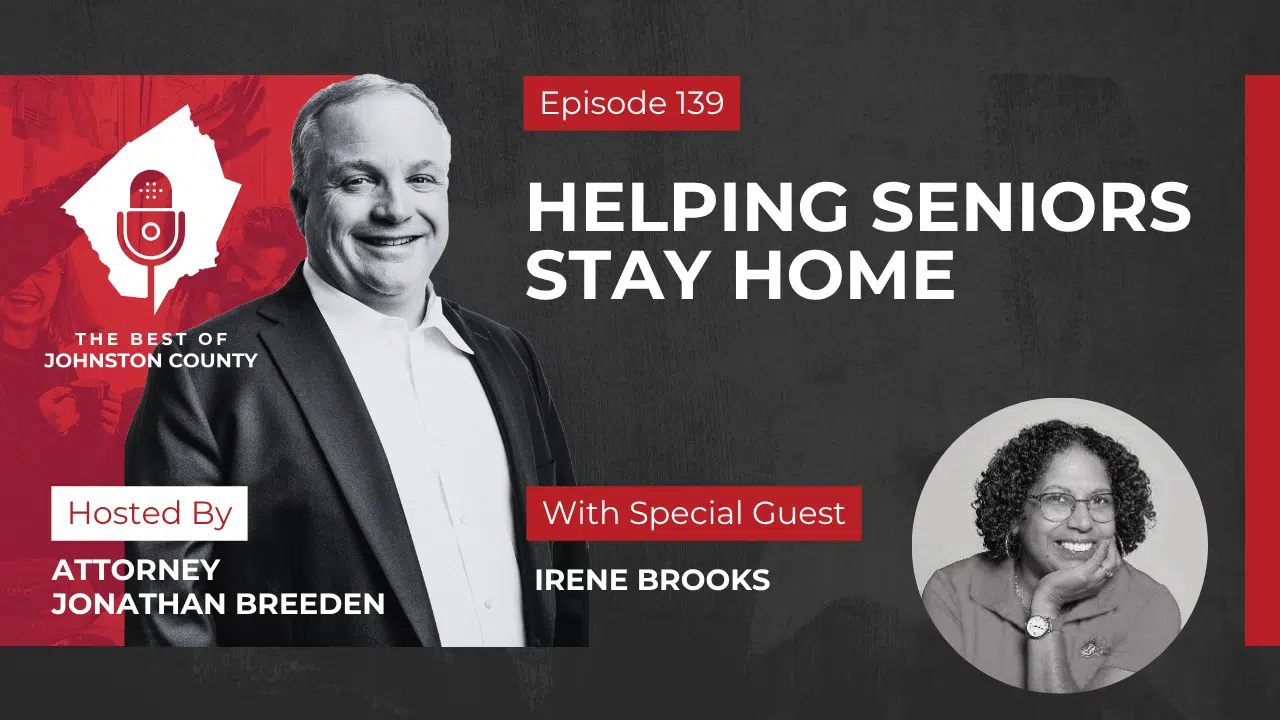
Helping Seniors Stay Home
Jonathan Breeden: [00:00:00] On this week’s episode of The Best of Johnston County podcast, our guest is Irene Brooks, the owner of No Place Like Home Senior Services right here in Johnston County. We talked to Irene a little bit about her journey to North Carolina from New York, her time as a social worker in Johnston County.
She also used to be in the magazine business for a little while, and why she started this senior services program that provides in-home care and placement services for seniors in Johnston County. We also talked a little bit about some of the services that are available and rumors of better programs on their way for Johnston County.
So if you’re interested in senior care, in-home care, how to maybe to find a placement or what might be coming, listen in.
Welcome to another episode of Best of Johnston County, brought to you by Breeden Law Office. Our host, Jonathan Breeden, an experienced family lawyer with a deep connection to the community, is ready to take you on a journey through the area that he has called home for over [00:01:00] 20 years. Whether it’s a deep dive into the love locals have for the county or unraveling the complexities of family law, Best of Johnston County presents an authentic slice of this unique community.
Jonathan Breeden: Hello, and welcome to another edition of the Best of Johnston County podcast. I’m your host, Jonathan Breeden, and on today’s episode, we have the owner of No Place Like Home Senior Services here in Johnston County, Irene Brooks.
We’re gonna talk to Irene a little bit about her journey to Johnston County why she got into social work, why she decided to start this business, and the services she provides to the seniors in this community. And a lot of it is paid for by Medicare and Medicaid, and you don’t have to come out of pocket for some of it, and we’re gonna talk a little bit about that.
But before we get to that, we’d like to ask you to like, follow, and subscribe to this podcast wherever you see it, whether it be on Apple, Spotify, YouTube, TikTok, X, LinkedIn, or any of the other social media channels of Best Johnston County Podcast. Best Johnston County Podcast comes out every single [00:02:00] Monday, and has now for over two and a half years.
So go back and listen to some of our previous episodes. We’ve had the vast majority of the county commissioners. We had Congressman Brad Knott. We had local dentist Tim Sims. We had local IT professional Woody Bailey. We’ve had a lot of great guests. If you love Johnston County as much as I do, this is the podcast for you.
Welcome, Irene.
Irene Brooks: Thank you for having me.
Jonathan Breeden: Yeah, this is gonna be a lot of fun. I think some of what you do is the Lord’s work, helping seniors, because I know that there is a shortage of senior care and senior resources, particularly in Johnston County especially with the growth. But anyway, we’ll get into that.
Tell the audience who you are, what you do.
Irene Brooks: Well, I’m Irene Brooks, and I own No Place Like Home Senior Services. And we are a senior in-home agency, but we also do placement. But the real mission behind it is helping people navigate through the journey of senior care, because most people don’t know what they don’t know, and [00:03:00] they get into the senior world, and they don’t even know where to begin, and they’re so overwhelmed.
So, that’s really the main thing that I do.
Jonathan Breeden: Okay. Well, that’s cool. That’s cool. So where are you from?
Irene Brooks: I am from, I apologize, New York, but.
Jonathan Breeden: You sound like you’re from New York. I knew the answer to that before I asked it, but anyway.
Irene Brooks: But I have been here since 1998, and this is home. I’ve never looked back really, since the day I got here.
Jonathan Breeden: I got you. So where’d you go to school?
Irene Brooks: I went to Hunter College and I have a MSW, masters in social work. And so I was a social worker for the Department of Social Services for a while.
Jonathan Breeden: Okay, here in Johnston County.
Irene Brooks: Yes.
Jonathan Breeden: Yeah, that’s right.
Irene Brooks: Yes. And I had to leave when both of my parents got sick, same month, same year. So they were chronically ill. My dad had dementia and stage kidney disease.
Jonathan Breeden: Right. Right.
Irene Brooks: And my mom had congestive [00:04:00] heart failure.
Jonathan Breeden: Oh, goodness. Oh, goodness.
Irene Brooks: So,
Jonathan Breeden: Yeah, that’s a lot.
Irene Brooks: Yeah, yeah, yeah. So I ended up quitting and staying with them. I worked part-time for a local magazine.
Jonathan Breeden: Okay.
Irene Brooks: Dedicated to Johnston County as well.
Jonathan Breeden: Right. Right. I remember that. I remember those days.
Irene Brooks: Yeah, yeah.
Jonathan Breeden: That’s, yeah, JNOW, right?
Irene Brooks: Yep.
Jonathan Breeden: Yeah, that’s right. I remember. Yeah,
Irene Brooks: Good people
Jonathan Breeden: that actually wasn’t that long ago.
Irene Brooks: No, it wasn’t.
Jonathan Breeden: So anyway.
Irene Brooks: It wasn’t.
Jonathan Breeden: Cause we always sponsor the JNOW Awards every year.
Irene Brooks: Yes. Yes.
Jonathan Breeden: That’s coming up this summer on July 23rd.
Irene Brooks: Yes. Yes.
Jonathan Breeden: So anyway, we sponsor that again, you know. So I think that’s great.
The, the Capps, we had Randy Capps
Irene Brooks: Uh-huh
Jonathan Breeden: on this podcast about a year ago. Go back and listen to that about JNOW Media, the JNOW Awards, where they recognize people- that don’t always get recognized, like firefighters and- … police officers and-
Irene Brooks: Yes
Jonathan Breeden: teachers and artists and stuff like that.
Irene Brooks: Yeah.
Jonathan Breeden: It’s like the awards ceremony for people who don’t get awards.
Irene Brooks: Exactly. Exactly.
Jonathan Breeden: Coach of the year.
Irene Brooks: Yeah.
Jonathan Breeden: Volunteer of the year, you know.
Irene Brooks: Yeah.
Jonathan Breeden: That kind of stuff. So, well, that’s cool.
Irene Brooks: Yeah.
Jonathan Breeden: That’s cool. So, when and why did you start No Place Like Home Senior [00:05:00] Services?
Irene Brooks: So when I was taking care of my parents, I thought, I just assumed that you work all your life, when it comes time to need resources for senior care, there are.
Jonathan Breeden: Right.
Irene Brooks: And that’s not the case.
Jonathan Breeden: Right. well, especially in Johnston County, but in general. And I think there’s more resources than people realize, but yeah, go ahead.
Irene Brooks: Well, there are, but what happens is you don’t know how to navigate any
Jonathan Breeden: Okay
Irene Brooks: of that.
Jonathan Breeden: Right.
Irene Brooks: And the reality is that if you have no money, there are resources.
Jonathan Breeden: Right.
Irene Brooks: If you have lots of money, well, you have lots of money.
Jonathan Breeden: Right, right, right, right.
Irene Brooks: So you’re okay.
Jonathan Breeden: Right, right.
Irene Brooks: But people in the middle that work 40, 50 years.
Jonathan Breeden: Right.
Irene Brooks: Unless they’ve planned, are really on their own.
Jonathan Breeden: Right.
Irene Brooks: And what happens is agencies don’t tend to talk to each other, so.
Jonathan Breeden: Right. No, that’s true. You get this silo thing.
Irene Brooks: Right.
Jonathan Breeden: Absolutely.
Irene Brooks: Right, right. So I learned, and I’m thinking because I’m a social worker, I know this, and.
Jonathan Breeden: Right.
Irene Brooks: I realized that I didn’t.
Jonathan Breeden: You did not know it. Yeah. I [00:06:00] got you.
Irene Brooks: Yeah, so once my journey with caregiving for my dad ended, I decided that I wanted to kind of be that navigator to help bridge all those agencies, so.
Jonathan Breeden: Okay.
Irene Brooks: So that’s what I do.
Jonathan Breeden: Oh, that’s awesome.
Irene Brooks: Yeah.
Jonathan Breeden: That’s awesome. Okay. So after your father passed away you know, you were like, okay, you realized that there was a lack of services in this community, and even you as a social worker didn’t know where everything was.
Irene Brooks: Right.
Jonathan Breeden: Is that right? And so is that why you decided to start what you started?
Irene Brooks: I did. I did. I also saw that there was not consistency in the quality of care.
Jonathan Breeden: Okay. Right.
Irene Brooks: In the community.
Jonathan Breeden: All right.
Irene Brooks: And so that was also very important. So I just started telling people, “I’ll talk to anyone. I won’t charge.”
Jonathan Breeden: Right.
Irene Brooks: “I’ll just, you know, give you step A, B, and C.”
Jonathan Breeden: Okay.
Irene Brooks: And so that became a thing, and then I realized that I could actually get paid for it.
Jonathan Breeden: Okay.
Irene Brooks: For it, and I started my [00:07:00] agency.
Jonathan Breeden: Okay. Cool. All right. So what does the agency do?
Irene Brooks: We go into people’s homes, and we help them with their activities of daily living but what’s different about what we do is that we go beyond tasks, right? When you think about somebody doing activities of daily living, you’re thinking bathing, dressing, feeding, things like that. Well, you know, there’s a quality of life component that often gets missed, and so we’re really big on quality of life.
Mom is not a plant that you put in front of the window and, you know. You have to have the best life that you can. Beyond you know, regardless of diagnosis, right? So you think, “Well, Mom has dementia, so, you know, she can’t do this,” but she can do other things. So what we do is we discover what Mom can do, and we expand on that, and we engage, and we create [00:08:00] activities.
We have technology that we employ so that they can do what they can do, enjoy what they can do and then we can support them with the things that they can’t do.
Jonathan Breeden: Okay, so how does this technology work?
Irene Brooks: So it’s an incredible piece of technology called CareLink 360. And it’s a unit kinda like, you know those frames that have the digital pictures?
Jonathan Breeden: Yeah.
Irene Brooks: Yeah. So it looks like that. But it has music that you can download. It has music built in, but if your mom likes you know, polka music, you can download the polka music.
Jonathan Breeden: Okay.
Irene Brooks: But it has brain games. It has exercises. It has some nutrition information. All abilities can do it, so if somebody, it has really advanced dementia, if they can do this with their finger, they can color something.
So it’s really robust, but the cool part about it is that it’s giving you a stay-at-home safe score. So say for instance Mom is doing these [00:09:00] puzzles or these games at a level of 70, right? And then we start seeing it going to 60, 50. So we can look. Now, family has access to this. We’d have access to this, and we could say, “Is there a UTI?
Is it progression of disease? Is there something that we need to do differently?” So it gives us a lot of information, but to Mom and the caregiver, they’re just playing games. But it’s, it tells a whole lot. So, One of the complaints that I’ve heard of people that have had in-home caregivers is that Mom’s in front of the TV, caregiver’s on her phone.
Jonathan Breeden: Yep.
Irene Brooks: Right? And that is a challenge. So this piece of technology also takes care of that. If there’s a bit of downtime where there’s no housekeeping going on or no bathing or… We can pull this out, and there’s hours and hours and hours of things that this person [00:10:00] can do, or the caregiver can do with your person.
And so it’s helping them, but it’s also making sure that y- the time you’re paying for is being utilized.
Jonathan Breeden: Right, okay. ‘Cause I know that’s… So this is… I know you provide dementia care. This machine is part of the dementia care program that y’all provide.
Irene Brooks: Yes.
Jonathan Breeden: Right, okay. And you also do respite?
Irene Brooks: Yes.
Jonathan Breeden: I heard you speak about respite at a BNI group we were at not too long ago. Talk about what respite care is, and that I think Medicare provides for it, and stuff like that.
Irene Brooks: Yeah. So respite care is really, really important. Most of us that take care of family members are working 24 hours a day, seven days a week. If Mom and Dad get up at 3:00 in the morning thinking that it’s 9:00 in the morning, you’re up with them to keep them safe, and then you go to work, or you, you know.
So caregiver fatigue or burnout is very, very common. So Medicare has created a program called [00:11:00] the Guide Program and it is for people that are, have a diagnosis of dementia, and you’ll get the equivalent of about 80 hours of respite care that you can use in four-hour increments or longer, and Medicare is going to pay the provider directly for that.
So if you imagine being able to take four hours a week off or eight hours a week off so that you can do stuff outside of taking care of your person, that really gives you that moment to, you know, refresh yourself.
Jonathan Breeden: Right.
Irene Brooks: So that you can come back and be the best caregiver that you can.
Jonathan Breeden: So is that 80 hours total, 80 hours a year?
Irene Brooks: It’s a year.
Jonathan Breeden: A year.
Irene Brooks: So.
Jonathan Breeden: Okay.
Irene Brooks: For instance right now, it’s a fiscal year, so right now, if somebody, a true story, starting with care using respite, July 1st, they get another 80 hours.
Jonathan Breeden: Okay.
Irene Brooks: [00:12:00] So, you know, it’s not June 1st, July 1st.
Jonathan Breeden: July 1st, right. Yeah.
Irene Brooks: July 1st.
Jonathan Breeden: Yeah, fiscal year.
Irene Brooks: Yeah.
Jonathan Breeden: Got it. Okay.
Irene Brooks: Yeah.
Jonathan Breeden: I got you. Yeah. Well, that’s cool. That’s cool. So, what can you do for the gap? We talked about this earlier. There’s plenty if you’re poor, and there’s plenty if you’re rich. But for the middle class person, you know, where are the gaps? How do you fill it? What does it cost?
Irene Brooks: Okay. So There’s things that I do, like I’ll ask them if they’re a veteran. People forget, you know, oh, there’s veteran benefits. Not just through the VA, but there’s a program called Aid and Attendance. So if you are a veteran or a spouse of a veteran at that served one day in wartime you may be eligible for Aid and Attendance, where the VA sends you money for in-home care.
Jonathan Breeden: Okay.
Irene Brooks: There’s also long-term care insurance. I tell all of my people, like, the time to get your long-term care insurance [00:13:00] is, you know, when you’re 40, 50. If you’re 80, it’s too late. But we have lots of people that have been paying 20, 30 years for long-term care, but the adult children don’t know.
So I ask them, I say, “Find out if there’s long-term care insurance.” And they’re like, “Oh, I didn’t know.” Long-term care will pay a certain daily amount for your care, so it possibly can be no out-of-pocket for you, or much less out of pocket. They have to pay and then get reimbursed, but we facilitate that.
So that’s another program. There’s, you know, so it also, you know, if your person has parkinson’s or dementia or there’s different organizations that have assistance when, you know, when appropriate. So,
Jonathan Breeden: Okay. Well, that’s cool.
Irene Brooks: Yeah.
Jonathan Breeden: That’s cool.
Have family law questions? Need guidance to navigate legal challenges? The compassionate team at Breeden Law Office is here to help. Visit us at [00:14:00] www. breedenfirm. com for practical advice, resources, or to book a consultation. Remember, when life gets messy, you don’t have to face it alone.
Jonathan Breeden: So now Medicaid … which you have to, I guess, be it’s, below a certain poverty level- Yeah, it’s means. I mean, it’s, well, it’s now, like, a lot more than just the regular poverty level. Right. Will pay for home, in-home services, but Medicare will not. I’m correct about that, right?
Irene Brooks: Right.
Jonathan Breeden: Okay. And Medicare is what everybody over 65 in the United States gets
Irene Brooks: Right
Jonathan Breeden: and then there are different levels of Medicare depending on what you wanna pay for.
Irene Brooks: Right.
Jonathan Breeden: But Medicare doesn’t provide for home health. But- but you do have a lot of clients who just pay you for their- their in-home services, correct?
Irene Brooks: Yes, absolutely.
Jonathan Breeden: Right, okay. So what does that cost?
Irene Brooks: It depends on the level of care.
Jonathan Breeden: Okay.
Irene Brooks: And I, and I try to be transparent about it, ’cause, you know, people say, “Well, no way, I can’t tell you a [00:15:00] price until”
Jonathan Breeden: Right, right.
Irene Brooks: You know, that’s- that’s crazy, right?
Jonathan Breeden: Right, right.
Irene Brooks: But we do everything from companionship, where you’re taking mom to the hairdresser to get her nails done, you know, it’s hands-off companionship. You’re-
Jonathan Breeden: Okay …
Irene Brooks: and that will start maybe 31, $32 an hour.
Jonathan Breeden: Okay.
Irene Brooks: All the way up to someone who’s bed bound. They need to be changed. They have a lift where, to move them.
Jonathan Breeden: Right.
Irene Brooks: That’s gonna be closer to $40 an hour.
Jonathan Breeden: Okay.
Irene Brooks: We do 24-hour care, and if that’s the case, then we do a daily rate- Which provides some savings. Not a whole lot, you know.
Jonathan Breeden: Right.
Irene Brooks: The, this is not a cheap service. and honestly, if it’s cheap, it’s probably not good.
Jonathan Breeden: Right.
Irene Brooks: I hate to say it like that.
Jonathan Breeden: No, you’re right. But- You’re right …
Irene Brooks: you know, i, I’ve seen people, like on Facebook, saying, “Hey, does anyone know just a la-” You know? And the lady may be lovely and fantastic.
Jonathan Breeden: Right.
Irene Brooks: But if she doesn’t have a license, if she doesn’t have insurance, if … There can, there’s a lot that can go wrong.
Jonathan Breeden: No, you’re absolutely right. You’re absolutely right.
Irene Brooks: [00:16:00] Yeah.
Jonathan Breeden: And so … And then you can sort of put a combination of these programs. Like, you could put some of the things Medicare does, if you qualify for Medicaid, some of the things Medicaid does, with some out-of-pocket expense, and you could sort of- try to make it work.
Irene Brooks: Right.
Jonathan Breeden: ‘Cause I mean, I know that you work really hard to try to meet people where they are.
Irene Brooks: Exactly. Exactly. And, and that’s what I do. I dig in to see. You know, sometimes I ask really sensitive questions, but to try to, you know, extract where we can get little nuggets of, of money, right?
There are some Medicare supplement for plans that’ll pay for 56 hours a year, right? That’s not a lot, but that’s 56 hours that you don’t have to pay for.
Jonathan Breeden: Right.
Irene Brooks: So, you know, so we’re, we’re figuring it out. So y- also if you have Medicaid, you, you can also get that respite program. You know, so there are things that you can, you know-
Jonathan Breeden: Right
Irene Brooks: it’s not really double-dipping- Right … but it’s, you know, maximizing. Right.
Jonathan Breeden: Well, another [00:17:00] pr- service that you provide is you help people find out-of-home placements.
Irene Brooks: Yes.
Jonathan Breeden: Talk about that. I don’t even know if you even charge for that, but anyway.
Irene Brooks: So- Right. So the way that that works is being at home is usually best because it’s safest, you have better outcomes.
85% of people wanna be home, but it’s not always possible. It can be a safety issue. It can be an elopement issue. You know, I’ve had people walking down the highway and that’s, you know, really dangerous. So, if being at home is not the right thing, I’ll help them find an assisted living, independent living, residential care homes skilled nursing, and it does not cost the family anything for me to help them.
I do get a referral fee from the location. Not every place pays a, a referral fee. But that, you know, that doesn’t stop me from, you know, really seeing the person and the type of care that they [00:18:00] need and making the right recommendations because it all works out, you know? Right.
Jonathan Breeden: Right. Yeah. Yeah. No, that’s great.
Yeah. That’s great. That’s great. Well, and use somebody like you, who I’m assuming you’re familiar with all of the facilities in the area.
Irene Brooks: Right.
Jonathan Breeden: You know which ones are better, which ones are worse.
Irene Brooks: Yeah.
Jonathan Breeden: You know the intake coordinators, and they’re gonna wanna make you happy because you’re a referral source.
Irene Brooks: Right.
Jonathan Breeden: You know, versus just somebody just showing up. So, and I guess you probably know what the strengths and/or weaknesses of each of these different facilities are.
Irene Brooks: Exactly. You know, sometimes you can walk into a place and there’s chandeliers and waterfalls and, you know, but they’ve changed management three times in the last year.
That’s not a place that you wanna risk putting your loved one in, and I give that information. Sometimes it’s not the popular information, you know, but I have to be super honest. And I say if it’s not good enough for me to put my parent in, I’m not gonna recommend it for you to put your parent in.
Jonathan Breeden: Right.
Irene Brooks: So, yeah.
Jonathan Breeden: That’s a good point.
Irene Brooks: Yeah.
Jonathan Breeden: That’s a good point. Did your parents have to go [00:19:00] somewhere.
Irene Brooks: No, no .
Jonathan Breeden: They did not. Okay.
Irene Brooks: Yeah, I moved to my parents’ subdivision across the street, and I used to go to my parents’ house every day to hook my dad to his dialysis. So, and then go, I’d go every night, plug him in, go in the morning, you know.
Jonathan Breeden: Okay.
Irene Brooks: Take it off and yeah, so that’s how we handled it, and my mom is still across the street.
Jonathan Breeden: Oh, cool.
Irene Brooks: Yeah.
Jonathan Breeden: Cool.
Irene Brooks: Yeah.
Jonathan Breeden: That’s great.
Irene Brooks: Yeah.
Jonathan Breeden: Okay. So, I know, I’ve heard you speak. You go give speeches. That’s also part of the business. Talk a little bit about that, and I think that’s what you enjoy the most, I think.
Irene Brooks: It really is.
Jonathan Breeden: So talk about the education part of your business ’cause I know that is one of the, it’s the reason you started the business, if nothing else.
Irene Brooks: Right. Right. Most people enter the time of taking care of their parents not even knowing what they don’t know. So, education is the biggest part of what I do, because if you’re sitting there going, “I’m gonna get fired,” or, “I’m gonna get written up again because I’ve been late,” or, “I’ve had to leave work,” or, “I’ve had, you [00:20:00] know, I was in the ER till 5:00 in the morning and I couldn’t go to work.”
And they’re, like, at the end of their wits, and they don’t even know who to ask. So, I love going to civic groups, churches, you know, anywhere that women’s groups are great as well. And really just giving some education on things that they can do to take care of themselves, take care of their parents options that they have, because caregiving for an ailing loved one is a family thing. You know, families will break up over it.
Jonathan Breeden: Oh, believe me. Believe me. Yeah. I completely understand that. So, let’s talk a little bit about what s- you know, we’ve had several people over the years on this podcast we had somebody else doing what you do from Smithfield last year. We had the head of JCATS on the podcast
Irene Brooks: Mm-hmm
Jonathan Breeden: about six, seven months ago. So what services are out there for seniors in Johnston County? I know we have the senior centers. There’s a meal at lunch most days.
Irene Brooks: Yep.
Jonathan Breeden: What services are you aware of that people can tap into?
Irene Brooks: [00:21:00] So, the Council on Aging, and I know they changed their names, and I, it, it-
Jonathan Breeden: Right. No, I agree
Irene Brooks: is just leaving my mind in Smithfield is incredible. They have so many things. If you call them and you talk to them, you can find out a lot of things. There’s even, for people that really, really need somebody there for X amount of time, they have some agencies that’ll work with them at a really reduced rate. So- There’s everything. Like, I’ve had them deliver bags of like, supplies that m- most people with a, an elderly loved one needs. You know, gauze and, you know-
Jonathan Breeden: Yeah …
Irene Brooks: gloves. And like, so they do, they do such good work and I, I, I don’t think people realize how much work they do. They also have support groups through, through the Council of Aging for people.
They have one in Clayton at the senior center, and they also have one in Smithfield once a month. [00:22:00] So I would definitely reach out to them. The Meals on Wheels is an incredible program. Not only for meals, but some people don’t see another person until they see the person delivering their meals.
Jonathan Breeden: Yep.
Irene Brooks: And loneliness is actually as deadly as smoking 10 packs of cigarettes. People don’t realize that loneliness can kill you. So having that friendly face come in, that’s, that’s a life-changer.
Jonathan Breeden: Yeah. I’ve, I’ve delivered Meals on Wheels before and I was, I like to talk, right? And so I got off schedule.
And, you know, and they- they’re calling me, and I’m like, yeah, I just cannot talk. Like, I get to talk to these people- … tell the stories. They’re like, “But, you know, the meal has gotta be a certain temperature.” Right. “It needs to be a six place.” And I, I was just like, I, I mean, in some ways I was a good Meals on Wheels volunteer.
In other ways- … I was bad because I was not on schedule- Right … because I just start talking, and I love to meet people. Like, like, [00:23:00] I, I should get back in it and, and get be better about staying on schedule. They didn’t fire me, but they were like, “If you keep doing this, you gotta be on the schedule.” Oh. ‘Cause I’d be like, you know, like, “I’ve never met a stranger.
You haven’t either.” Right, right. You know what I mean? It was, it was so much fun. But look, I mean, while we’re talking about senior services, JCATS is out there. I- it’s free or just a few dollars, but mainly free. We’ll pick you up, take you to medical appointments- Yes … take you where you need to go.
You just call JCATS. They’re running, they got more, they got new buses now. Yes. He was, he was talking about that when he, he was on here. We had the JCATS- … director a few months ago. And and then of course, if you’re in Smithfield and Selma, they now have Quick Rides, which is like Uber for Smithfield and Selma, and it’s like six bucks to go anywhere in Smithfield and Selma, and they’re looking to expand that later in 2026 into Clayton.
And so that is a way to get around as well. JCATS is tremendous. It’s exploding. That’s out there to g- help get your family member to and from their, their medical appointments and, and stuff like that. Right. So there’s stu- there’s stuff out there- … I think people need to be aware of.
It’s [00:24:00] part of, one of the reasons I wanna have you on here is that we’re trying to let people know that there are people to provide these services, but you, but you gotta reach out and ask. You gotta- Right … you gotta ask questions, you gotta do research- Mm … that kind of stuff. So, do you see anything, is there anything new coming down the horizon for senior services in Johnston County?
I, I know there’s been talk of trying to do a senior center in Benson. Right. That doesn’t have a ton of momentum, but- Right … have you seen any, anything coming?
Irene Brooks: So there’s a rumor that there is a day program being created here in like the 4042 area.
Jonathan Breeden: Okay.
Irene Brooks: And that, I have people all the time asking me if I know of a day program, you know?
And there are, but they’re, you know, Wake Forest Durham, Cary. There really, there’s nothing in this area. So whoever is doing that will be very, very successful.
Jonathan Breeden: Right. Right.
Irene Brooks: You know.
Jonathan Breeden: Well, that would be great.
Irene Brooks: Yeah.
Jonathan Breeden: That would be great. I mean, I think about the success Able to Serve has [00:25:00] as a day program for, for adults with, with disabilities.
Irene Brooks: Yeah.
Jonathan Breeden: And we had Carlton Daniel on this podcast- … probably 18 months ago now.
Irene Brooks: Right
Jonathan Breeden: And yeah. And so you got that.
Irene Brooks: Yeah.
Jonathan Breeden: And it would be great to have something like that
Irene Brooks: Yeah
Jonathan Breeden: for seniors where they go interact with people- be supervised
Irene Brooks: Yep
Jonathan Breeden: have a meal, stuff like that. Yeah. Right. I’m glad to hear that.
I’ve not heard that rumor, so that’s great. I might have to make a few calls and see if I can find out if that’s actually gonna happen. So anyway, well, that’s great. Well, the last question we ask everybody on… Well, first thing is how can people reach out to you?
Irene Brooks: They can call our office. I’m pretty findable.
Jonathan Breeden: You have a great website, by the way.
Irene Brooks: Oh, thank you.
Jonathan Breeden: I, I personally enjoy your website.
Irene Brooks: Thank you, thank you. I appreciate it.
So we’re, we, we’re reachable through my office, online social media.
Jonathan Breeden: So what’s your website?
Irene Brooks: It’s www.noplacelikehomenc, like North Carolina, .com.
Jonathan Breeden: Okay, and what’s your phone number?
Irene Brooks: 919-762-0035.
Jonathan Breeden: I gotcha. And you’re taking new clients every day.
Irene Brooks: Every single day.
Jonathan Breeden: Every day. Every day. All [00:26:00] right. Yes. The last question we ask everybody on this podcast, what do you love most about Johnston County?
Irene Brooks: Well, it’s home. It’s been home since the day I got here, and my husband and I actually talk about it’s so cool to be able to see, like, your child’s teacher in the supermarket.
Or, you know, even though we are growing, but it still has that homey feel where you, you know your community, and I love that.
Jonathan Breeden: Right. That’s awesome. That’s awesome. Yeah. That’s awesome. The people are pretty good, too, and that’s what makes it feel like home, right?
Irene Brooks: Yes. Right. Yes, absolutely.
Jonathan Breeden: Even if we have a lot of people from New York.
Irene Brooks: I know. I apologize. I married a, a North Carolina boy, and my, my kids say, “What are you fitting to do?” Versus, “What are you doing?”
Jonathan Breeden: That’s awesome. That’s awesome. That’s awesome. Anyway, i’d like to thank Irene Brooks for being our guest on this week’s episode of the Best of Johnston County podcast. As we mentioned earlier, please like, follow, and subscribe this podcast wherever you see it. Give us a five-star review down below. Tag us in your [00:27:00] Instagram stories, Best of Johnston County.
Until next time, I’m your host, Jonathan Breeden
That’s the end of today’s episode of Best of Johnston County, a show brought to you by the trusted team at Breeden Law Office. We thank you for joining us today and we look forward to sharing more interesting facets of this community next week. Every story, every viewpoint adds another thread to the rich tapestry of Johnston County.
If the legal aspects highlighted raised some questions, help is just around the corner at www. breedenfirm. com.
There are some conversations that impact almost every family sooner or later.
This week, I sat down with Irene Brooks, owner of No Place Like Home Senior Services, to talk about one of the biggest challenges many families face: caring for aging parents.
What stood out most was that Irene didn’t enter this work because of a business opportunity. She entered it because she lived it.
After spending years as a social worker in Johnston County, Irene found herself navigating the healthcare system for her own parents. What she discovered changed the course of her life and eventually led her to create a business dedicated to helping other families avoid the confusion and overwhelm she experienced firsthand.
When Caregiving Becomes Personal
Irene’s journey into senior care began when both of her parents became seriously ill during the same year.
Her father was dealing with dementia and kidney disease. Her mother was battling congestive heart failure.
Like many family caregivers, Irene assumed resources would be easy to find after a lifetime of working and paying into the system. Instead, she found herself struggling to navigate a maze of agencies, programs, and services that often didn’t communicate with one another.
Even with her professional background in social work, she discovered there was far more to learn than she expected.
That experience became the foundation for No Place Like Home Senior Services.
Today, her mission is simple: help families understand their options and connect them with the right resources before they become overwhelmed.
More Than Just In-Home Care
While many people think of home care as help with bathing, dressing, and meals, Irene believes quality of life matters just as much as daily tasks.
Her team focuses on helping seniors maintain engagement, independence, and purpose whenever possible.
One example is a technology platform called CareLink 360, which combines games, activities, music, and cognitive exercises into one easy-to-use device. Families and caregivers can monitor participation and notice changes that may indicate a medical issue or progression of disease.
For seniors living with dementia, this type of engagement can make a meaningful difference.
As Irene explained, the goal is not simply to keep someone safe. The goal is to help them continue enjoying life.
Understanding Respite Care
One of the most important topics we discussed was caregiver burnout.
Many family caregivers are effectively working around the clock. They may be helping loved ones overnight, managing medications, coordinating appointments, and still trying to maintain jobs and households of their own.
Irene highlighted Medicare’s GUIDE Program, which provides eligible dementia caregivers with approximately 80 hours of respite care each year.
Those hours can be used in increments throughout the year, giving caregivers an opportunity to rest, attend appointments, run errands, or simply recharge.
It may not sound like much, but for someone providing care every day, even a few hours of relief can be life changing.
Finding Resources Hidden in Plain Sight
One of the biggest challenges families face is simply not knowing what help is available.
During our conversation, Irene shared several programs that families often overlook:
- Veteran Aid and Attendance benefits
- Long-term care insurance policies
- Medicare supplement benefits
- Medicaid-funded home care services
- Dementia support programs
- Community-based assistance organizations
Many families discover these resources only after they are already struggling.
That is why Irene spends so much of her time educating civic groups, churches, and community organizations. She wants people to know their options before they reach a crisis point.
Her belief is that informed families make better decisions and experience less stress along the way.
When Home Is No Longer the Best Option
While most seniors prefer to remain at home, Irene recognizes that it is not always the safest solution.
When families need assistance finding assisted living, memory care, skilled nursing, or other residential options, she helps guide them through the process.
Her familiarity with local facilities allows her to provide honest recommendations based on experience rather than appearances.
As she explained during our conversation, beautiful buildings and impressive amenities do not always tell the full story. Stability, leadership, quality care, and consistency often matter much more.
Her approach is straightforward.
If she would not feel comfortable placing her own family member somewhere, she will not recommend it to someone else’s family.
The Resources Johnston County Families Should Know About
Johnston County offers more support than many residents realize.
Irene encouraged listeners to connect with local senior centers, Meals on Wheels, support groups, transportation services, and aging-focused organizations throughout the county.
Programs such as JCATS transportation services and local senior centers can provide valuable assistance while helping seniors remain active and connected.
She also highlighted the importance of combating loneliness, noting that social isolation can have a significant impact on both physical and emotional health.
Sometimes a meal delivery, support group, or regular visitor can make a tremendous difference.
Looking Ahead
One of the most encouraging updates from our conversation was the possibility of a future adult day program serving the Highway 40 and Highway 42 area.
While details remain limited, Irene believes there is a tremendous need for a local program where seniors can spend the day safely engaged while caregivers attend to work and other responsibilities.
As Johnston County continues to grow, the demand for senior services will only increase.
The good news is that people like Irene Brooks are working every day to ensure families have guidance, support, and access to the resources they need.
And sometimes, that guidance is exactly what makes a difficult journey feel manageable.
Closing Reflection
One of the things I appreciate most about conversations like this is the reminder that none of us are meant to navigate life’s hardest seasons alone.
Whether you’re caring for a parent today or simply preparing for the future, understanding the resources available can make all the difference.
As Irene shared throughout our conversation, senior care is not just about services. It’s about preserving dignity, creating connection, and helping families find a path forward together.
Thank you for joining us for this episode of The Best of Johnston County Podcast. Stay tuned for more conversations that inspire connection and growth.
AND MORE TOPICS COVERED IN THE FULL INTERVIEW!!! You can check that out and subscribe to YouTube.
Connect with Irene Brooks:
- Website: https://noplacelikehomenc.com/
- Phone: (919) 762-0035
Connect with Jonathan Breeden:
- Website: https://www.breedenfirm.com/
- Phone Number: Call (919) 726-0578
- Podcast: https://breedenlawpodcast.com/
- YouTube: https://www.youtube.com/@BestofJoCoPodcast
Listen On