
August 10, 2026
Discovery Can Change Your Family Law Case
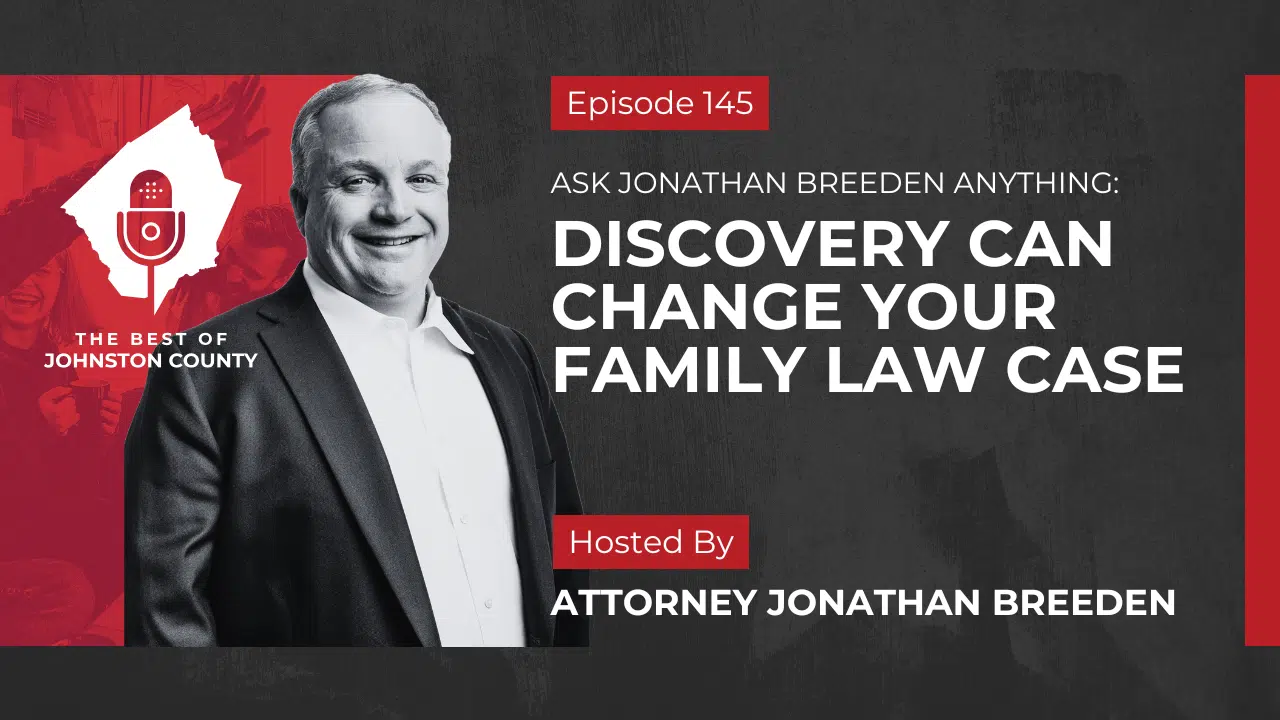
Jonathan Breeden: [00:00:00] On this week’s episode of The Best of Johnston County podcast, we’re doing a special edition episode that we like to call Ask Jonathan Breeden Anything. And on this episode, our social media coordinator, Raena Burch, asked me, Jonathan Breeden, questions about discovery in a family law case.
What is discovery? How often is discovery used in cases? What is the timeline for discovery? What forms does discovery take? How can discovery help you make sure you know you’re getting a fair settlement if you’re gonna settle the case? So if you’ve ever had any questions about, “How do I find out if the other side is hiding money?”
Listen in.
Welcome to another episode of Best of Johnston County, brought to you by Breeden Law Office. Our host, Jonathan Breeden, an experienced family lawyer with a deep connection to the community, is ready to take you on a journey through the area that he has called home for over 20 years. Whether it’s a deep dive into the love locals have for the county or unraveling the [00:01:00] complexities of family law, Best of Johnston County presents an authentic slice of this unique community.
Jonathan Breeden: Hello, and welcome to another edition of the Best of Johnston County podcast. I’m your host, Jonathan Breeden, and on today’s episode, we’re having a special edition episode that we like to call Ask Jonathan Breeden Anything.
Normally on this podcast, I, Jonathan Breeden, interview interesting community members, business leaders politicians people that work and live and make Johnston County as great as it is. But every once in a while, we do these special edition episodes where we have our social media coordinator, Raena Burch, come on and ask me, Jonathan Breeden, questions about family law, which is what we do here at the Breeden Law Office.
And in today’s episode, we’re gonna talk about discovery, and discovery is how you go about getting information from the other side when you’re in litigation to determine what strategies you might wanna take or what you might be entitled to. I don’t know what the questions are, but we’ll see how we do in answering [00:02:00] the questions.
But before we get to that, I’d like to ask you to like, follow, and subscribe to this podcast wherever you see it, whether it be on Apple, Spotify, YouTube, TikTok, LinkedIn, X, or any of the other social media channels, the Best Johnston County Podcast. The Best Johnston County Podcast comes out every single Monday and has now for just under three years.
So go back and listen to our previous episodes. We’ve had a lot of great guests, the owners of Just Dog People. We’ve had Woody Bailey with the IT services Dr. Tim Sims. We had Chris Johnson, county economic development director. We had Adrian O’Neal, county parks director twice. We’ve had a lot of great guests on this podcast over the years.
If you love Johnston County as much as I do, this is the podcast for you. Welcome, Raena.
Raena Burch: Welcome, Jonathan.
Jonathan Breeden: All right. We’ll have to see how we do here.
Raena Burch: Listen-
Jonathan Breeden: You gave me the topic about-
Raena Burch: We’re gonna-
Jonathan Breeden: 45 seconds ago
Raena Burch: We’re gonna just discover discovery-
Jonathan Breeden: Okay …
Raena Burch: today. All right. So how common is discovery in a divorce process?
Jonathan Breeden: If you’re in litigation, like you’re actually gonna sue somebody, and you are going to [00:03:00] try to go to court, then it is pretty common in almost all cases. Now, the caveat is 99% of the actual divorces are uncontested. Yes, you have to file at the courthouse. They are uncontested. They are based on being separated for a year and a day which is the only grounds to be divorced in North Carolina.
It’s not irreconcilable differences, any of that. It’s a year and a day, and most people just get divorced. If you need to figure out child custody, if you need to figure out property distribution, alimony, post-separation support, or anything other than, ” I’m divorcing you and we’ve been separated a year and a day,” and you’re not working it out and you’re gonna litigate those, then you’re going to probably need to get some discovery, which is discover information you don’t have from the other party.
So [00:04:00] it is pretty common in actual cases that are being litigated for some portion of You know, a lot of people put the divorce under everything, but in North Carolina, divorce is kind of by itself.
Raena Burch: Yeah.
Jonathan Breeden: And then equitable distribution of property-
Raena Burch: Yep.
Jonathan Breeden: Is a thing. Child custody’s a thing. Child support’s its own issue.
Raena Burch: Yeah.
Jonathan Breeden: Alimony’s its own issue. Post-separation support’s its own issue. These are their own separate things.
Raena Burch: Very compartmentalized.
Jonathan Breeden: Right. North Carolina, everything’s bifurcated.
Raena Burch: Yes.
Jonathan Breeden: Where in probably 48% of the… 48 of the 50 states
Raena Burch: Yeah
Jonathan Breeden: it’s all under the divorce.
Raena Burch: Yeah.
Jonathan Breeden: So every time I get these questions- I give this long explanation, but people move here from all over.
Raena Burch: And they may need it.
Jonathan Breeden: We have listeners from all over, so it is kind of unique. But yeah, it is pretty common in an actual litigation case.
Raena Burch: Okay. And so what types of evidence surprise people when they discover it can be used in a divorce or custody case?
Jonathan Breeden: Well, I think they’re surprised at how much can be used. And I think they’re [00:05:00] surprised that texts that they sent, emails that they sent,
Raena Burch: Mm-hmm …
Jonathan Breeden: social media posts they made possibly one, two, three, four years ago.
Raena Burch: Yeah.
Jonathan Breeden: Can be used against them, you know, now.
Raena Burch: Yep.
Jonathan Breeden: Particularly when you start showing a pattern of behavior.
Raena Burch: Yeah.
Jonathan Breeden: Towards your ex-spouse or your child’s mother or whoever you’re in this litigation with. If it’s child custody, you don’t have to be married to have a child custody case. You know, I think they’re a little surprised by that. I think they’re a little surprised by how, particularly in a financial case, when it’s alimony, post-separation support, or property distribution, how detailed most attorneys are in going through these bank statements and what money is being spent on, and whether this money was being spent for the good of the marriage or possibly on somebody they were having an affair with.
Raena Burch: Yeah.
Jonathan Breeden: You know, and it’s become easier now because so few people [00:06:00] use cash.
Raena Burch: Yes.
Jonathan Breeden: Right? Like, you know, when I started practicing law.
Raena Burch: I don’t carry cash anymore.
Jonathan Breeden: Right. When I started practicing law, you know, a lot of the transactions were in cash. Now, nobody uses cash. Everything’s digital: credit cards, debit cards, whatever.
And so, you know, a lot of these things were going on since the dawn of time.
Raena Burch: Yes.
Jonathan Breeden: But you know, you gotta look at it now, like.
Raena Burch: It’s a little hard to get away with it nowadays.
Jonathan Breeden: Yeah, it’s harder to get away with it now because there’s this digital footprint whether it be credit cards, debit cards, this kind of stuff.
So, so I think they’re a little surprised that I’m gonna go through your bank ha- statements and I’m gonna add up all the time yous- bought stuff at the ABC Store, and I’m gonna make a chart- … of all the purchases you made at the ABC Store over a period of time, and I’m gonna use that chart of your purchase at the ABC Store and the amount of money you spent and how often you went to try to convince this judge that maybe you have an alcohol problem.
Raena Burch: Yeah.
Jonathan Breeden: And I’m gonna match these times that you’re shopping at the ABC Store for [00:07:00] liquor, which is the only way to g- place to get liquor
Raena Burch: Yeah
Jonathan Breeden: in North Carolina-
Raena Burch: Yep …
Jonathan Breeden: with the times you have your children.
Raena Burch: Mm.
Jonathan Breeden: And I’m gonna have a chart that says, on this custodial day over a four-month period, you had 20 custodial days, and eight of them you went to the ABC Store.
Raena Burch: Mm.
Jonathan Breeden: The judge can draw his own conclusion-
Raena Burch: Yeah …
Jonathan Breeden: about whether you may have been drinking when you had your kids. So I, I think that there’s, there, there’s, there’s that, right? I think there’s also who is in the background of these pictures. Mm. Who’s in the pictures?
Raena Burch: Yep.
Jonathan Breeden: Right? Because, like, there’s, a lot of times in the pictures, there are people that are not the best people, but you’re hanging out with them-
Raena Burch: Yep
Jonathan Breeden: and you don’t realize that hanging out with somebody who’s a registered sex offender is gonna be used against you 18 months later in a custody case because they’re in the picture with you. I’m not saying you were dating, but, like, why are you hanging out with registered sex offenders?
Raena Burch: Yeah.
Jonathan Breeden: Are you bringing these people around your children?
So I think the, [00:08:00] the breadth of it, i- you know, is, is shocking to a lot of people.
Raena Burch: Yeah.
Jonathan Breeden: The detail by which attorney’s gonna go through it, it’s getting easier to go through it now with AI.
Raena Burch: Yeah.
Jonathan Breeden: What used to take me a couple hours now takes five minutes- Mm … to run summaries of how much you spend at the ABC Store, how much you’re eating out, particularly- In a post-separation support, “Oh, I need all this money.
I can’t afford to live,” but you’re spending 8 to $900 a month eating out.
Raena Burch: Yeah.
Jonathan Breeden: And a lot of people spend that. Yeah. I mean- I
Raena Burch: mean- …
Jonathan Breeden: they, I mean, it, it’s nothing for us to look at something, and we’re not talking about people that are rich, I’m just talking about people in general. It’s easy, it’s expensive.
Yep. You know? I mean, it’s- Nothing … nothing for a family to spend $1,000 a month eating out. Yeah. And, and, and they don’t even know it. Like, when we start running these summaries, they don’t have any idea. Yeah. So I th- I think it’s really the scope and the detail that it’s going to be looked at. You know, you don’t think anybody cares about your life all that much, but you get in a litigation case, people are gonna [00:09:00] care.
Raena Burch: Yeah. Yeah, every, every little nook and cranny is gonna be brought to light whether you like it or not, usually.
Jonathan Breeden: Well, well, and it’s also if money is hi- being hidden, right? Yeah. You gotta find out where that paycheck is going, and then you’re looking where money’s going, right? And if you start seeing these sort of transfers out, well, where, where did that go?
Y- you know what I mean? And about 80% of the time, when I start seeing large transfers out, they’re not giving me that statement of the statement where it went. And so-
Raena Burch: It’s weird how that works …
Jonathan Breeden: right. Like, w- w- where did it go? Yeah. What, what was it used for? This is important, because any money that you earn during the marriage, if you don’t have a prenup, belongs to the marriage.
Yep. And the marriage should benefit from that money. If the marriage is not benefiting from the money that you earned during the marriage, then it maybe should not be counted in the divorce settlement. Yeah. In the property settlement.
Raena Burch: Yeah.
Jonathan Breeden: Maybe that should be your separate money.
Raena Burch: Yeah. So- Maybe, maybe you owe that, all that debt- Mm
not the other person.
Jonathan Breeden: That’s true. [00:10:00]
Raena Burch: Yep. Okay, and you kinda touched on this before, but- How should someone think about going about texting their spouse when they know a divorce is likely because text messages could be subpoenaed in discovery?
Jonathan Breeden: Right. Well, text messages are the number one thing we use.
Raena Burch: Yeah.
Jonathan Breeden: In custody trials. I cannot think of the last custody trial that any attorney in my office was involved in, and we do custody trials every week, that we were not using text messages in a negative manner against somebody.
Raena Burch: Yes.
Jonathan Breeden: And so, you know, the thing I would say is, if you do not want it read out loud in a courtroom full of strangers before a judge who’s determining how much time you get with your child, don’t send it.
Raena Burch: Yep.
Jonathan Breeden: And, you know.
Raena Burch: Good rule of thumb.
Jonathan Breeden: Right. Right. And yeah, that’s exactly right. And we had one that case didn’t go our way this week and part of it was some of the language used in the text [00:11:00] messages towards the mother.
Raena Burch: Yeah.
Jonathan Breeden: That we did not know about until the other attorney walked up and said, “Did you send this text message?”
Raena Burch: Oh.
Jonathan Breeden: And it involved the F word and some other things about the mother and that was not good.
Raena Burch: No.
Jonathan Breeden: That’s not good. That’s not good.
Raena Burch: And something we harp on in many of our episodes is tell your lawyer everything. Doesn’t, good, bad, or indifferent, doesn’t matter, please, please, please just lay it all out on the table.
Tell your lawyer everything. Before court, preferably.
Jonathan Breeden: Right. Well, and just don’t communicate in a negative way.
Raena Burch: Yeah. Gotcha.
Jonathan Breeden: Like, I don’t care how mad you are or how frustrated that other party’s being, don’t communicate in a negative way because you’re not gonna win, right? You’re not gonna get something that you want by belittling, criticizing, running down the other party in a case.
Raena Burch: Yeah, exactly okay. And so you talked about hiding money and all [00:12:00] of that. So how do attorneys uncover financial ins- information when one spouse controls the money and is suspected of hiding things?
Jonathan Breeden: Well, that’s where the discovery becomes very important, right?
Raena Burch: Yes.
Jonathan Breeden: So you have to send one very common thing in discovery is called an interrogatory where we send a list of written questions to the other side, and they have to answer those questions.
Raena Burch: Yeah.
Jonathan Breeden: If they’re relevant to the case. And it becomes very important how we couch those questions to try to get, you know, and we also do what’s called a request for production of documents, where we send a long request for basically every kind of financial document that could possibly exist.
Raena Burch: Yeah.
Jonathan Breeden: And you are supposed to turn those over tell us whether they exist, where they are, and then give us the statements or give us permission to go get our own statements from those accounts as well.
I think you know, everybody that gets a paycheck, everybody gets paid by direct deposit, right? Like, a very few people get checks anymore.
Raena Burch: Yeah, yeah.
Jonathan Breeden: So the first thing.
Raena Burch: Unless you’re like contractors or [00:13:00] stuff like that.
Jonathan Breeden: Right. The first thing you wanna do is find out, where’s the paycheck going? You know what I’m saying? Yeah, there is some cash out there but you know, that kind of stuff. You wanna ask them, you know, “Do you have Bitcoin?” You know, that’s pretty common now, you know?
Raena Burch: Yeah.
Jonathan Breeden: These sort of fungible token type thing. So, you know, and look, this is not a perfect thing, but unless you have income coming from some secret source, you’re probably getting a paycheck.
It’s coming from your paycheck. And whatever’s happening is that money is being siphoned off the paycheck. Well, now the paycheck might not be going to a joint account, but it’s going to A account, and we just need to start analyzing that account and looking at patterns of stuff that maybe doesn’t make sense.
Or maybe you’re doing side work and, you know, these random cash deposits are showing up in these bank accounts.
Raena Burch: Yeah.
Jonathan Breeden: You know, what’s going on with that? Or are large cash withdrawals being made? Well, what are you doing with that cash, right? So we can send interrogatories, we can request documents.
We can send we [00:14:00] can send we can take somebody’s deposition. That gets kind of expensive, but you can- Yeah … actually bring them to our office here and put them under oath and have a court reporter record everything they say, and ask them questions for some hours and show them documents and see kind of what they say about it.
And you know, sometimes it’s a little easier in live conversation to see if you can figure out what’s going on- Yeah … and if somebody’s telling you the truth or not telling you the truth. They might slip up and- Right. I mean, right. So, I mean, there, there’s definitely ways to go about doing it. You know, some ways cost more than others.
Yeah. You know, we have to be very cognizant of the client’s budget- Yeah … in doing this. You know, in a perfect world, we would take depositions in every single case, but depositions cost $3,000-
Yeah …
by themselves. Forget the rest of the case.
Yeah, just
that. Right. And, and so, so a lot of people choose not to spend $3,000 on a deposition.
They’d rather use that for, for something else. So- Yeah … so there are, there are other things you can do. You could do requests for admissions, where you could send a list, [00:15:00] list of, like, 50 questions and they’re all yes/no, true/false.
Oh, okay.
Y- you know, admit or deny. Yeah. So it’s, it’s admit or deny, not true/false- A-
but basically that … yeah, admission type thing. Right, admit or deny. Yeah. You could, you could, you could send that. And then of course you could send subpoenas. I mean, you know, if, if you know where an account is, or if you don’t, you could send a subpoena to- Every- … every bank in Johnson County-
Yep …
that says, “I want any and all bank accounts, financial records you have for Raena Burch with this date of birth from this date to this date.”
Yeah. And they’ll send it to you. You know, it’s, if it’s part of a litigation you know, it’s relevant, you know, and they’ll send it to you. Now, you’re gonna pay for it, but they’ll send it to you. And a lot of them will write back and say, “We have nothing for Raena Burch.” Like, 90% of them will say that, but maybe one or two will say, “Yes, here it is.”
So I mean, there’s, there you can do that as well.
Raena Burch: Yep, exactly.
Have family law questions? Need guidance to navigate legal challenges? The compassionate team at Breeden [00:16:00] Law Office is here to help. Visit us at www. breedenfirm. com for practical advice, resources, or to book a consultation. Remember, when life gets messy, you don’t have to face it alone.
Raena Burch: And okay, so- What is the timeline for the discovery process with… ‘Cause like you said, there’s lots of different ways to go about it, and there’s, you gotta keep the, the client’s budget in mind and all that. So on average, like what do you think the discovery process timeline is?
Jonathan Breeden: You know, I would say that it usually starts about 60 days after the case starts. And it probably goes in some form up until the date of trial. When you send these interrogatories, these requests for admissions, the sort of true false, admit or deny.
Raena Burch: Yeah.
Jonathan Breeden: When you send the request for production of documents, they get an initial 30 days, and they’re entitled to a 30-day extension by asking the clerk for it, and the clerk will give it. So they really have 60 days to [00:17:00] respond. And then sometimes the lawyers will say, “Look, I don’t have it yet. Give me another 10 days.”
Raena Burch: Yeah.
Jonathan Breeden: And then when you get the response, 98% of the time you didn’t get everything that you should have gotten.
Raena Burch: Yeah.
Jonathan Breeden: It’s incomplete. It’s caused more questions than answers.
Raena Burch: Yeah.
Jonathan Breeden: Based on the answers you did get, which then leads you to write a letter saying, “Hey, I need more stuff about this account, this account. Where did this money go?” And then they have some time to give more of that. It then allows you to then say, “Okay, well now I know that Raena Burch has this account at State Employees’ Credit Union. Let me send a subpoena because I think there’s more accounts than she’s telling me.”
So it really does last the rest of the case in some form or fashion. In a perfect world, you would get it. I think the judges would like to see it done in 120 days. That doesn’t happen. You know, but I would say if you’re in a case and you’re dealing with discovery, don’t wait till the last minute.
Don’t [00:18:00] start on day 55 trying to get this stuff. Start immediately. It’s harder to get. Banks have timelines. They charge for this. Like, your lawyer needs time to put this stuff together in some sort of cohesive fashion. If you can put it together for them, with bank statements, and date order, and year order, and stuff like that, and a summary, and give it to them electronically, that would save you a ton of money.
But you can’t start… The biggest mistake our at- our clients have is they don’t wanna do this, right? They don’t want people digging into their stuff. Yeah. They don’t wanna go get all this stuff. It, you know, half the people don’t even want this case to be going on. Yeah. Right? In all, in most all divorces and custody cases, one half wants the case to happen, one half doesn’t.
You know, if you have the half that doesn’t, they don’t wanna do this, and they start too late, and then the attorney is scrambling. Because if you don’t answer it, and you don’t object within your 60 days, then it’s deemed admitted, and you can’t object [00:19:00] to responding- No … because you should have objected- Within the time-
in a more timely manner Yeah, within the timeframe. Correct. Now, a judge may overrule your objections, but you lose the objection if you don’t file it in a timely manner.
Raena Burch: Yeah. And so if you decide to move forward with discovery, right? Because like you said, not everybody does, ’cause budget and costs and all that, but if you do decide to move forward with discovery, you want information from the other side, that… does that then open them up to be able to s- do that to you as well?
Jonathan Breeden: Well, right. Right. I mean, it’s, it’s not gonna just go one way.
Yeah.
Raena Burch: Usually not.
Jonathan Breeden: You’re not gonna send, no, you’re not gonna send discovery to the other side, and they’re not gonna send it back. Yeah. Like, like, I mean, right. I mean, they’re gonna, they’re gonna want information, you’re gonna want information.
But to me, more information’s better. Yeah. Right? Because once the, once the attorneys have the information, the attorneys know basically what the judge is gonna do. Yeah. So once the attorneys have the information, and they can apply the law to it, and they can make charts, and they can create summaries, they can get a really good idea of what the case should settle for.
Now, whether you agree to settle it or not [00:20:00] is your decision. Yeah. But at least with the information, they can give you a really good educated guess- Yeah … and help get this case over with, and move on, and save you some money. When you don’t have it, and you’re imagining what the other side has, and everybody always assumes the other side has hidden a large amount of money somewhere, and has a lot more than they have, and that they’re gonna somehow win the lottery- Mm-hmm
uh, in this case- Yeah … which is not true. No. A- and many times it’s like, do the other side. Just send it to me to show what happened to the money. There was a ton of money here. Once I have it, I can cross off all the things that our cl- might think would’ve happened All the conspiracy theories … conspiracy theories- Yeah
lottery winnings, inheritances. Mm-hmm. You know, even though inheritances are separate, but like, whatever it is, just give it to us. Yeah. So we can, we can move on. Because the sooner we get it, the sooner we can come up with a realistic- outcome- Yeah … and the sooner we can probably get the case settled.
Yes.
And that saves you money [00:21:00] and mental anguish.
Raena Burch: Yes. Yes, it does. Okay. So what is something people believe is private during divorce that they later learn is not protected and could become public record or become part of discovery to the other side?
Jonathan Breeden: The text messages.
Raena Burch: Yeah.
Jonathan Breeden: You can record conversations in North Carolina. One-party consent state.
Raena Burch: One-party consent state.
Jonathan Breeden: So, and now these phones all have recording apps.
Raena Burch: Yep.
Jonathan Breeden: So you know, I think a lot of people think if they call and tell the other side off, that’s a private conversation. It’s not, especially if they recorded it. And if you’re somebody that has said not nice things before, you’re likely to be recorded every call you make.
Raena Burch: Yeah.
Jonathan Breeden: The text messages, I think people don’t realize that they’re gonna come back up and be used against them as well. I think people are shocked about what we can do with social media. I think they’re shocked at the number of Snapchats that get saved by somebody.
Raena Burch: Yeah, like.
Jonathan Breeden: And don’t go away.
Raena Burch: Well, not. Go away.
Jonathan Breeden: You think [00:22:00] it’s gone away, but somebody saved it.
Raena Burch: Yeah.
Jonathan Breeden: And you didn’t send it to your spouse, but the person who got it gave it to the spouse who then gives it to me, and it’s you’re a statement that you made. And I’m playing Snaps that you thought were erased.
Raena Burch: Yeah.
Jonathan Breeden: I mean, so
Raena Burch: You thought didn’t exist anymore, but they took a picture of the phone with another phone, and so that they didn’t, you didn’t realize that was being, that was happening, ’cause it doesn’t tell you on the other end of that, so All, like there’s so many ways to get around. This, that kind of stuff.
Jonathan Breeden: Right, because I think they’re surprised that anybody cares that much to look that specifically, right? I think it’s like maybe in the back of their mind they might know it, but like, are they gonna go get these four or five texts out of 150?
Yes, they are.
Raena Burch: Yes, yes, they are.
Jonathan Breeden: Yes, they are. Because we’re gonna, we’re gonna ask AI to pull out the cuss words. We’re gonna ask AI to tell us about the tones, right?
Raena Burch: Yeah.
Jonathan Breeden: We’re looking for aggressive tones. We’re looking for cuss words, right? We can quickly analyze this stuff and find every bad thing you’ve said in a very quick [00:23:00] period of time.
Yeah. So I think that’s it. Like, they don’t think that this is going to, to come back when they’re doing it because they’re mad, right? Yep. And, and a lot of the problems people have in discovery and everything else is stuff they said and done, stuff they bought when they’re angry. Yes. And they’re not dealing with their emotions very well.
Raena Burch: Yep. And so, and you mentioned the one-party consent state, you know, for somebody who’s, if you’re angry often, then they’re gonna start recording every conversation because you get angry a lot and whatnot. What about somebody who, say, says one thing one day to get you to do what they want, and then two weeks later, they, “Oh, never mind.
I, I don’t agree to that anymore. I don’t…” Because it doesn’t, it no longer works out for them, and so they start recording all of those conversations because things are being,
Jonathan Breeden: Correct …
Raena Burch: wishy-washy and, and you’re, you know, trying to protect yourself and whatnot. Do those get used to discovery and in the courtroom?
Jonathan Breeden: Yes, absolutely. You can, because, you know, a lot of times [00:24:00] we’ll have a custodial change made in a text. And then the side that agreed to it changes their mind.
Raena Burch: Mm.
Jonathan Breeden: And the other side is unable to change their plans because the other side changed their mind so late in the process.
Yep.
And then the side that initially agreed files a motion to show cause for contempt for accusing the other side of violating the custody order.
But we have it in writing that there was gonna be a change that we could rely on.
Raena Burch: Yeah.
Jonathan Breeden: So if you’re dealing with somebody that cannot be trusted, that does not tell the truth-
Raena Burch: Yeah …
Jonathan Breeden: that changes their mind, likes to play gotcha, only communicate in writing.
Raena Burch: Mm.
Jonathan Breeden: that is the number one thing, whether it be text, whether it be email, but only communicate in writing with that person so that there can be no question as to what was said and what was not said.
Yeah. And if you’re dealing with someone like that, [00:25:00] record every single conversation.
Raena Burch: Yep.
Jonathan Breeden: Period. And I don’t care if you’re standing at a baseball game, you put your phone in your pocket and you hit record. Yep. Because you’ve got to be able to protect yourself from these people because they cannot be trusted.
Raena Burch: Yep. And they will take every opportunity to, you know, if they want to, say something without, you know, having to take responsibility for it.
Jonathan Breeden: Correct.
Raena Burch: So that was, that was what I had for today.
Jonathan Breeden: All right. Yeah. So if you’ve got a case where you think you need to do some discovery or have not gotten the discovery you think you need, or you know you’re headed into a high-conflict situation where you don’t know what the assets are, and you don’t even know where they are give us a call here at the Breeden Law Office.
Be glad to try to help you with that. 919-661-4970. Do your homework. There’s a lot of… We’ve got blog articles about discovery on our website, other things. We’ve got a lot of other videos where we’re answering sort of basic discovery questions on YouTube. Do your homework about it, because it can be the single most [00:26:00] important part of your case and can make the difference between you getting what you’re owed and you getting sort of cheated out of what you should have gotten.
So anyway as we mentioned earlier, please like, follow, and subscribe to this podcast wherever you see it. Give us a five-star review down below. Tag us in your Instagram stories, Best of Johnston County. Until next time, I’m your host, Jonathan Breeden.
That’s the end of today’s episode of Best of Johnston County, a show brought to you by the trusted team at Breeden Law Office. We thank you for joining us today and we look forward to sharing more interesting facets of this community next week. Every story, every viewpoint adds another thread to the rich tapestry of Johnston County.
If the legal aspects highlighted raised some questions, help is just around the corner at www. breedenfirm. com.
Most people going through a divorce or custody dispute know there will be paperwork, conversations with attorneys, and potentially a trip to court.
What they may not realize is just how much information can come into play once litigation begins.
In this special edition of The Best of Johnston County Podcast, social media coordinator Raena Burch sits down with Jonathan Breeden to “discover discovery.” They talk about how attorneys gather information, what happens when someone may be hiding assets, how text messages and social media can become evidence, and why starting the discovery process early can make such a difference.
What Discovery Actually Means
Discovery is the process attorneys use to gather information from the other side during litigation.
Jonathan explains that while most actual divorces in North Carolina are uncontested, discovery becomes much more common when the parties are litigating issues such as child custody, equitable distribution, child support, alimony, or post-separation support.
North Carolina treats these as separate issues rather than simply putting everything under the divorce itself.
When those issues cannot be worked out between the parties, information becomes critical. Discovery can help attorneys understand what happened, determine what evidence exists, apply the law, and develop a clearer picture of what a fair resolution might look like.
Your Digital Footprint May Become Evidence
One of the biggest surprises for people entering family law litigation is the sheer amount of information that can potentially matter.
Texts, emails, social media posts, bank statements, photographs, and even older communications can become relevant.
Jonathan says text messages are particularly important in custody cases:
“If you do not want it read out loud in a courtroom full of strangers before a judge who’s determining how much time you get with your child, don’t send it.”
A frustrated text sent in the heat of the moment may feel temporary. In litigation, however, that message could resurface much later.
The same applies to social media. A photo can reveal who someone was spending time with. A Snapchat someone thought had disappeared may have been saved. A recorded conversation could also become relevant.
Jonathan’s advice is simple. If you are involved in a high-conflict situation, be intentional about how you communicate.
Following the Money
Discovery becomes especially important when one person controls the finances or there is concern that money may be hidden.
Attorneys can use interrogatories, which are written questions the other party must answer when relevant to the case. They can also send requests for production of documents seeking financial records and other information.
From there, attorneys can begin following the financial trail.
Where does a paycheck go? Are there transfers to another account? Are unexplained cash deposits appearing? Are there large withdrawals? Does someone have cryptocurrency or other assets that need to be identified?
Jonathan explains that attorneys may also use subpoenas to request records directly from financial institutions.
Depositions provide another option. A person can be placed under oath, questioned in front of a court reporter, and asked to explain documents or financial activity.
Each method comes with different costs, so Jonathan emphasizes the importance of considering the client’s budget when deciding how aggressively to pursue discovery.
Why Starting Early Matters
Discovery is rarely a quick process.
Jonathan says it often begins around 60 days after a case starts and can continue in some form all the way to trial.
Written discovery generally begins with a 30-day response period, and a party can request another 30 days. Even after responses arrive, the process may continue because documents are missing, answers create new questions, or additional records need to be subpoenaed.
That is why waiting until the last minute can create problems.
Jonathan encourages clients to begin gathering information immediately. Organizing bank statements by date and year, preparing summaries, and providing documents electronically can also make an attorney’s work more efficient and potentially save the client money.
Deadlines matter too. Failing to respond or object within the required timeframe can have consequences, including losing the ability to raise certain objections later.
More Information Can Create Clarity
Discovery is not necessarily one-sided.
If you request detailed information from the other party, you should expect that they may request information from you as well.
But Jonathan sees that exchange of information as valuable.
“More information’s better.”
Once attorneys have reliable information, they can analyze the facts, apply the law, create summaries, and develop a much better understanding of what a case may realistically be worth.
That can also help cut through assumptions.
A client may believe an ex-spouse has hidden a large amount of money. Financial records may confirm that concern, or they may show where the money actually went. Either way, having the information allows the attorneys and clients to make decisions based on evidence rather than speculation.
And when both sides understand the facts, settlement may become easier.
Protecting Yourself Through Communication
One of the most practical lessons from this conversation is also one of the simplest: be careful how you communicate.
North Carolina allows a participant in a conversation to record it without the other participant’s consent. Jonathan says people are sometimes surprised to discover that angry phone calls or other conversations they assumed were private were recorded.
When dealing with someone Jonathan describes as untrustworthy, inconsistent, or likely to change an agreement later, he recommends communicating in writing.
That can be particularly important with custody arrangements.
If two parents agree by text to change a custodial schedule and one later denies that agreement, the written conversation can help establish what was actually said.
Documentation can create clarity when memories, stories, or positions change.
Closing Reflection
Discovery can feel invasive. It can also be time-consuming and expensive.
But when the outcome of a family law case depends on knowing the truth about finances, communications, behavior, or agreements between two people, the information uncovered through discovery can become one of the most important parts of the case.
As Jonathan explains, it can make the difference between guessing about what happened and having the evidence needed to make informed decisions.
The larger lesson is to think ahead. Gather your records early. Communicate carefully. Tell your attorney what they need to know. And remember that the digital trail you create today may become part of the story a court examines tomorrow.
AND MORE TOPICS COVERED IN THE FULL INTERVIEW!!! You can check that out and subscribe to YouTube.
Connect with Jonathan Breeden:
- Website: https://www.breedenfirm.com/
- Phone Number: Call (919) 726-0578
- Podcast: https://breedenlawpodcast.com/
- YouTube: https://www.youtube.com/@BestofJoCoPodcast
Listen On