
February 2, 2026
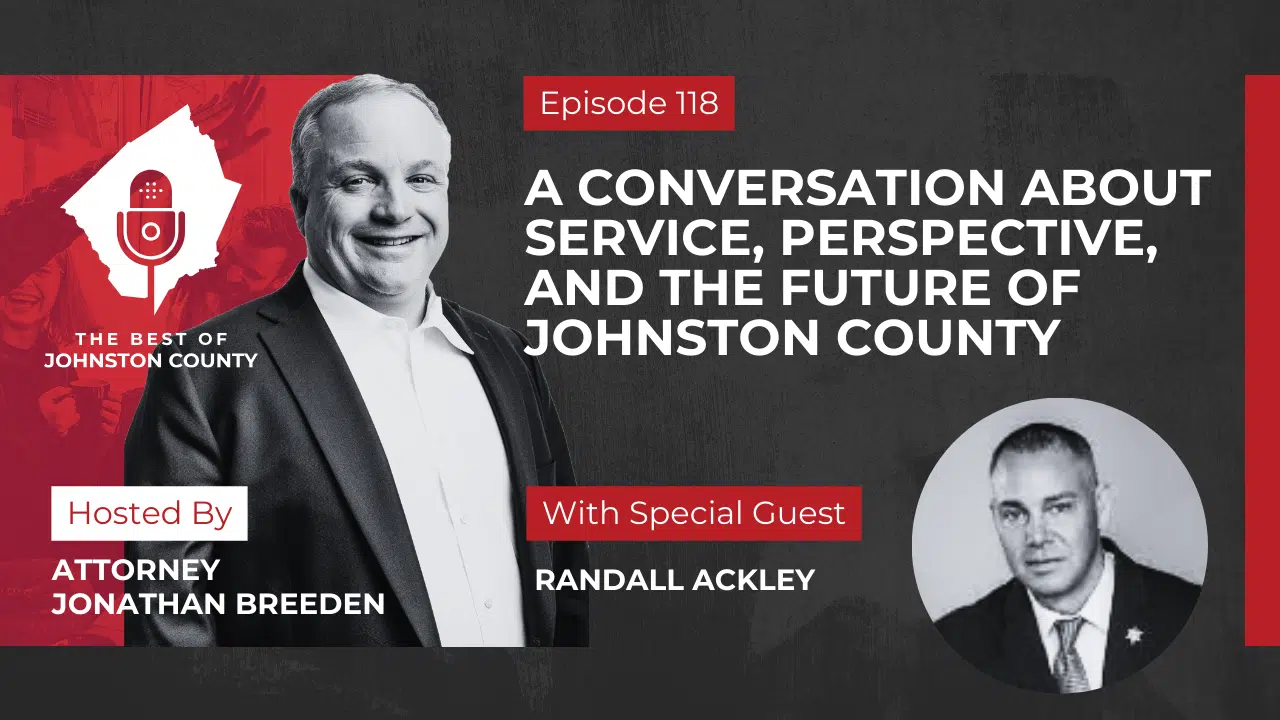
A Conversation About Service, Perspective, and the Future of Johnston County
Jonathan Breeden: [00:00:00] On this week’s episode of The Best of Johnston County Podcast. Our guest is Randy Ackley, a sheriff on the Republican primary ballot on March 3rd, 2026. He is challenging in current sheriff Steve Bizzell. We talked to Randll about growing up in Michigan.
Why he came to Johnston County, his different jobs and law enforcement including. I think 19 years with the Sheriff’s Department and why he thinks he should be the next sheriff of Johnston County. So listen in.
Welcome to another episode of Best of Johnston County, brought to you by Breeden Law Office. Our host, Jonathan Breeden, an experienced family lawyer with a deep connection to the community, is ready to take you on a journey through the area that he has called home for over 20 years. Whether it’s a deep dive into the love locals have for the county or unraveling the complexities of family law, Best of Johnston County presents an authentic slice of this unique community.
Jonathan Breeden: Hello and welcome to another edition of The Best Of [00:01:00] Johnston County Podcast. I’m your host, Jonathan Breeden, and on today’s episode, we have a Republican candidate for Sheriff Randy Ackley. He is the Challenger to current Sheriff Steve Bizzell, and the election is on March 3rd, 2026. There is no Democrat, so this will be the election for the sheriff of Johnston County. From December of 2026 until December of 2030.
If you are a registered Republican or a registered unaffiliate in Johnston County, you can vote in this race. Early voting starts February 12th. The election is March 3rd. You should know your candidates, which is why we’re bringing you this candidate series. But before we get to that, we’d like to ask you to like, follow and subscribe to this podcast wherever you see it.
Whether we on Apple, Spotify, YouTube, TikTok X, LinkedIn, Instagram, or any of the other social media channels of The Best Of Johnston County Podcast. The Best Of Johnston County Podcast comes out every single Monday and has now for a little over 20, about 28 months, so you can go back and listen to some of our previous episodes.
We’re well over a hundred episodes now. We’ve had the vast majority of the [00:02:00] county commissioners. We’ve had county Economic Development director, Chris Johnson, we had the county manager, Rick Hester. We’ve had small business owners like just dog people. If you love Johnston County as much as I do. This is the podcast for you.
Welcome Randy.
Randy Ackley: Thank you.
Jonathan Breeden: Yeah, so it’s a long time to see ya. I used to do criminal defense and we used to work together when you were at the sheriff’s department. And I stopped doing criminal defense about, I don’t know, 15 years ago and started doing just family law. I don’t see you as much as I used to, but we used to be at district court all the time.
Randy Ackley: Yep.
Jonathan Breeden: You know, I think you were doing some of the drugs and stuff back then. So tell the audience who you are and what you do.
Randy Ackley: Currently right now I’m just, I’m running for sheriff. Prior to that I, I worked at the sheriff’s office. I was a major crimes detective there. Prior to that worked our patrol division, property crime.
So kind of got a litany of experience on how things work there. And just really as of, of March made the decision to run for sheriff here in Johnston County just because of some of the things that I, I was seeing. Not that anybody was doing anything wrong or bad, it’s just sometimes we just see [00:03:00] things that we feel the the need to act and make it better.
Jonathan Breeden: Alright, so where’d you grow up?
Randy Ackley: I grew up in Michigan. So Muskegon, Michigan is. It’s primarily where a lot of my, my growth was. It’s on the, as a true Michigan person. Take your hand. You’re on the, the west coast of Michigan. Right there at Lake Michigan. So,
Jonathan Breeden: okay
Randy Ackley: I graduated from a small town named Hesperia High School. It’s really close to Fremont, Michigan, which is the Gerber, Gerber baby food capital of the world. So, okay. Came down here early two thousands, got involved in law enforcement and here we are today.
Jonathan Breeden: Alright, well, cool. Cool. So what brought you to Johnston County?
Randy Ackley: So, in, in true Michigan fashion, I wanted to get away from the weather.
Jonathan Breeden: I understand that.
Randy Ackley: So, but what caused me to stay is the love for Johnston County. You know, you get here, you see it, and it’s just the people the people of Johnston County welcome, welcomed me with open arms. Really drove home their moral, their values. And their family atmosphere. So that was definitely the main [00:04:00] reason of being here and staying here.
Jonathan Breeden: So when and where did you go to BLAT school?
Randy Ackley: I went through BLAT at Johnston Community College. After I graduated in BLAT. That was December of 2002. I went to work for a company police with Westhead Company police. Primarily, we worked the housing authorities here in Johnston County. I worked in Durham a little bit in Raleigh.
And then really wanted to get into the local municipality. So I, I kind of went from there into Four Oaks Police Department and then kind of stepped my way into the Sheriff’s office.
Jonathan Breeden: Okay. Alright. And I think I first met you when you were, you were at Four Oaks. I think that’s right. I, I, I think I’m remembering that right. So when did you switch to work for the Johnston County Sheriff’s Office?
Randy Ackley: 2006. So the first stint that I did at the sheriff’s office, so 2006 to 2008, I, I was at the Sheriff’s office. Made a, a decision to leave and go to Wilsons Mills. Wilsons Mills is where I currently live at, so they put me there at home.
But primarily some of the driving forces within our campaign right now that we talk about is training and career [00:05:00] advancement. So not that I don’t think that we don’t have career advancement, but I just wanted to get more training and that what was offered to me at Wilson’s Mills.
Jonathan Breeden: Okay. So, you worked at Wilson’s Mills for how long?
Randy Ackley: It’s like six months and I went back to the sheriff’s.
Jonathan Breeden: Oh, okay. You went back to the sheriff’s department. Okay.
Randy Ackley: Yep.
Jonathan Breeden: Golly, Wilson’s Mills is a small department. I, I mean, back then it might have only had three members.
Randy Ackley: Yeah. So,
Jonathan Breeden: or four it wasn’t very big, I don’t think back then. It’s a little bigger now.
Randy Ackley: Yeah. It, it’s grown tremendously. Just like Johnston County. So primarily what, what had happened at that is, is I was offered a, a job there and was given an opportunity to grow and go to training. And then I got there like many times in, in smaller agencies, things happen, administration change. And all those promises kind of went out the window,
Jonathan Breeden: right
Randy Ackley: so I was able to luckily get back at the sheriff’s office and work there again from 2008 until I. 2018. Okay. Worked my way all the way up and again, it just, you know, pay scale was right. So I left, left again in 2018, went to Clayton. Just [00:06:00] again, as far as a lack of better terms in law enforcement now with, that’s something that we’re dealing with is another political issue is we got our officers and deputies that are chasing money, so, right.
Jonathan Breeden: Yeah, they do. They do. And I don’t blame ’em.
Randy Ackley: So,
Jonathan Breeden: I mean, they got, they got families to feed like everybody else.
Randy Ackley: Yep. So, and that’s so that, that caused that decision. And again, you know, the sheriff called me back and said, Hey look we just, we just got some, some really good pay raises. I’d love to have you come back and sat down with my family, made the decision and, and went back until, you know, this past march.
Jonathan Breeden: Alright. So when did you go back to sheriff’s department? For the third time
Randy Ackley: 2018 same
Jonathan Breeden: 2018. Oh, so you weren’t in Clayton very long.
Randy Ackley: No. So it is a very, like my stints at other agencies are very short.
Jonathan Breeden: Okay.
Randy Ackley: I know. It looks, it looks really bad on paper and when you say it out loud, it sounds even worse, but really and truly is.
There’s always been a, a standard of, of what’s gonna be best for not only my family, but Right. Also looking after the things that I have to look after as a family man and, and as anybody would, so.
Jonathan Breeden: Right, right. Okay. So yeah, [00:07:00] so you worked in several of the different divisions of the sheriff’s department.
Randy Ackley: Mm-hmm.
Jonathan Breeden: I think you start out in patrol, as most people do and did you ever get the, the Cleveland Zone?
Randy Ackley: Every once in a while we got, we got to, we did what we call like positions or area swaps, so we worked.
This area, or I always loved going out towards like Bentonville and, you know, the Four Oaks area.
Right. Just because kind of the roots back home, but Right. I still love going out there, man. Right.
Jonathan Breeden: So we have, are they called zones? Patrol areas. Patrol areas. Okay. All right. I used to always call ’em zones. And we have six,
Randy Ackley: eight.
Jonathan Breeden: Eight. We have eight. Okay. How long have we had Eight,
Randy Ackley: let’s see. 2000 probably.
2008, probably 2008, 2009, somewhere around there. Right. So
Jonathan Breeden: this county’s grown a lot, right. Since 2008 or oh nine, and we still only have 8,
Randy Ackley: 260, 200 60,000 people. And I just did a little bit of research from the North Carolina Office of Budget Management. It’s around 175,000 people live in the unincorporated areas of this [00:08:00] county. So that’s all service to and by the sheriff’s office,
Jonathan Breeden: right? Yeah, no, that’s exactly right. And, and, you know. Sheriff’s offices traditionally, until you get into a boom county, have not been patrol. Right.
The job of the sheriff is to, I mean, he’s got a lot to do, but run the jail. Guard the courthouse, serve the civil papers of the sheriff’s department of the court. Also do the involuntary commitments of people that have mental health problems.
And that’s really where it started. Now I think it has evolved, particularly when you’re having to cover 175,000 people. But am I right about that? Like is as the sheriff’s department was originally decided to do that and then all this other stuff of patrolling and what would be more like community policing kind of got added?
Randy Ackley: Yeah, most definitely.
Jonathan Breeden: So, okay.
Randy Ackley: And then you get into the the 911 calls, the breaking and entering calls, the domestic violence calls, all those things that [00:09:00] we’re now seeing in today’s modern society. So it adds, and in Johnston County has evolved drastically. You know, you throw in the fact that we’ve got I 40 sitting out here, and then you got I 95 that interchanges here in Johnston County. So, you know, it’s a demographic change that we can’t do anything about. It’s gonna be here until right, until it’s essentially the end of society.
Jonathan Breeden: Right. So you also worked in property crimes?
Randy Ackley: Yeah.
Jonathan Breeden: And we’ve had a lot of those out here, particularly in the Cleveland area. We’ve had, I mean, every time you turn on next door or whatever, there’s car break-ins.
Randy Ackley: Yeah.
Jonathan Breeden: I mean, every week somebody’s car’s getting broken into, I mean, is there a solution? Like can the sheriff’s Department staffed as it is now actually patrol and maybe prevent or all they do is run calls because I think all they do is run calls and there’s no actual patrolling.
But I don’t know. You work there.
Randy Ackley: I think based on what I experienced there and just the continuing talks that I have with the deputies that are working there, is that they really don’t have time to be actively patrolling [00:10:00] because you take into account, there’s a lot of things that play into it, is one you got the response times that are that they’re going from the time that the call is dispatched to the driving, to them getting there, taking the report, then having to finish the report.
So there’s a lot of time and effort. So once that one deputy, for instance, like out here in 4042 or what we call area 6, you know, that is one deputy that is tied up there and there’s nobody else really out there actively patrolling.
And if especially at nighttime. So that one officer is out there. Let’s say it’s 30, 45 minutes. This area is potentially uncovered for 30 to 45 minutes.
Jonathan Breeden: Now, isn’t there supposed to be. A sergeant in each area or is that, is it one sergeant for two areas? I don’t know.
Randy Ackley: It’s one sergeant per patrol shift. So there’s four patrol shifts.
So you have a lieutenant, a sergeant, eight, eight patrol areas and four Roman cars. One fully staffed, so a total of around 14 deputies per shift.
Jonathan Breeden: Okay.
Randy Ackley: So,
Jonathan Breeden: so those extra cars might not be in area six while he’s running whatever report or call he’s had to run.
Randy Ackley: Yep. And then you [00:11:00] take into account too, that.
You know, deputies take vacation, people call out sick. They have family emergencies as we were talking about earlier. So there’s, you know, we’re, we’re at a critical staffing level to where we need to grow, and it’s, and it’s no no fault to anyone. It’s just we can’t predict that. You know, there’s gonna be a $10,000 Inc.
Or not $10,000, but 10,000 people increase here in Johnston County, so, right. You know, those are things that we have to rapidly plan for now and get caught up and then look forward to in the future.
Jonathan Breeden: How many areas. I personally think we need more patrol areas. I’ve had this debate with the kind of county commissioners, commissioners, like we’ve not been asked for more patrol areas. If you ask, we’ll look at it, but they haven’t been asked. How many patrol areas do you think we need?
Randy Ackley: I don’t know if we def necessarily need patrol areas. I like, I I don’t like the, when we use patrol areas, it’s kind of a static map mapping system.
Jonathan Breeden: Okay.
Randy Ackley: So I kind of look at it more as a dynamic. Let’s look at the population influx. So like for instance, out here at Cleveland, let’s say. [00:12:00] You know, how many people do we want to have per like 2000 people or 3000 people? So right now, based on the, we have one deputy per 12, I think it’s 12,500 people. You know, if we get it to the bare minimum and just say we want one deputy per 3000 people, then, you know, look at the areas and kind of influx and put them in those areas.
Because what do we know, and you know this as a, as a criminal defense attorney, is that law enforcement we have a use of force continuum. And it’s very simple. This is that our presence is a deterrence. So how do, to answer your question earlier, how do we deter those crimes from happening? We have to unfortunately put more people out there to be visible.
They can’t be running from one call to the other.
Jonathan Breeden: Right. They need to patrol.
Randy Ackley: Right.
Jonathan Breeden: Right. I mean, I agree and, and I think that’s. There, there’s no time. I mean, I don’t think the public realizes just how many calls for service there is. From domestic calls to my dog has run off to mental health calls to drunken disruptive to [00:13:00] my neighbor’s shooting his gun in the middle of the driveway.
Like, I mean. it’s unbelievable. And you live out here in your little neighborhood like I do, and I don’t think you realize all the things that the sheriffs have to do. And once again, we’re an unincorporated area, so the sheriff’s department in Johnston County, at least out here in these areas that look like cities.
Need to function like a city, but they don’t have the staffing of a Clayton or a Wilson’s Mills. So, I mean, what do we do?
Randy Ackley: Well, there’s a couple different things. One, we gotta work with our county commissioners and really start looking at the analytics and the data and saying, what is our call volume? What is our population? What kind of things are we seeing out there? And then establish communications with our businesses out here and saying, Hey, look, what are you guys seeing? That way we can use this to work with county commissioners. Not only that, you’ve got multiple different areas that you can look at as grants.
You’ve got the cops grants, you’ve got the department of Public Safety and Crime Control grants. You’ve got, you know, non-profit grants that are out there that are willing, if we already know, if we’re having this conversation, that we know that we need these [00:14:00] deputies. You know, the taxpayers don’t want to have the burden.
That’s one of the biggest things that I got. Well, how are we gonna pay for it? We’re they’ve already raised our tax with this re-evaluation and all these other things. But if we know that we have it, for instance, like the cops grants, there’s a 25% match.
So the county’s paying 25% versus the full hundred percent. I would rather pay 25 versus the whole a hundred.
Jonathan Breeden: Right.
Randy Ackley: And already know that we need have those needs.
Jonathan Breeden: I got you.
Have family law questions? Need guidance to navigate legal challenges? The compassionate team at Breeden Law Office is here to help. Visit us at www. breedenfirm. com for practical advice, resources, or to book a consultation. Remember, when life gets messy, you don’t have to face it alone.
Jonathan Breeden: So, let’s talk about. The jail. We have a brand new jail. We have a brand new 9 1 1 center. Staffing issues there.
Randy Ackley: Yeah.
Jonathan Breeden: What can we do about, well, we got a lot of staffing issues, but let’s talk about jail staffing issues. [00:15:00] That is a statewide problem. That’s actually a national problem. What would be your solution to try to solve the jail staffing issues?
Randy Ackley: I think part of it is kind of a double-edged sword is, you know, obviously you’re working in a place where people go and, I mean, when you talk to jailers, they’re just like, it’s horrible. Like nobody wants to go in there, they work. And then you got the mental health crisis that’s going on in there as well. So you’ve gotta make it, you know, I don’t wanna say it. A better sell it better, but really you gotta get them an opportunity to grow. And some, a lot of the jailers that I’ve talked to have said like, Hey, I’m willing to stay here and do this, but I wanna become a deputy.
So is there ways that we can incorporate a career ladder for them that kind of opens a pathway to get into. Law enforcement. So that’s just one idea. But there’s, you know, we can sit here and throw money at him. I don’t know if that’s necessarily gonna change.
Jonathan Breeden: I got you.
Randy Ackley: Change the issue. I think we just gotta look at it culturally and say, how do we cultivate?
Jonathan Breeden: Right. The sheriff’s department has openings as does [00:16:00] most.
Randy Ackley: Yeah.
Jonathan Breeden: Law enforcement after George Floyd and all that mess. What would be your solution to try to fill those openings?
Randy Ackley: Get out. You gotta get out in the community and it starts, you know, obviously making a career path, career ladder, training ladder. Like right now, we don’t have a set standard of like, Hey, Jonathan, you’re gonna come here, work at the sheriff’s office within your first year, you’re gonna get X, Y, and Z training by year two, you’re gonna get this, this, and this. It gives people a motive to keep motivated at work, I guess you can say.
Jonathan Breeden: Okay.
Randy Ackley: And then. You know, you gotta expand and once we start expanding, you’re gonna open up other opportunities for them to grow. Like we don’t have a fugitive task force.
Jonathan Breeden: Okay.
Randy Ackley: We don’t have a domestic violence unit, so those. We’re an interdiction unit. We’ve got two major interstates that are known drug trafficking and human trafficking avenues, but we don’t have anything out there really actively pursuing it.
So those are some of the things that we can make and advertise and make it more advantageous. And then throw in the training aspect as well.
Jonathan Breeden: Now we have the safe team.
Randy Ackley: Yeah.
Jonathan Breeden: And they’re, they’re pulling cars on interstate and they’re pulling kilos off [00:17:00] of the interstate and they do special patrol interdiction. I mean, they’ve done a great job over the last few years. I mean, that’s, are they not doing what you’re talking about?
Randy Ackley: I would, I wouldn’t say that they’re a dedicated interdiction unit.
Jonathan Breeden: Okay. What then, what are they?
Randy Ackley: I think I would, I would say that, you know, we have, we have a, a speeding problem. We see that all the time as far as the chases that are going on.
So I think they’re, they’re more concentrated on out there getting traffic and. Do they go out there and get drugs off the, the roads and everything else, but yeah, probably, I mean it, but I’m, I’m talking about a dedicated unit that is out there every single day that they’ve been sent off to specialized training that are specialized. We used to have that.
Jonathan Breeden: We used to have a drug addiction unit.
Randy Ackley: Yeah.
Jonathan Breeden: Crocker was on it.
Randy Ackley: Yeah,
Jonathan Breeden: Johnson was on it.
Randy Ackley: Two the best.
They were awesome.
Jonathan Breeden: Two the best on the, I had multiple. People charged with trafficking kilos of cocaine. That ccro, I used to call ’em Crocker Johnson. Like, like you saw like, Magnum Pi or whatever. That’s what I called ’em, you know, and, and they [00:18:00] were really good. I mean, they were, they were phenomenal. And we don’t have that team anymore.
Randy Ackley: No.
Jonathan Breeden: What happened to that?
Randy Ackley: I really don’t know.
Jonathan Breeden: Okay.
Randy Ackley: I don’t remember.
Jonathan Breeden: I mean, that was probably. 20 years ago.
Randy Ackley: Yeah.
Jonathan Breeden: I mean, I haven’t done criminal defense in a long time.
Randy Ackley: Yeah.
Jonathan Breeden: But they were really good.
Randy Ackley: Yeah. They, they were phenomenal. They were, when I say that, they were probably two on the best on the East coast.
I mean, they, they were very well known and very well regarded. Two of the, the most humble individuals that I, I’ve ever had the chance to work for. I think what had happened with them is, is that they, obviously, in, in professional development, they, they grew outside of that role and moved up and then eventually retired. So we just never filled that void.
Jonathan Breeden: Okay. I got you. So you keep talking about training. What training are they not getting that you think you’ll be able to provide?
Randy Ackley: So, I mean, it gets down into the basic, basic report writing, effective courtroom testimony. Those are two of the biggest things that are essential to our jobs. You know, not saying that our guys can’t write reports or anything else, but let’s train them up to the standards that we want to be. Not just say, Hey, this is the way that we’ve always [00:19:00] done it, you know, being able to go to court and sit in a courtroom and testify to 12 people about someone’s potential life changing experience is very important.
And I think that is something that we need to focus on. So those are just two examples. I mean, you get into Officer Survival, high risk warrant service, you know, there are multiple different things that our guys aren’t getting out there that are just, you know, I think it’s important.
Jonathan Breeden: So where does that training come from? I mean, the community college does a lot of training.
Randy Ackley: Right.
Jonathan Breeden: But like, are these, I don’t know, you bring somebody in and they do a week. I don’t know how training for law enforcement works.
Randy Ackley: See, a lot of it goes through the community college. You can go through Salemburg with the North Carolina Justice Academy or you get into specialized training. Like for instance a lot of us in the major crimes when I was there. We were going to the University of Louisville and going through some of the specialized training there. So you’ve got north Florida University in Jacksonville that we’ve been to as well.
Jonathan Breeden: Right.
Randy Ackley: So there’s specialized training out there.
The issue that I think that comes with that is, is that it’s a money issue.
Jonathan Breeden: Right.
Randy Ackley: You know, and I can understand where people are like, do we really wanna [00:20:00] sink this much money into it in the society where we are, where law enforcement goes from one agency to the other.
Jonathan Breeden: Right.
Randy Ackley: But I look at it as a way of let’s use that as a means to keep them there and show that we’re willing to invest. And if they do go somewhere else, that’s great because we’re encouraging them to grow.
Jonathan Breeden: Right, right. I got you. I got you. So what are some other things you want to do? I know you’ve talked about training you, you keep saying modernize the department, bring it into the 21st history. What does that mean?
Randy Ackley: So a lot of it, I mean, like really and truly, you look at our communities right now, you know, I know that there is a need whether it’s police, athletic league a cadet programs through the school system just getting back out there into the community and really start cultivating.
And that’s part of the recruiting thing too, is, you know, I go back as when I was a kid, you know, you look at it and you saw these cops and that was what you wanted to do. You know, and the fire departments do a phenomenal job. EMS does a phenomenal job and I feel like we’ve kind of lost our way a little bit. Part of that is really just getting back out into the community and really [00:21:00] start reaching and showing up just day in and day out
Jonathan Breeden: I got you. So, what other ideas do you have for the sheriff’s department? You’ve talked about better equipment. I’ve heard you talk about that. What type of better equipment do you think they need?
Randy Ackley: Well, we talked about body cameras and, you know, we put a huge emphasis on that and the sheriff has implemented that. So, I mean, that’s, a lot of people want to be upset and say this or you know that but really and truly at the end of the day, what we’re asking for and what we’re talking about is to affect change.
So, and that’s the betterment of not for me or not for him, but it’s for the community, so.
Jonathan Breeden: Right.
Randy Ackley: You know, we’ve talked about license plate readers and they have license plate readers. You know I think we need to implement a little bit more of those, just especially in this because as of the theft issues.
Jonathan Breeden: Right, right, right, right.
Randy Ackley: Great investigative tools that help us, not that we want to track our citizens, it’s just in law enforcement, you know, just as well as I do that if you don’t generate a lead. The very good chance of solving a case is down the drain.
Jonathan Breeden: Right? Right. So you would like to [00:22:00] see license plates readers put out here and maybe McGee’s and, and 40 42 and the high traffic areas around the interstates and stuff like that.
Randy Ackley: Yeah. And then ultimately, like work with our businesses. Like we’ve got Walmart, we’ve got a lot of different places out here that are, are havens that have a high call volume for theft. Right. So let’s cultivate. I identities and, and really ideas with them and, and collaborate and come up with a system that, that is beneficial for everybody.
Jonathan Breeden: You know, we’re, this is one of the people may not realize this is one of the only Walmarts. In the country that’s not in a city. Walmart prioritizes being in towns and cities because of local police departments, because the theft is so high at Walmart and, and some of that is the volume. Some of that is the clientele that shop at Walmart, but like we’re one of the very few. Walmarts that are not in a city. It’s the only one that I know that’s not in a city anywhere. And that was a debate when Walmart decided to come here 15 years ago, you know, was could the sheriff’s [00:23:00] department handle the call volume because they got a lot of calls to Walmart?
Randy Ackley: Yeah, a lot. And, and then it’s, it is, you got the, the growth around it.
So, I mean, not only do you have the. The initial calls of theft and everything else that ha happened there. But then you’ve got the apartments that are coming in, the subdivisions that are coming in. So those are all aspects of, and layers of complexity, so.
Jonathan Breeden: Right, right. Yeah. Well, and one thing the sheriff said was he wanted to, he used drug seizure money to buy the body cameras.
Randy Ackley: Mm-hmm.
Jonathan Breeden: How does that work? I mean, he’s done a lot of that over the years. Like, I mean, you were on some of those things that led to that. I mean, he bought a big bus, like, like I, you know, I don’t understand how that works. Like I guess if you find the money in the car and it sees, the sheriff gets to keep it, I don’t know how that works.
Randy Ackley: It’s, it is essentially a, as an asset fortuner, so they go through a certain process and, and you know, essentially that money is eventually rewarded to the sheriff’s office and it depends on. You know, if the sheriff’s office is full head, head unit on it, or the ones that actually did the [00:24:00] investigation where if they’re a secondary unit, breaks down into percentages and everything else, but you know, it’s a great avenue to, to save the taxpayer money, to get us some of the things that we need like body cameras. So I mean, that’s, if I was in the position, I would’ve did the same exact thing. Right. And that’s how I, I planned to do that when I was talking about it.
Jonathan Breeden: Alright, well, we’re gonna wrap this up here in a second.
Anything else you want to talk about? I think I’ve hit most of the issues that you’ve been talking about on the campaign trail. Anything I’ve not asked you about that you wanna point out about why you should be the sheriff?
Randy Ackley: I think it’s just, it’s perspective, right? Everything in life is perspective. We have talked about a lot of different things and from the sheriff’s perspective, but this is coming from somebody that has actually had boots on the ground in the last five years whether it be investigative and seeing the needs and talking to the guys that are out there on the road.
And again, it’s not a finger pointing who’s better, who’s not. It’s really about the betterment of our county and staying positive with it. And at the end of the day, I’ve gotta live here. He’s gotta live here. You’ve gotta live here. And we’re not gonna gain anything [00:25:00] by attacking one another or anything else.
Jonathan Breeden: Right. Well, I have noticed you’ve run a very positive campaign. I mean, I’ve not seen any attacks. I mean, you don’t dislike the sheriff. I mean, he employed you for a very long time.
Randy Ackley: No.
Jonathan Breeden: And he hired you three times.
Randy Ackley: Right. And I would hope he would hire me a fourth. Matter of fact, when I sat down and talked to him and told him what my intentions were one of the first things that I told him is that I loved him and I respected him.
And I truly meant that, and that this is not an attack on him. It’s just, it’s a love for this County. And sometimes whether it’s a motivating factor for him or a motivating factor for the community. At the end of the day, I think we are trying to move forward in a direction that is more cohesive and more modern.
Jonathan Breeden: Alright, well I could understand that last question we ask well, well, how can people get up with you? Always forget that. Always forget how can people get up with you and learn about your campaign?
Randy Ackley: Absolutely. So our campaign website is Ackleyforsheriff.com. We’re out very active on Facebook, Instagram and TikTok.
So, all our information is on there. Check us out. It’s [00:26:00] Ackleyforsheriff.com.
Jonathan Breeden: All right, and the last question we ask everybody, what do you love most about Johnston County? You already talked about the people.
Randy Ackley: Oh yeah.
Jonathan Breeden: Almost everybody says the people, but I’ll ask you the question anyway.
Randy Ackley: Man. It is, it is honestly.
I would not be the man that I am today without the people of Johnston County. Most definitely they have shown love and grace in, in ways that go beyond measure. And I’ve been, been blessed. Just blessed beyond measure.
Jonathan Breeden: Well, that’s awesome. That’s awesome. Well, and most people say they love the people. I love the people. I’m blessed. They’ve done a lot for me and my business and my growth. I mean, when we got, when we started, like we were both young men now. You got some gray hair. I got a lot less hair. So anyway, so anyway, we’d like to thank Randy Ackley for being our guest on this week’s episode of The Best of Johnston County Podcast.
As I said earlier, he will be on the Republican primary ballot for Johnston County Sheriff on March 3rd, 2026. Early voting starts February 12th, 2026. Any unaffiliated voter or Republican [00:27:00] registered voter. Can vote in this election, and this will be the election. There is no Democrat running as in most cases in Johnston County.
So this will decide who will be your sheriff from December 7th, 2026, to the first Monday in December, 2030. So reach out to him, go to his website learn more about what he’s doing and decide who you would like to vote for. As I mentioned earlier, please like follow us, subscribe to this podcast wherever you see it, whether it be on Apple, Spotify, YouTube, TikTok, LinkedIn, or any of the other social media channels. If you’d be so kind as leave us a five star review down below that would help spread our reach to other people and tag us in your Instagram stories. Best of Johnston County. Until next time, I’m your host, Jonathan Breeden.
That’s the end of today’s episode of Best of Johnston County, a show brought to you by the trusted team at Breeden Law Office. We thank you for joining us today and we look forward to sharing more interesting facets of this community next week. Every [00:28:00] story, every viewpoint adds another thread to the rich tapestry of Johnston County.
If the legal aspects highlighted raised some questions, help is just around the corner at www. breedenfirm. com.
Every election season brings a familiar responsibility. Not just to know who is running, but to understand why. On this episode of the Best of Johnston County Podcast, I sat down with Randall Ackley, a Republican candidate for Johnston County Sheriff, to talk through his background, his experience, and the perspective that led him to enter this race.
From Michigan to Johnston County
Randall’s story does not begin in Johnston County. He grew up in western Michigan, near Lake Michigan, graduating from Hesperia High School not far from Fremont, home of Gerber baby food. Like many who leave Michigan, weather played a role in his move south. What caused him to stay, he told me, was Johnston County itself. The people welcomed him, and the values and sense of family he found here became the foundation for building his life.
Entering Law Enforcement
After completing Basic Law Enforcement Training at Johnston Community College in December 2002, Randall began his career working company police assignments in Johnston County housing authorities, with time spent in Durham and Raleigh. He later joined the Four Oaks Police Department, which is where I first worked with him during my years practicing criminal defense. From there, he transitioned into the Johnston County Sheriff’s Office in 2006.
Career Decisions and Professional Growth
His career includes multiple stints with the Sheriff’s Office, along with shorter periods at Wilson’s Mills and Clayton. Randall is candid about how that can look on paper, and even more candid about why it happened. Each move, he explained, was about training opportunities, professional growth, and making decisions that were best for his family.
Seeing the Strain on Patrol Coverage
During his time with the Sheriff’s Office, Randall worked patrol, property crimes, and later major crimes investigations. As we talked, it became clear that much of his perspective is shaped by seeing how dramatically Johnston County has grown while patrol coverage has remained largely unchanged. Today, eight patrol areas serve a significantly larger unincorporated population, which means deputies spend most of their shifts responding to calls rather than patrolling proactively.
Randall explained how response times, travel distance, report writing, and staffing shortages combine to leave large areas uncovered for long stretches of time. When a deputy is tied up on a call for thirty to forty-five minutes, that area effectively goes without active patrol. Add in vacation time, sick leave, and family emergencies, and the strain becomes even more apparent. The issue, he emphasized, is not effort, but capacity.
Rethinking Patrol and Presence
Rather than focusing only on adding more patrol zones, Randall talked about taking a more dynamic approach. He suggested looking at population density and call volume instead of static maps, with the goal of reducing the number of residents each deputy is responsible for. Presence, he reminded me, is the first level of deterrence. If deputies are constantly running from call to call, that presence disappears.
The Expanding Role of the Sheriff’s Office
We also talked about how the role of sheriff’s offices has evolved over time. Traditionally focused on running the jail, guarding the courthouse, serving civil papers, and handling involuntary mental health commitments, sheriff’s departments today respond to domestic violence calls, property crimes, mental health crises, and emergency situations across large unincorporated areas. In places like Cleveland, which function like cities without municipal police staffing, the demands increase while resources lag behind.
Jail Staffing and Career Pathways
Staffing challenges extend into the jail as well. Randall described jail staffing as a statewide and national problem, made even more difficult by the mental health crisis. Many jailers, he said, are willing to stay but want a clear pathway to become deputies. Rather than treating the jail as a dead end, he sees an opportunity to create a career ladder that supports both retention and growth.
Training as a Foundation
Training came up repeatedly throughout our conversation. Randall talked about the need for more consistent training expectations, including report writing and courtroom testimony. He emphasized how important it is for deputies to be prepared when testifying before juries, knowing their words can shape life-changing outcomes. Beyond fundamentals, he pointed to officer survival training, high-risk warrant service, and specialized investigative instruction as areas where more investment is needed.
While training opportunities exist through community colleges, the North Carolina Justice Academy, and specialized programs at universities outside the state, cost is often a limiting factor. Randall views training not as an expense, but as an investment. Even if deputies eventually move on, he believes showing a willingness to invest in their development benefits the department and the profession as a whole.
Modernization Through Community Connection
When we talked about modernization, Randall focused heavily on community connection. He reflected on earlier generations who saw law enforcement as a calling and pointed to fire and EMS departments as examples of strong community engagement today. Rebuilding those connections through cadet programs, school involvement, and consistent presence, he believes, is key to recruitment and trust.
Technology, Tools, and Investigation
We also discussed equipment and technology. Randall acknowledged steps already taken, including the implementation of body cameras funded through asset forfeiture. He supports expanding investigative tools like license plate readers, especially near high-traffic areas and interstates. He was clear that these tools are not about tracking citizens, but about generating leads. Without leads, cases often stall before they begin.
Commercial Growth and Collaboration
Our conversation also touched on the unique challenges posed by large commercial centers like Walmart, which in Johnston County exists outside a municipal police jurisdiction. High call volume, surrounding residential growth, and theft concerns place added strain on deputies. Randall emphasized collaboration with businesses as a practical necessity in areas experiencing rapid development.
Perspective, Respect, and the Campaign
As we wrapped up, I asked Randall why he believes he should be the next sheriff. His answer came back to perspective. His views are shaped by recent, firsthand experience, by working patrol shifts, conducting investigations, and regularly talking with deputies still on the road. He stressed that his campaign is not about criticizing leadership, but about improving systems for the future of the county we all share.
I noted during the episode that he has run a notably positive campaign, and that respect for the current sheriff is evident. Randall confirmed that respect, explaining that he expressed it directly when he shared his decision to run. The motivation, he said, is not conflict, but progress, cohesion, and preparing Johnston County for what lies ahead.
What He Loves About Johnston County
When I asked what he loves most about Johnston County, his answer was the same one I hear most often. The people. He credited them with shaping the man he has become and described the support and grace he has received as blessings beyond measure.
Election Information and Closing Thoughts
This episode concludes with a reminder that the Republican primary for Johnston County Sheriff will take place on March 3, 2026, with early voting beginning February 12. For registered Republicans and unaffiliated voters, this election will determine who serves as sheriff from December 2026 through 2030.
For those who prefer the written word to video or audio, this conversation offers a grounded look at experience, service, and a vision shaped by years inside the department and a deep connection to the community it serves.
AND MORE TOPICS COVERED IN THE FULL INTERVIEW!!! You can check that out and subscribe to YouTube.
Connect with Randall Ackley:
- Website: https://www.ackleyforsheriff.com/
- Facebook: https://www.facebook.com/AckleyforSheriff
- Instagram: https://www.instagram.com/ackleyforsheriff/
- TikTok: https://www.tiktok.com/@ackleyforsheriff
Connect with Jonathan Breeden:
- Website: https://www.breedenfirm.com/
- Phone Number: Call (919) 726-0578
- Podcast: https://breedenlawpodcast.com/
- YouTube: https://www.youtube.com/@BestofJoCoPodcast
Listen On