
June 8, 2026
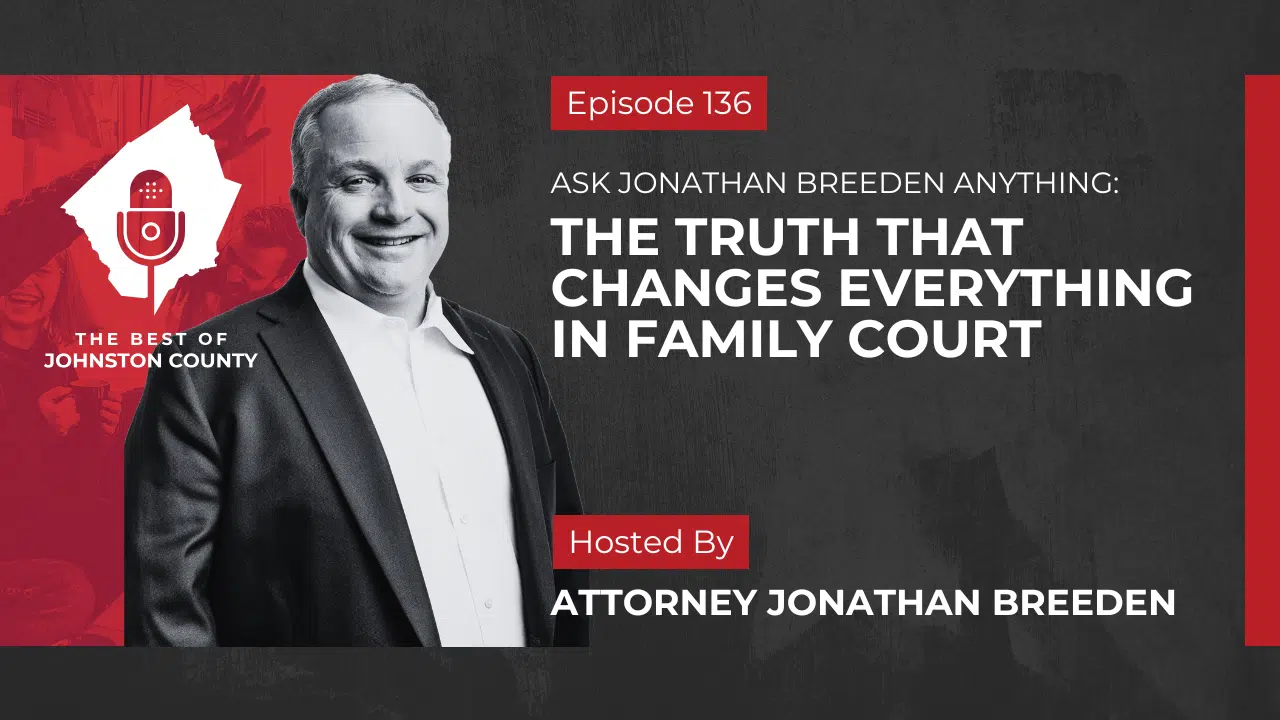
Ask Jonathan Anything: The Truth That Changes Everything in Family Court
Jonathan Breeden: [00:00:00] On this week’s episode of The Best of Johnston County podcast, we’re having a special edition episode that we call Ask Jonathan Breeden Anything. And in this episode, I answer questions about does one single fact that the attorney not know change the outcome? Should you follow court orders, and what happens if you don’t follow a court order?
And whether co-parenting can get better or does it always get worse between two parents? If you’re interested in the answer to these questions as I see it after doing this for 26 years, listen in.
Welcome to another episode of Best of Johnston County, brought to you by Breeden Law Office. Our host, Jonathan Breeden, an experienced family lawyer with a deep connection to the community, is ready to take you on a journey through the area that he has called home for over 20 years. Whether it’s a deep dive into the love locals have for the county or unraveling the complexities of family law, Best of Johnston County presents an [00:01:00] authentic slice of this unique community.
Jonathan Breeden: Hello, and welcome to another edition of the Best of Johnston County podcast. I’m your host, Jonathan Breeden, and on today’s episode, we’re doing a special different episode we like to call Ask Jonathan Breeden Anything, where our social media coordinator, Raena Burch, asks me, Jonathan Breeden, varying family law questions.
And this one is going to be sort of real-world stories that I have seen in 26 years of practicing family law, and how they have affected the outcome, and why it is very important to tell your attorney the truth. But normally on this podcast, I, Jonathan Breeden, interview interesting community members, leaders small business owners about what they love about Johnston County and the services that they provide to the citizens of Johnston County.
But every once in a while, we do these special different episodes that we call Ask Jonathan Breeden Anything, and that’s what this podcast is gonna be about. But we would like to ask you to like, follow, subscribe to this podcast wherever you see it, whether it be on Apple, Spotify, YouTube, TikTok, X, LinkedIn, or any of the other social [00:02:00] media channels of the Best of Johnston County podcast.
The Best of Johnston County podcast comes out every single Monday and has now for over two and a half years. So go back and listen to some of the previous episodes. We’ve had the vast majority of the county commissioners. We had now Congressman Brad Knott. We’ve had County Economic Development Director Chris Johnson.
We’ve had the Parks and Rec director twice. So if you love Johnston County as much as I do, this is the podcast for you. Welcome, Raena.
Raena Burch: Welcome, Jonathan. Are you ready?
Jonathan Breeden: I guess. I, I never really know what these questions are gonna be before we start-
Raena Burch: I know
Jonathan Breeden: but we’ll see how I do.
Raena Burch: I know. My theory is every good lawyer has good stories.
Jonathan Breeden: Well, I’ve got a few.
Raena Burch: I figured you did. All right, so the first question. A newer topic, especially in the legal sense, is social media, right? There’s not a lot of statutes or anything on that at the moment. So the question is, does it really come up in court? Does social media really come up in court?
Jonathan Breeden: Yes, all the time.
Raena Burch: Okay.
Jonathan Breeden: Almost every single contested hearing, there’s something about social media being introduced as [00:03:00] evidence. And it’s not for the positive.
Raena Burch: Yeah.
Jonathan Breeden: It’s mainly for the negative. And the things that you see that are negative on social media is you have one party out there blasting the other party.
Raena Burch: Okay.
Jonathan Breeden: You know what I mean? Saying that they’re a horrible person and calling them profanity and insulting their family members. And if they were have, would’ve, oftentimes these relationships break up ’cause somebody cheated. They have something to say about who they cheated with.
Raena Burch: Yeah.
Jonathan Breeden: And it’s not good.
Raena Burch: Mm-hmm.
Jonathan Breeden: And particularly if you have kids who are old enough who have access to social media and the age for that is a whole nother debate, but there’s a lot of kids that have access to social media at a fairly young age that then see this. And while you didn’t say it to the child, it’s out there, and it can be seen, and it can be shared with the child. The child can [00:04:00] see it.
And so that is the problem, and nothing good is coming out of telling the world about how horrible your ex is.
Raena Burch: Mm-hmm.
Jonathan Breeden: Like, what are you trying to get? Pity? You want people to say, “Oh, we’re so sorry for you”? What does that accomplish, right?
Raena Burch: Yeah.
Jonathan Breeden: So anyway, so that’s what we see. It also can show people out partying and drinking and-
Raena Burch: Mm.
Jonathan Breeden: And, you know-
Raena Burch: Yeah
Jonathan Breeden: hanging out with a lot of different people. Some of those people might not be the best people to be hanging out with.
Raena Burch: Yeah.
Jonathan Breeden: Particularly if they have criminal records or they’re on the sex offender registry- Yeah … and stuff like that.
And so, you know, that’s not great either. No. When you’re trying to show yourself to be a stable parent and in the best interest of the child
Raena Burch: Mm-hmm
Jonathan Breeden: and then I’m holding pictures of you drunk out of your mind, doing keg stands with a sex offender in the background, right? Yeah. Like, I mean, this happens.
Oh, yeah. Like, I, I, I wish it didn’t, [00:05:00] but it does. And so, you know, the court’s gonna be like, “Okay, you know, is this person really a responsible parent?” Y- you know- Yeah … are they really the best parent for this child if this is what they’re doing? And they’re voluntarily sharing, right? Like, or who tags you, right?
Like-
Raena Burch: Yeah.
Jonathan Breeden: That’s a big one … you gotta be real careful about that, right? So, so I think that that’s, because the other thing is- If you’re out there on social media telling the whole world, people you don’t even know, how bad the other party is, the court is going to presume that you’re telling the child how bad the other party is.
Raena Burch: Mm.
Jonathan Breeden: And that is terrible for the child. It’s like stabbing the child in the heart because that child is half the other party’s, and they care more about you and the other party than anybody else in this world, no matter how much you hate the other party.
Raena Burch: Mm.
Jonathan Breeden: And so that also goes in to how judges make decisions. So you gotta be real careful about what is out there on social media. But yeah, we’re using it in almost every single contested hearing, not for the positive-
Raena Burch: Mm …
Jonathan Breeden: but for the negative [00:06:00] against somebody.
Raena Burch: Yeah. Okay. And so- Is there any platform that’s like more, that you see more often than most? Or is it kind of just it runs the gamut?
Jonathan Breeden: I mean, we see Facebook. You see- You know what I mean? I mean, you know, there’s not as much writing on Instagram.
Raena Burch: Yes.
Jonathan Breeden: You, you know what I mean?
Raena Burch: Yeah.
Jonathan Breeden: People don’t really use X anymore. It’s Twitter, it’s kinda gone away. Yeah. you know, so we see a lot of Facebook. You know what I mean?
Raena Burch: Okay. Yeah.
Jonathan Breeden: Snapchat kinda comes and goes. Maybe somebody… You know, but it’s not ever gone, right? Like-
Raena Burch: No …
Jonathan Breeden: somebody could’ve captured it before it went away. Like- Yeah, like, like you- … somebody could’ve videoed it with their phone.
Raena Burch: I was about to say, yeah.
Jonathan Breeden: But, you know, like there’s, there’s that. You gotta be very, very careful about that. You know, there’s other chat things out there.
Raena Burch: Yeah.
Jonathan Breeden: You know, You know, we had one the other day where somebody felt like they were being threatened, you know, by this rant against the other party, and-
Raena Burch: Oh, gotcha
Jonathan Breeden: you know, everybody’s gonna pay for what they did to this person.
Raena Burch: Okay.
Jonathan Breeden: You, you know what I mean?
Yeah. I don’t think [00:07:00] they intended any harm, they’re just mad.
Raena Burch: Yeah.
Jonathan Breeden: But, you know, it is-
Raena Burch: It just depends on how you take it …
Jonathan Breeden: how you take it, correct.
Raena Burch: Yeah. Okay. And so have you ever had a case or seen a case where one small detail changed everything?
Jonathan Breeden: Yeah. I mean, we’ve had a lot of those cases, particularly ones we didn’t know about.
You know?
Raena Burch: Yeah, that’s bad.
Jonathan Breeden: Right. Right. One that comes to mind from a few years ago was a custody case where the mother’s new husband.
Raena Burch: Okay.
Jonathan Breeden: Had a past
Raena Burch: Okay
Jonathan Breeden: and was moving on from that past and was doing great.
Raena Burch: Yeah.
Jonathan Breeden: And was doing everything you would ask somebody to do. But what we did not know was that the mother’s husband and other people had been recreationally using drugs. Like, I mean, not even serious drugs, like marijuana, which everybody thinks, you know, is legal in a bunch of states.
Raena Burch: Yeah.
Jonathan Breeden: [00:08:00] Together.
Raena Burch: Okay.
Jonathan Breeden: And this came out in the trial that, you know, it was one of the dad’s family members. Everybody was friends. You know, people in this one largely got along until they didn’t.
And they came and they was talking about what they saw.
Raena Burch: Yeah.
Jonathan Breeden: Nobody harmed but it was enough, I think it turned the whole case.
Raena Burch: Oh, wow.
Jonathan Breeden: You know, so I mean, things happen.
Raena Burch: Yeah.
Jonathan Breeden: you know what I’m saying? I mean, people do things that they’re not proud of. But not telling your attorney. So they can prepare can put you in a real spot.
Raena Burch: Yes.
Jonathan Breeden: And, you know, if the attorney knows, they can prepare for it, they can try to mitigate it. They can develop a strategy around it.
Raena Burch: Yep.
Jonathan Breeden: But if they don’t know, and you’re in a live fire situation in a courtroom where a trial is going on, and the trier of fact is sitting right there listening to every word, then it becomes very difficult. And some things can’t be mitigated.
Raena Burch: Yeah.
Jonathan Breeden: But some things can be.
Raena Burch: Yeah.
Jonathan Breeden: [00:09:00] With other witnesses and other-
Raena Burch: Yeah …
Jonathan Breeden: character and, and that kind of stuff. So I mean, you know, I mean, there’s been, I mean, every case you do, something is gonna come out that you don’t know about.
Raena Burch: Yeah.
Jonathan Breeden: And you’re gonna look at your client and you know, like… But, but, you know, but not, that doesn’t always turn the case.
Raena Burch: Yeah.
Jonathan Breeden: But sometimes-
Raena Burch: It does
Jonathan Breeden: it does.
Raena Burch: Yeah.
Jonathan Breeden: And depending on what it is.
Raena Burch: Exactly.
Jonathan Breeden: And you know, and that does happen, so you’re right. And yes, we have seen one or two things that we didn’t know anything about turn an entire case. If they’re, if they’re substantial enough and they go to the best interest of the child and what’s in the welfare of the child, then absolutely it can change the thing.
And it can, can change the outcome because ultimately the judge is trying to decide what’s in the best interest of the child. Yeah. So you need to tell your client, you need to tell your lawyer everything
Raena Burch: Mm-hmm
Jonathan Breeden: that there is so that they can be prepared. Even if you don’t think the other side has it or knows about it, they still need to know so they [00:10:00] at least have it in the back of their mind- and have a plan if it comes out.
Raena Burch: Yes. Because you never know, like you said, you could be good with someone until you’re not.
Jonathan Breeden: Correct.
Raena Burch: And then that someone is telling-
Jonathan Breeden: Correct
Raena Burch: is telling other people-
Jonathan Breeden: Right … or- Or you’re good with their family- … but not with the opposing party, but your fam- You’re everybody’s friends.
Raena Burch: Yeah.
Jonathan Breeden: And then the other opposing party decides to take you to court and then, you know-
Raena Burch: Yeah …
Jonathan Breeden: family sometimes family.
Raena Burch: Yeah.
Jonathan Breeden: I, I mean, I’ve seen it. Look, I, I’m not saying… I’ve had a lot of family members testify against their own family members over the years.
Raena Burch: Yeah.
Jonathan Breeden: But I’ve also had a lot of these mutual friendships among families, you know- sometimes go south.
Raena Burch: Exactly. So lesson to the listeners, tell your attorney everything, even if it’s shameful or embarrassing or something you don’t want anybody else to know in the world. That, that lawyer confidentiality is, is ironclad. Tell your lawyer.
Jonathan Breeden: Right. Tell your lawyer. Because they need to be prepared-
Raena Burch: Yes …
Jonathan Breeden: if it does come out in the trial.
Raena Burch: Absolutely. Okay, so number three [00:11:00] is ignoring a court order, like, really as big of a deal as people make it out to be?
Jonathan Breeden: Yes, it is a huge deal.
Raena Burch: Okay.
Jonathan Breeden: And if you violate a court order, and it’s found that you willfully violated a court order, the court can and will put you in jail. And it’s jail with the murderers and everybody else.
Raena Burch: Yes.
Jonathan Breeden: And so you could be just a regular person who’s never gotten a speeding ticket ending up in the jail with some really bad people.
Raena Burch: Yeah.
Jonathan Breeden: And I’ve had that happen many, many times where people did not follow the court’s order and the court put them in jail. And so, you know, the court orders are there for a reason, right?
Raena Burch: Yes.
Jonathan Breeden: They create order in society. Why we have courts, right? All the way back to English common law, all that stuff.
Raena Burch: Yep.
Jonathan Breeden: It’s a way to create order. It’s a way to govern society, right? And so if a court has entered an order, then the judge fully expects you to comply with the order.
Now does every judge put every violation in jail? No. [00:12:00] Should they? I might if I was the judge. But I’m not the judge. So I mean, I really have very little tolerance for people that don’t follow court orders. That, I just it’s clear. It’s right there. You know what you need to do, and you need to just follow it.
Raena Burch: Yeah.
Jonathan Breeden: And I don’t care if the other side’s not following it, we’ll deal with that our own way.
Raena Burch: Yeah.
Jonathan Breeden: But if you don’t, if you violate a court order, you know, somebody can file a motion to show cause against you, and they’re gonna allege that you willfully violated this order in this way and ask that you be punished. You can be fined, you can be ordered to pay attorney’s fees. It could be grounds to modify a custody order.
Raena Burch: Yep.
Jonathan Breeden: It could be the underlying basis for a mode motion to modify custody. It can be and you can lose your freedom.
Raena Burch: Yeah.
Jonathan Breeden: And you lose your job.
Raena Burch: Yeah.
Jonathan Breeden: Like, you get 30 days in jail, like what job’s gonna be there when you come out?
Raena Burch: Yeah.
Jonathan Breeden: And, and the judge doesn’t really care.
Raena Burch: Yeah.
Jonathan Breeden: What he wants or she wants-
Raena Burch: Doesn’t
Jonathan Breeden: is compliance with the court order. And you know, and that might be the only way to get it.
Raena Burch: Yeah.
Jonathan Breeden: You know, but tell you what, in my experience, when judges do put somebody [00:13:00] in jail, we don’t have any more problems with them, whether- … whether it be my client or the other client.
Raena Burch: Yeah.
Jonathan Breeden: Usually once they, once those doors lock behind you, I, they get compliance real quick.
Raena Burch: Yeah.
Jonathan Breeden: And I have argued for 26 years for judges to put more people in jail so we don’t have as many show causes as we do-
Raena Burch: Yeah
Jonathan Breeden: so that we could, so that we could get some people to follow these orders. It would make my job as a family law attorney much easier.
But, you know, I’ve never been sitting there in that position as a judge, probably never will be, so I don’t look at it the way they do. But I always thought like, “Look, like if you just give them 48 hours, we won’t have to come back here any more show causes because they’ll get the message.”
Raena Burch: Yep. That reality really sets in.
Jonathan Breeden: Absolutely.
Raena Burch: Sending them off-
Jonathan Breeden: Absolutely.
Raena Burch: Yeah.
Have family law questions? Need guidance to navigate legal challenges? The compassionate team at Breeden Law Office is here to help. Visit us at www. breedenfirm. com for practical advice, resources, or to book a consultation. [00:14:00] Remember, when life gets messy, you don’t have to face it alone.
Raena Burch: So let me ask you this. What’s the longest amount of jail time you’ve seen of a judge order?
Jonathan Breeden: I mean, you know, if you get held in civil contempt particularly for not paying your child support, I mean, you might be there for three months before they bring you back in to see whether they’re gonna let you out.
Raena Burch: Oh, wow.
Jonathan Breeden: A lot of the ones in regular custody court, you get 30 days for contempt. And you know, and sometimes you can appeal it and get out. Sometimes you just do the 30 days. You know, but yeah, I’ve seen 4 days, I’ve seen 48 hours, I’ve seen 30 days, I’ve seen 90 days in a child support situation.
Raena Burch: Wow. Yeah.
Jonathan Breeden: and, if you get found in civil contempt, it can kind of be somewhat indefinite depending on whether you’re gonna comply with the court’s order or not which is approves you see child support. You’re gonna pay your child support, or you’re gonna pay what they’re asking you to pay.
Raena Burch: Yeah.
Jonathan Breeden: You know, and there’s different ways to get money to pay that, you know. Like most people have a vehicle, you know, you could sell. I saw a judge.
Raena Burch: Yep. Payday loans.
Jonathan Breeden: I saw a judge one time [00:15:00] put somebody in jail for not paying child support, and he knew that the person had a truck ’cause they had the child support agency had introduced a title.
You know, the DMV title to this truck, and his girlfriend was standing there crying, “What are we gonna do? We can’t pay our bills.” And he looked at her and said, “He has this truck, and CarMax is open.” And.
Raena Burch: Wow.
Jonathan Breeden: That’s what the judge said. And,
Raena Burch: He’s not wrong.
Jonathan Breeden: And he was not wrong. He absolutely was not wrong.
Raena Burch: Yeah.
Jonathan Breeden: The man did have a truck, and CarMax was open. So, anyway, so that was like 15 years ago. I’ll never forget that. I was like, “It’s a good point. It’s a really good point, Judge.”
Raena Burch: Can’t really argue with that one.
Jonathan Breeden: Luckily it wasn’t my case, but it was a good point.
Raena Burch: Okay. So, and just one last on that one. When they order like the 30 days, the 90 days, is it consecutive? Is it broken up? Is it… How does that work?
Jonathan Breeden: No, it’s often you go right then, and it’s straight.
Raena Burch: Oh, they take you immediately.
Jonathan Breeden: Right. They take, they take you immediately straight from the courtroom.
Raena Burch: Okay.
Jonathan Breeden: And you know, it’s rare that it gets broken up. It’s too much, it’s too much paperwork and too, [00:16:00] too hard-
Raena Burch: Mm …
Jonathan Breeden: for the sheriff’s department to keep up with. With the new jail in Johnston County, they can, it’s a little easier ’cause they’re not- Mm … overcrowded like they were in the old jail. But usually they just take you right then.
Raena Burch: All right.
Jonathan Breeden: Well- Just put the cuffs on you and out you go.
Raena Burch: Good to know. Pay your child support.
Jonathan Breeden: Well, and follow court orders.
Raena Burch: And follow court orders. Okay. Number four. So biggest topic in family law, aside from children, is usually money. And so do people really try to hide their assets?
Jonathan Breeden: Not very often.
Raena Burch: Okay.
Jonathan Breeden: I think people think that that’s a big thing. And in certain cases it is, but it is very rare. Okay. I, and I’m not saying never- Mm … because we always- It, it does … have, at a firm this size-
Raena Burch: Yes
Jonathan Breeden: we’re always gonna have cases where it’s happening, but it’s probably less than one or 2% of the cases. I’m gonna be honest. Okay. I think, I think a lot of people come in here and think that- Yeah
but they just don’t know where their money went, and they don’t want to realize that they just lived a lifestyle they couldn’t afford. And there’s [00:17:00] just not money missing.
Yeah. I’m being, I’m being real. Yeah. Like, they just spent it.
Raena Burch: Yeah.
Jonathan Breeden: But, you know, every once in a while, but for the, as a general rule we don’t see that.
What we do see is people taking money out of joint accounts and putting it into-
Raena Burch: Mm …
Jonathan Breeden: their own name account. Yeah. Which is, I mean, some people say that’s hiding, but I’m gonna get that back. I’m gonna see it come out of the joint account.
Raena Burch: Yep.
Jonathan Breeden: And, you know, and I’m gonna trace it somewhere. Yeah. And you’re, you’re gonna have to turn it over.
You’re gonna give me all your bank statements and all this stuff. I’m gonna be looking for this amount of money. Where did it go? Yeah. When was this other account opened? You know, what happened with that account? You know, that kind of stuff. Yeah. But it’s, it, it’s rare. I’m not saying never.
Raena Burch: Yeah.
Jonathan Breeden: And, and you know, the, what we do see more than people trying to sort of hide it or squirrel it away is they just don’t want to disclose it.
And I mean, I guess that’s kinda hiding. Yeah. But it’s not like they’ve, like, moved it offshore or something. Yeah, yeah. Y- you know what I mean? Like, they just don’t-
Raena Burch: They just don’t want the other person to know about it.
Jonathan Breeden: Right. They don’t just [00:18:00] wanna disclose. They don’t wanna answer the discovery fully.
They don’t wanna turn the documents over. They don’t want- Yeah … our business evaluators to look at it. You know, that kind of stuff. And then we have to fight real hard to get it, but usually we’ll get it, it’s just extra work, extra time-
Raena Burch: Yeah
Jonathan Breeden: extra money you know, that often our clients don’t get their money back for. But y- you know, but you get some of that. But-
Raena Burch: Yeah
Jonathan Breeden: but actually trying to squirrel it away is, is rare. But if you’re in one of those one or two or 3% of cases where it’s happening, it’s a really big deal. But it’s not as common as everybody thinks.
Raena Burch: Gotcha. So what are some assets you’ve seen people try to hide or not wanna disclose or?
Jonathan Breeden: I mean, they don’t wanna turn over if they own a business, they don’t wanna turn over the business bank accounts. They don’t wanna turn over the business tax returns or the depreciation schedules. They’ll want to not turn over, you know, some of the bills of sale for some of the equipment in the business. They will not want to disclose all of their credit card statements because there’s a [00:19:00] credit card that somebody didn’t know about that paid a lot of money for the mistress, you know,
Raena Burch: Yeah.
Jonathan Breeden: Took some trips with a mistress, and they just don’t want that credit card disclosed. They’re not asking the other side to. They’re not claiming it as a marital debt. They’re not asking the other side to pay it, but you have to disclose everything.
Raena Burch: Yep.
Jonathan Breeden: And so, you know, you run into some of that. You know, and then people do seem to want to either intentionally, unintentionally, they do seem to co-mingle stuff with their parents.
Raena Burch: Yeah.
Jonathan Breeden: You know what I mean? And so all of a sudden, you know, this money ends up in an account, and their parents’ name’s on it, and parents are spending money out of it, and they’re spending money out of it.
Raena Burch: Yeah.
Jonathan Breeden: And whose money is it? And,
Raena Burch: Yeah.
Jonathan Breeden: You know, I mean, we can figure it out, but, you know, you run into some of that, and there’s a whole lot of parents giving people money that all of a sudden when they separate becomes a loan but there was never.
Raena Burch: Yeah.
Jonathan Breeden: A document signed that said it was gonna repay.
Raena Burch: Yeah.
Jonathan Breeden: There were never repayment terms. There was never a repayment [00:20:00] interest rate. But now that they’re breaking up, it’s a loan.
Raena Burch: Yeah.
Jonathan Breeden: And they’re gonna want the spouse whose parents’ it wasn’t, that was giving money to them, to pay half of that back to the parents.
Raena Burch: Yeah.
Jonathan Breeden: That if they’d have stayed together, would have never got married. We get into some of that.
Raena Burch: Yeah.
Jonathan Breeden: And I don’t know if that’s right or not, but I mean, these are things that we happen to see.
Raena Burch: Yeah. And so, like, one of the newer things, do you see ever, do you ever see anybody maybe not disclose or try to hide, like, crypto accounts or s- trade, like trading?
Jonathan Breeden: You do. You know, that is new and, and, and that’s out there, but, you know, there’s usually the money People don’t have a lot of sources of income, right?
Raena Burch: Yeah.
Jonathan Breeden: So most people get a paycheck. Y- you know, so that money’s going somewhere, right? So we can start with where did the initial paycheck go? How much were they paid?
Raena Burch: Yeah.
Jonathan Breeden: Even if it was going into their separate bank account we can usually sort of figure it out from there. You know what I mean?
Raena Burch: Yeah.
Jonathan Breeden: What, what’s harder to trace is cash.
Raena Burch: Mm.
Jonathan Breeden: But most people [00:21:00] don’t have access to cash that didn’t come from a paycheck.
Raena Burch: Yeah.
Jonathan Breeden: Now, if you own a business, yeah, I mean, it gets to be real interesting-
Raena Burch: Yeah
Jonathan Breeden: for people that own businesses.
Raena Burch: A little dicey.
Jonathan Breeden: Right. Okay? Because there you got income coming from a lot of different things. But, you know, most people are honest. I’m, I’ma be honest, like most people wanna do the right thing. They wanna move forward.
Raena Burch: Yeah.
Jonathan Breeden: You know, they’re not the, the vast majority. I mean, we’re still talking about a small percentage that may be trying to hide something. And look, and depending on where crypto is, I mean, people lose a lot of money in crypto. It doesn’t always go up.
Raena Burch: Yeah.
Jonathan Breeden: I mean, it’s, you know, it’s, it’s, it’s been down, it goes up.
Raena Burch: Very volatile.
Jonathan Breeden: Right.
Raena Burch: Yeah.
Jonathan Breeden: So it’s not always that it’s a good thing that you have crypto because of how the volatility of it.
Raena Burch: Exactly.
Jonathan Breeden: And in North Carolina, all assets, well, houses, crypto, all that, are, are valued on the date that you divide them, not really on the date of separation. And so that becomes important as well, particularly when you’re dealing with that volatile an asset.
Raena Burch: Absolutely. Okay, very last question. A [00:22:00] co-parenting have you ever seen it get better with a case? Like maybe after somebody went to jail, or have you seen it get worse? And then like what happened?
Jonathan Breeden: I mean, we’ve seen everything, right? I mean, we’ve seen a lot of co-parenting situations get better, especially after they’ve gone to court and there’s a court order that defines, what everybody’s rights and responsibilities are, and their roles, and their visitation. I would say that the vast majority of cases, the co-parenting does get better once you get an order and we’re not, you don’t have the dad having to negotiate every visit with the mom. And the mom messing with the dad on whether they can see the kid based on nothing about what’s best for the kid, just because the mom might be mad at the dad ’cause he didn’t pay a bill or.
Raena Burch: Yeah.
Jonathan Breeden: He’s dating somebody else or whatever. Like that makes it very difficult often for the men in that situation, when you have women that are not being fair and open and honest about things. And once they get that order and the dads now have the [00:23:00] access and there’s no more negotiating and everybody’s on the same page, it often does get better the vast majority of the time.
Now co-parenting can also get worse.
Raena Burch: Yeah.
Jonathan Breeden: And that often tends to deal around new parties coming involved in the people’s lives. Whether it be new girlfriends or new boyfriends. And you know, it can also get worse sometimes when the child support number goes up and the person paying it is unhappy about that amount and would like to have the child more or full-time to lower that number or lower the amount that they would have to pay.
Raena Burch: Yeah.
Jonathan Breeden: So, you know, but it really just depends, you know what I mean? You know, co-parenting’s not easy, right? It’s very difficult to do. I understand that. I do say, like I’ve said so many times on this podcast, you know, try to think about it from the other side’s position, even if you don’t like them or don’t agree. You know, try to consider it just not from yours. Try to consider what is [00:24:00] actually best for the child in the situation, which is to have a loving, healthy relationship with both parents in its best way possible that those parents can be there for that child.
I think that is extremely important. And you know, try to get along. And look, co-parenting apps help. OurFamilyWizard,
Raena Burch: Yes
Jonathan Breeden: is a great parenting, co-parenting app where everything is clear. Nothing can be deleted. You know, it’s clear when it’s posted, it’s clear when it’s read. There’s calendars and places to upload receipts and all of that stuff. You know, I mean, just be honest, I would say.
Raena Burch: Yeah.
Jonathan Breeden: Be honest and clear in your communication. Yeah. Think about the other side. Think about what’s best for the child. Don’t try to relive why the relationship didn’t work out.
Raena Burch: Yeah.
Jonathan Breeden: Whether it was your fault, their fault, it doesn’t matter. It’s not probably getting back together.
And you know, rehashing those old fights that led to the separation do nothing to move the children forward now.[00:25:00]
Raena Burch: Yeah.
Jonathan Breeden: And so that’s what I try to tell people. Just focus on the child, you know what I mean? Yeah. You know, and if it’s bad, communicate only as necessary. Communicate in writing. Use a parenting app like OurFamilyWizard, and get a court order that is very detailed and in- and insist on it.
You follow it and, and insist on the other side following it. If they’re not, start filing show causes to get their compliance.
Raena Burch: Absolutely.
Jonathan Breeden: Back to the first question.
Raena Burch: Absolutely. And you know, I mean, I would say be realistic, right? Right. Like, there’s going to be one-off situations that come up that you might need to work with each other on to get one to-
Jonathan Breeden: Right
Raena Burch: activities or-
Jonathan Breeden: Right …
Raena Burch: or whatnot. And, you know, just be aware that that’s probably gonna happen at some point. Just be realistic and, you know, set ex- like any expectations you have for the other party should also be applied to you. Like y- if you expect them to do A, B, and C, you should also do A, B, and C. Like, so just, just across the board expectations and, you know, just be realistic.
Jonathan Breeden: Sounds good to me. Sounds good to me. [00:26:00] We’d like to thank Raena Burch for coming on and being, helping us with this special edition of the Best Of Johnston County podcast that we call Ask Jonathan Breeden Anything. Like I said earlier, please follow, like, subscribe.
Give us a five-star review down below wherever you’re seeing this podcast YouTube Spotify, X, any of those places, so you’ll be made aware of future episodes of the Best Of Johnston County podcast. We, we do love for people to tag us in their Instagram stories, Best Of Johnston County. And just tell your friends and neighbors, share it with somebody.
If you love this podcast as much as we love bringing it, and you love Johnston County as much as we do, share it with your neighbors and friends. Until next time, I’m your host, Jonathan Breeden.
That’s the end of today’s episode of Best of Johnston County, a show brought to you by the trusted team at Breeden Law Office. We thank you for joining us today and we look forward to sharing more interesting facets of this community next week. Every story, every viewpoint adds another thread to the rich tapestry of Johnston County.
If the legal aspects highlighted raised some [00:27:00] questions, help is just around the corner at www. breedenfirm. com.
When Social Media Becomes Courtroom Evidence
Many people assume social media is separate from their legal case. In reality, Jonathan explained that social media appears in court far more often than most people realize.
The surprising part is that it is rarely used to show someone in a positive light. Instead, posts often become evidence of poor decision-making, public arguments, hostile behavior, or activities that raise questions about a parent’s judgment. Photos, comments, tags, and messages can all become part of the story presented in court.
What feels like a harmless post in the moment can take on an entirely different meaning when viewed through the lens of a custody dispute.
Jonathan’s advice was simple: think carefully before posting. The internet remembers far more than people think it does.
The One Fact Your Attorney Needs to Know
One of the biggest mistakes people make is deciding for themselves what information matters.
During the episode, Jonathan shared how a custody case was dramatically affected by information that surfaced during trial, information the legal team did not know beforehand. While the issue may have seemed minor to the people involved, it became a significant factor in the court’s decision-making process.
The lesson is straightforward.
Your attorney cannot prepare for what they do not know exists.
Even details that feel embarrassing, insignificant, or unrelated should be shared with your legal team. Attorneys can often develop strategies to address difficult facts when they know about them in advance. Surprises in the courtroom leave very little room to respond.
As Jonathan emphasized, honesty with your attorney is one of the most important investments you can make in your own case.
Why Court Orders Matter More Than You Think
Family court orders are not suggestions. They are legally binding instructions that courts expect people to follow.
Jonathan was clear that violating a court order can carry serious consequences. Depending on the circumstances, individuals may face fines, attorney’s fees, modifications to custody arrangements, or even jail time.
Many people believe they can justify ignoring an order because the other party is not following it. Courts generally do not see it that way.
The proper response to a violation is to address it through the legal process, not through retaliation.
Court orders exist to create structure, accountability, and stability. Following them protects everyone involved, especially children.
Are People Really Hiding Assets?
Television and movies often make divorce cases look like elaborate financial investigations filled with secret accounts and hidden fortunes.
According to Jonathan, reality is usually much less dramatic.
While asset concealment does happen, it is relatively uncommon. More often, people fail to fully disclose information or delay providing financial records. In many cases, the issue is not hidden money at all. It is simply a misunderstanding of spending habits, debts, or financial circumstances.
Business ownership, undisclosed accounts, cryptocurrency, and complex financial arrangements can create challenges, but most cases ultimately involve people trying to untangle ordinary financial realities rather than uncover secret fortunes.
The key is thorough documentation and transparency throughout the process.
Can Co-Parenting Actually Improve?
One of the most encouraging parts of the conversation focused on co-parenting.
The popular perception is that conflict between parents continues forever. Jonathan’s experience tells a different story.
In many cases, co-parenting improves after a court order is entered because expectations become clear. Parents no longer have to negotiate every exchange, visitation schedule, or holiday arrangement. The structure reduces uncertainty and removes many of the conflicts that fuel ongoing disputes.
That does not mean challenges disappear. New relationships, financial disagreements, and changing circumstances can still create tension. But clear communication, realistic expectations, and a shared focus on the child’s well-being can make a significant difference.
Jonathan emphasized that successful co-parenting starts with remembering what matters most: helping children maintain healthy relationships with both parents whenever possible.
The Bigger Lesson
What stood out most in this Ask Jonathan Breeden Anything episode was a simple truth: small decisions often create the biggest consequences.
A social media post. An undisclosed fact. A missed court obligation. A failure to communicate.
Each may seem minor in the moment, but family court often turns on details.
After more than two decades of practicing family law, Jonathan’s message remains consistent. Be honest. Follow court orders. Think before you post. Focus on your children. And whenever possible, work toward solutions instead of conflict.
Those choices may not make headlines, but they often make all the difference.
Thank you for joining us for this episode of The Best of Johnston County Podcast. Stay tuned for more conversations that inspire connection and growth.
AND MORE TOPICS COVERED IN THE FULL INTERVIEW!!! You can check that out and subscribe to YouTube.
Connect with Jonathan Breeden:
- Website: https://www.breedenfirm.com/
- Phone Number: Call (919) 726-0578
- Podcast: https://breedenlawpodcast.com/
- YouTube: https://www.youtube.com/@BestofJoCoPodcast
Listen On