
March 2, 2026
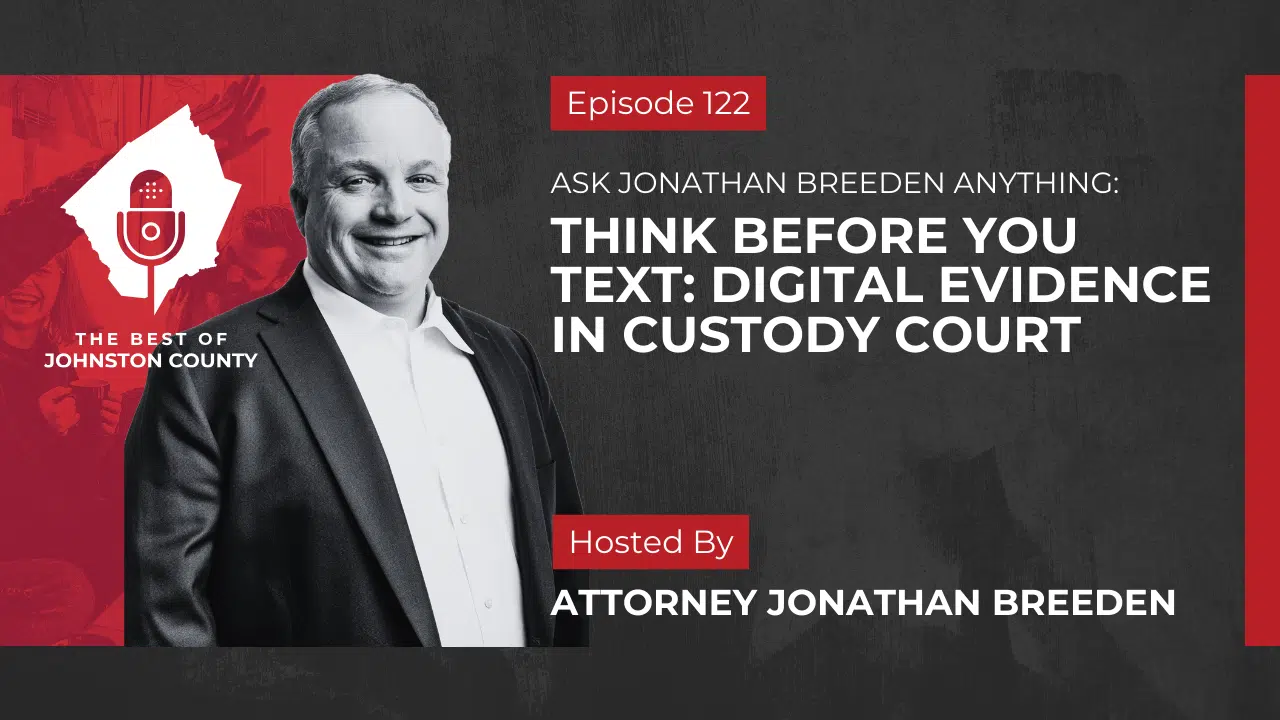
Ask Jonathan Anything: Think Before You Text: Digital Evidence in Custody Court
Jonathan Breeden: [00:00:00] On this week’s episode of The Best of Johnston County Podcast, we’re doing a special edition episode that we like to call Ask Jonathan Breeden Anything. And on this episode, I, Jonathan Breeden answer questions about digital evidence in custody and divorce cases from our social media coordinator Raena Burch.
What is digital evidence? How do you lay a foundation for it? How do you collect it? What can you do with it? Should you have your children try to gather it for you? What happens with the digital evidence once you give it to your attorney? If you have wanted to know about any of these questions or exactly how it works, listen in.
Welcome to another episode of Best of Johnston County, brought to you by Breeden Law Office. Our host, Jonathan Breeden, an experienced family lawyer with a deep connection to the community, is ready to take you on a journey through the area that he has called home for over 20 years. Whether it’s a deep dive into the love locals have for the county or unraveling the complexities of [00:01:00] family law, Best of Johnston County presents an authentic slice of this unique community.
Jonathan Breeden: Hello and welcome to another edition of the best of Johnston County podcast. I’m your host, Jonathan Breeden, and on today’s episode, we have a special edition episode that we like to call Ask Jonathan Breeden Anything.
And in these episodes, our social media coordinator, Raena Burch ask me, Jonathan Breeden Common family law questions that we deal with in our office here at the Breeden Law Office every single week in most of our episodes. For those of you that listen on a regular basis, know that this is a community-based podcast where we interview interesting people in the community, from small business owners to community leaders to nonprofits and anybody else that we find interesting doing great things here in Johnston County. But every once in a while we do these special edition episodes that we call Ask Jonathan Breeden, anything where we talk a little bit about family law which is what we do here at the Breeden Law Office.
But before we get to that, I’d like you to like follow and [00:02:00] subscribe to this podcast wherever you see it, whether on Apple, Spotify, YouTube, TikTok, X, or any of the other social media channels of The Best Of Johnston County Podcast. The Best Of Johnston County Podcast comes out every single Monday and has now for over two years.
So we’re well over a hundred episodes now. So go back and listen to some of our previous episodes. We’ve had the vast majority of the county commissioners we’ve had now Congressman Brad Knott, when he was a candidate. We’ve had Chris Johnson, Johnston County Economic Development Director. We’ve had Adrian O’Neal twice from Johnston County Parks and Rec.
We’ve got tons and tons of great guests. If you love Johnston County as much as I do, this is the podcast for you. Welcome, Raena.
Raena Burch: Hi. All right, so are we ready for today?
Jonathan Breeden: I’m ready for today. I’m glad you sort of gave me a heads up so I can think about it.
Raena Burch: All right, so briefly. So today we’re gonna talk about digital evidence in a custody court case, because with technology and, you know, everything constantly evolving all the time, people wanna know, you know, what counts, what’s proof, what do you have to do, how do you show it, [00:03:00] how do you present it, all of that.
So the first question is, what is digital evidence? Like, what is considered digital evidence?
Jonathan Breeden: I mean, digital evidence really is any evidence that isn’t physical evidence, right? Like so text, emails, videos, social media post. Anything that is created using your phone or computer or camera really ’cause pictures as well.
Raena Burch: Yep.
Jonathan Breeden: You know, would be digital evidence. So it’s not, you know, we think of physical evidence back in the days I did criminal law, fingerprints, shoeprints, blood, DNA lot of that in the criminal world, right?
Raena Burch: Yes.
Jonathan Breeden: And then of course there’s a lot of digital evidence in the criminal world, including.
Raena Burch: Oh yes.
Jonathan Breeden: Where your phone pinging near, you know? Your phone is ping near that cell tower, which puts you in the location of when the crime happened.
Raena Burch: Yep.
Jonathan Breeden: So, unless you could prove somebody else had your phone, pretty good evidence that you’re gonna be there. But [00:04:00] yeah, so anything really that it would be evidence, you know, and evidence has to be relevant, right?
Raena Burch: Yes.
Jonathan Breeden: So we talk about this all the time. So, you know, the courts are going to, and family court, they’re going to accept all relevant evidence, which means it has to be gain lawfully and all that we’re talking about over that in a few minutes. You know, and you know, you have to be able to lay a foundation, which is crucial.
Raena Burch: Yes. Extremely.
Jonathan Breeden: Particularly in digital evidence. That’s always the hardest part of digital evidence is the foundation of how did you get it? How do we know it’s real? How do we know? It hasn’t been.
Raena Burch: Edited.
Jonathan Breeden: Altered, edited in any way, that kind of stuff. But really you’re looking at, I mean, you’re really looking at sesame relevant, which means it has to assist the trier of fact in family court, a district court judge in making a determination on whatever subject matter that that district court judge is making a decision on that day.
Raena Burch: Mm-hmm.
Jonathan Breeden: You know, partying on TikTok probably is not great for [00:05:00] custody. But does it really anything to do with child support? You see what I’m saying?
Raena Burch: Yeah.
Jonathan Breeden: So it has to be relevant. So not,
Raena Burch: Yeah. And those are two, those are two separate courts in North Carolina.
Jonathan Breeden: Right. Two separate courts. Child support and custody are two separate courts, right?
Raena Burch: Yes.
Jonathan Breeden: So, so that’s why I’m saying, you know, it has to be, it has to be relative.
Raena Burch: Yes.
Jonathan Breeden: You have to be a lay foundation. It has to be relational to what is being heard that day. And if it is, and you know you can lay all that, then the court will receive the evidence. Now what the court. What weight the court gives to any evidence
Raena Burch: Yes
Jonathan Breeden: that it receives is beyond me.
Raena Burch: Yeah.
Jonathan Breeden: I mean, I, I’ve been doing this 25 years. I don’t know what judges think. I mean, I, I mean, you think, you know, and then they do something completely different.
Raena Burch: Yep.
Jonathan Breeden: But you know, they’re elected to do the job and they’re doing the best they can. So so that’s kind of, kind of what it is.
Raena Burch: Okay. And like you said, the foundation will, not, screenshots are important, but you have to prove where you got it, where it came from.
Jonathan Breeden: Right. Well, I mean, right. I mean,
Raena Burch: how you got it
Jonathan Breeden: right. I mean, you start thinking about the foundation of, you know, right. Where did it come from?
Raena Burch: [00:06:00] Mm-hmm.
Jonathan Breeden: You know, has it been altered? You know, what evidence can you bring that the person posted it.
Raena Burch: Mm-hmm.
Jonathan Breeden: That’s always questionable.
Raena Burch: Yep.
Jonathan Breeden: You know, people get, people’s, Facebooks get hacked all the time.
Raena Burch: Yeah.
Jonathan Breeden: People allow other people, particularly famous people to post under their name and image.
Raena Burch: That’s true though. Yeah. You take over all this stuff.
Jonathan Breeden: Right. You routinely post for me.
Raena Burch: Mm-hmm.
Jonathan Breeden: ‘Cause that’s your job working for me.
Raena Burch: Yep.
Jonathan Breeden: I don’t always see what you’re gonna post before it gets posted.
Raena Burch: Yep.
Jonathan Breeden: So if it gets posted. Are you speaking or am I speaking?
Raena Burch: Yeah. Right. Mm-hmm.
Jonathan Breeden: Well, from the business standpoint, the business is speaking.
Raena Burch: Yes.
Jonathan Breeden: And, but once again, I didn’t post it.
Raena Burch: Mm-hmm.
Jonathan Breeden: It’s on my webpage, but like
Raena Burch: Yeah.
Jonathan Breeden: I mean,
Raena Burch: and that’s why I have business insurance in case it, you know, if God forbid anything were to harm your business accidentally, obviously I’d never do that on purpose.
Jonathan Breeden: Right. So,
Raena Burch: but that kind of thing,
Jonathan Breeden: So right, so, so you have to have. You know, screenshots can be good. You have to [00:07:00] have some evidence or proof that they’re the ones who actually posted it.
Raena Burch: Mm-hmm.
Jonathan Breeden: Oftentimes it would only, you know, some of the stuff that’s posted would be only stuff that they know.
Raena Burch: Mm-hmm.
Jonathan Breeden: And you can look at the postings around it to sort of show, okay, well they’re clearly in charge of this.
Raena Burch: Yes.
Jonathan Breeden: They’ve been posting this and my experience is. If you ask people, did you post this? Most of the time they’re gonna tell you the truth. They’re supposed to tell you the truth.
Raena Burch: Yeah.
Jonathan Breeden: But you, you know, as far as that’s concerned. Same thing with text messages, you know, we do sometimes have problems with text messages because people send text messages from other people’s phones
Raena Burch: pretending to be someone else.
Jonathan Breeden: Correct. I mean, we definitely had girlfriends and new wives texting from husband’s phone or child’s father’s phone telling the child’s mother what they think of them. And that’s not good.
Raena Burch: Nope. Don’t do that.
Jonathan Breeden: Right.
Raena Burch: Don’t do that.
Jonathan Breeden: Don’t do that. But that does happen. And then [00:08:00] sometimes the person whose phone it is does send them.
So, you know, my advice is don’t let any, anybody, particularly if you’re headed to a divorce or you’re in a custody case or any of this stuff, don’t let anybody post anything underneath your name.
Raena Burch: Yeah.
Jonathan Breeden: Whatever it is. Whatever is sent.
Raena Burch: Mm-hmm.
Jonathan Breeden: It needs to be from you by you.
Raena Burch: Yeah.
Jonathan Breeden: And you need to think real hard about, do you want this played out loud in a courtroom full of strangers? In front of a judge
Raena Burch: Yes
Jonathan Breeden: before you send it.
Raena Burch: Mm-hmm.
Jonathan Breeden: Because once it’s been sent. The genie’s outta of the bottle.
Raena Burch: Yep.
Jonathan Breeden: Put back and you’re not pulling the back. And if it’s negative and it’s a bad light, you can 100% guarantee that the other lawyer’s gonna get it. And you’re gonna be on a court, you’re gonna be on a stand in a courtroom reading it, being asked, did you send this?
Why did you send it? And how is this text message, video, whatever, in the [00:09:00] best interest of your child.
Raena Burch: Mm-hmm.
Jonathan Breeden: And
Raena Burch: good luck.
Jonathan Breeden: Good luck. Because it is not good.
Raena Burch: No.
Jonathan Breeden: And that fit of anger or rage or whatever, because something happened probably 12, 18, 24 months before this trial that caused you to, in a fit of anger, to send that text in about 20 seconds, it’s gonna come back to haunt you.
Raena Burch: Yep.
Jonathan Breeden: And so you should not be doing that, right. No. Once again, this digital evidence. Is absolutely damning. I have won so many cases
Raena Burch: Yes
Jonathan Breeden: off of just the digital evidence.
Raena Burch: Mm-hmm.
Jonathan Breeden: And the other side gave it all to me because they did it.
Raena Burch: Yep.
Jonathan Breeden: Right. They sent the text, they left the voicemail, they made the messages, they did all, they sent the emails.
They did all of this for me to show.
Raena Burch: Yep.
Jonathan Breeden: That they were not in it for the best interest of the child. They basically were [00:10:00] mad that a relationship was over. Yeah. And they were gonna tell that other person what they thought of them and their ability to parent and all of that stuff, which accomplished nothing other than cost them significant custodial time with their children. ‘Cause the judge didn’t like.
Raena Burch: Yep. Yeah.
Jonathan Breeden: But I mean, that’s, that’s how it goes. But you could, don’t post anything. That you don’t wanna see in a courtroom.
Raena Burch: Yep. And especially in the, the court ordered family apps, everything you do in there, every single thing you do in there is admissible in court.
Jonathan Breeden: Correct? Correct. Right. So, right. So if you’re dealing with, if you’re dealing with Our Family Wizard, which is the most popular of the parenting apps that are out there. Mm-hmm. And these are for high conflict cases where people really struggle to communicate
Raena Burch: Yep
Jonathan Breeden: in a positive manner. Our Family Wizard is an app cost about a hundred dollars a year. And in that app you can do, you can send text messages, you can upload pictures, you can upload receipts if you’re need to be reimbursed for medical bills. There’s a calendar with all of the child’s doctor’s appointments, doctor’s names, all [00:11:00] of that gets put in there. Nothing can be deleted. It shows when it’s posted, it shows when it’s read, and it even tells you if you start to send a message.
If you get the part that says it gives you a tone meter yes. That says maybe this tone is not good. Maybe fix it. And, and you need to tone your tone down with the words you’re using. Mm-hmm. And your lack of punctuation. And so you know that that’s been a good one. There are several other parenting outs out there.
Definitely our family winners is the most popular one, at least at Wake, Johnston and Harnett Counties. And everybody has access to it. Including the judge
Raena Burch: Yep.
Jonathan Breeden: Including your attorneys and can go look at it at any time to see what’s going on. And those are deemed automatically admitted.
Raena Burch: Yes.
Jonathan Breeden: So don’t let, we’ve had it where the new girlfriend or new wife
Raena Burch: mm-hmm
Jonathan Breeden: has been on OFW given their opinion of somebody, and it’s assumed that you did it because, you know, like, and it’s admissible.
Raena Burch: Yeah. They can’t make their own account. You have to,
Jonathan Breeden: they can’t make their own account.
Raena Burch: Right. You have to give them permission to make an [00:12:00] account.
Jonathan Breeden: Correct.
Raena Burch: So you’re, you’re an accomplice.
Jonathan Breeden: Yeah. So it’s, it’s really, really not a good situation, but you really have to be thinking. And if you’re, you know, like you want to make sure that what you have out there. Particularly if you think you’re headed for a divorce or you’re in the middle of a divorce or a custody case is positive information that you would want a judge to see.
Because if it’s out there, the odds are you’re gonna end up seeing it
Raena Burch: again. Yes. Again and again. So how do you collect like this digital evidence in the right way? ’cause there’s many wrong ways to do it, but what’s the right way to do it?
Jonathan Breeden: You know, I mean, I think for Facebook. Screenshots are okay. Yeah. You know what I mean? But you can also upload, there are tons of apps and websites . Where you can upload Facebook, you know, there, or you can there’s definitely text, there’s definitely text apps out there where you can put your text in there and then they’re going to capture it.
The [00:13:00] biggest thing with text and emails is that they not be edited. And that if you intend to introduce emails or text, you need to do the entire chain.
Raena Burch: Yes.
Jonathan Breeden: There’s a lot of select, sometimes editing of text messages and emails where one side sends an innocuous text. Like, how is the daughter. Jessica doing today.
Raena Burch: Yeah.
Jonathan Breeden: And the other parent writes back, great. And then the next email is, you really are a horrible slutty mom. And then the person writes back, why are you saying those to me? You are kind of not a very nice guy. And then when you get into court, the part about calling the person a horrible slutty mom.
It’s not there.
Raena Burch: It’s weird.
Jonathan Breeden: Right? And that’s why it is crucial that you not delete any of your text messages between you and the opposing [00:14:00] party ever because you need to be able to pull your phone out if they are showing edited text chain, which happens all the time, and be able to say, here’s my version judge in my phone in raw form to where you can see which text got deleted.
Raena Burch: Yep.
Jonathan Breeden: And so that’s important as well. But, but there are apps and stuff where you can, you can upload these texts and emails and it will put ’em there and, and, and organize ’em.
Raena Burch: Mm-hmm.
Jonathan Breeden: They need to be, they need to be in time synchronous
Raena Burch: chronological
Jonathan Breeden: order, chron, chronological order. So it can be read. They don’t need to be edited or deleted or changed in any way. Same thing with pictures. If you want to introduce a picture into a, into a court case, you have to be able to testify that you took the picture or you were present if you’re in the picture, that you were present when the picture took place.
Raena Burch: Yep.
Jonathan Breeden: That it fairly and accurately represents. The time and what was in the picture at the time the picture was taken, that the picture has not been photoshopped and edited [00:15:00] in any way, and that the picture would help support some testimony that you’re offering that the kids and I have fun on vacation, or these are the kids, this is my house and this is the kids’ bedrooms and this is our living room and this is our yard, and stuff like that.
Because Photoshop’s real easy. Now all of our iPhones have Photoshop technology. You can shop people into pictures, you can shop people out of pictures.
Raena Burch: Yep.
Jonathan Breeden: AI makes pictures all the time. So this is actually getting harder for judges and attorneys rather than easier as there’s more and more stuff out there.
Raena Burch: Yeah.
Jonathan Breeden: And so it really becomes important that you have to be able to lay the foundation that the person did it, and if, and if you didn’t do it or you’ve seen something that you know you didn’t do or is not right, you need to be standing on your head going, I didn’t make it. I didn’t send it.
Raena Burch: Mm-hmm.
Jonathan Breeden: Here’s a text change. I can show you the, I mean, we did one the other day, Raena, where the mom had removed. 15 or 20 text out [00:16:00] of a hundred text chain, and it completely changed the dynamic, the entire conversation that was being presented. And her attorney didn’t even know it had happened.
Raena Burch: Oh no.
Jonathan Breeden: We, like, our client is like, that’s not right.
Pulls his phone out and we literally go through it in court.
Raena Burch: Mm-hmm.
Jonathan Breeden: And it’s like, and it was just, it was terrible.
Raena Burch: Yeah.
Jonathan Breeden: And the other attorney felt bad because she assumed she’d been given something that was correct.
Raena Burch: Well, yeah,
Jonathan Breeden: but it was not correct.
Raena Burch: Yeah. That’s one thing. Always tell your, tell your attorney everything.
Literally everything. There’s attorney client privilege. They’re not gonna be mad. Well, they might be mad at you, but tell ’em everything because it’s only gonna, they’re only trying to help you. That’s their job. Please do that.
Jonathan Breeden: Right. There’s no, there’s no doubt about it.
Have family law questions? Need guidance to navigate legal challenges? The compassionate team at Breeden Law Office is here to help. Visit us at www. breedenfirm. com for practical advice, resources, or to book a consultation. Remember, when life gets messy, you don’t have to face it [00:17:00] alone.
Raena Burch: All right. So also to your point when you said there’s apps, there’s tools on Facebook, there’s tools on TikTok, there’s tools on most social media places platforms that have an option to download all of your data all at once.
So you don’t have to go through, keep scrolling and keep scrolling and wait for it to load and wait for it to load. They have those tools built into those platforms, please use them to save yourself and your attorney some time.
Jonathan Breeden: Right. And you need to try to make sure when you’re doing that you’re getting timestamps. Date and timestamps.
Raena Burch: Yes.
Jonathan Breeden: Are crucial to when stuff is ’cause.
Raena Burch: Absolutely.
Jonathan Breeden: I mean, like when it’s posted on Facebook, the picture might be a year old or 30 years old, right?
Raena Burch: Yeah.
Jonathan Breeden: And so that becomes very well, very important as well, especially as you start to build a chronological timeline, particularly if you’re trying to show a pattern of abuse or negative behaviors.
Raena Burch: Yes.
Jonathan Breeden: You know, I think that’s important.
Raena Burch: Yep. And to your point, that’s what you’re trying to do in any custody court case is not, you’re not trying to show the judge all these isolated incidents unless they’re really, really [00:18:00] bad isolated incidents. But you’re trying to show a pattern of behavior ’cause the pattern is what’s gonna win your case?
Jonathan Breeden: Correct.
Raena Burch: Not the isolated incidents.
Jonathan Breeden: Correct. I mean, if the isolated incident is bad enough, yes. But a pattern of behavior is important and if you can show. You know that the other parent is being abusive and, and not acting in the best interest of the child, because that’s ultimately what the judge is there to decide in a custody case.
And you know what you wanna do, particularly if you’re the object of the abuse is be able to, you know, if the judge sees a pattern of abuse towards you. They will start to assume or can start to deduce that the child is gonna receive a similar level of abuse. From that parent and maybe limit that parent’s opportunities to parent to sort of shield that child.
Raena Burch: Yeah.
Jonathan Breeden: And so that’s, that’s important as well.
Raena Burch: Exactly. So we kind of already touched on this with the, you know, don’t delete, don’t edit, don’t alter, definitely don’t cherry pick your evidence. But what are some other things that people should not do with their [00:19:00] digital evidence?
Jonathan Breeden: Well, one thing is once you’re in a case. You shouldn’t be going back and deleting everything. Right? Like you’re in a case that evidence needs to be preserved. Right?
Raena Burch: Yes.
Jonathan Breeden: You know, so we don’t need to be trying to hide it, like.
Raena Burch: No.
Jonathan Breeden: You know, it’s probably not good that it’s out there, but you definitely don’t need to add to it for sure.
Raena Burch: Yeah.
Jonathan Breeden: What was the question?
Raena Burch: Oh, is what should you not do when it comes to digital? So we talked about like, don’t delete, don’t cherry pick, whatever.
Jonathan Breeden: Right.
Raena Burch: But also like recording, ’cause lots of people record.
Jonathan Breeden: Right well, in North Carolina it’s a one party consent state to record a conversation.
Raena Burch: That’s important.
Jonathan Breeden: So you can record any conversation that you are a party to
Raena Burch: mm-hmm
Jonathan Breeden: without the other side’s knowledge, but you gotta be a party to the action.
Raena Burch: Yes.
Jonathan Breeden: So you cannot be recording the child and the other parents’
Raena Burch: mm-hmm.
Jonathan Breeden: Interactions because you’re not a party to that conversation unless you get specific permission from the court to able to do that in a really, really high, complex case. And that is very, very rare.
Raena Burch: Yes.
Jonathan Breeden: You know, you [00:20:00] should not be. You know, wiring up the baby’s diaper bag to where it’s recording
Raena Burch: Yeah
Jonathan Breeden: what’s happening at the other parent’s house, because again, you’re not part of that conversation. You should not put a recording device in the other parent’s car.
Raena Burch: Mm-hmm.
Jonathan Breeden: And record them because you’re not part of that conversation. I don’t care if you’re still married and living together, you’re not supposed to be recording. And these are all things I’ve seen
Raena Burch: Yes
Jonathan Breeden: in the last
Raena Burch: Oh yeah
Jonathan Breeden: six months for sure.
Raena Burch: Oh yeah.
Jonathan Breeden: Like these are not new.
Raena Burch: It happens all the time.
Jonathan Breeden: It happens all the time.
Right. So I mean, yeah.
Raena Burch: And then, and then you’re going from family court to criminal court at that point, so,
Jonathan Breeden: right. I mean, you gotta be, you gotta be real careful. You cannot hack into somebody’s email or fault. If you know the password to their phone and if you know the password to their email, then you have the right to access it and see what’s in there.
But you do not have the right to hack in or guess the password to the phone or guess the password to the email. [00:21:00] So that would be against the rules. A common mistake we see is the parents or the, everybody has a shared computer at the house.
Raena Burch: Yes.
Jonathan Breeden: Kids, parents, everybody has a computer and one parent, and they people save their passwords.
Raena Burch: Yep.
Jonathan Breeden: In the browser, right?
Raena Burch: Yep.
Jonathan Breeden: It makes it easy
Raena Burch: all the time.
Jonathan Breeden: I do it. You do it Raena and then if it’s saved in the browser, then you have to presume that anybody that has access to that computer can get in and so has permission. Right. So a lot of the evidence we get that is damning against people.
Raena Burch: Mm-hmm.
Jonathan Breeden: You know, comes from family computers.
Raena Burch: Yeah.
Jonathan Breeden: Where the pass either the email is left open or the password is saved on the computer and the other side just goes, click, click. And then that’s not illegal. They gathered information of affairs or whatever that they come up with.
Unfortunately, we’ve found other stuff that was more criminal than just extramarital affairs.
Raena Burch: Yeah.
Jonathan Breeden: And Bobby minors and stuff like that. We don’t need to get in and out on this podcast. I wanna keep [00:22:00] my clean rating from Apple, but, but you know, I’m just saying like, so, so that’s the thing, you know if you do not know the password to your spouse’s phone and they will not give it to you. You probably have a problem.
Raena Burch: I would say so.
Jonathan Breeden: Yeah. I mean, I’m just being honest. I’m not saying legally they don’t have to give it to you, but if you don’t have it, you gotta be asking
Raena Burch: why,
Jonathan Breeden: what’s being hidden from me? Yeah. Right now I’m just being honest.
Raena Burch: Mm-hmm.
Jonathan Breeden: You know what I’m saying? Yeah. I mean, it, it is what it is and you know, it’s, it’s unfortunate.
Raena Burch: Agreed. Yeah. And. One final thing I would say like, don’t involve your kids.
Jonathan Breeden: Absolutely. Your kids.
Raena Burch: Please don’t involve your kids.
Jonathan Breeden: Right, don’t have your kids trying to gather evidence. Don’t have your kids make recordings. Don’t have your kids taking pictures of what they’re doing over there and sending it to you. Don’t be asking them to be your detectives. That is not a place for children. That is bad for their development. They love both parents as much as they love each parent, and if a court finds [00:23:00] out that you were using your kids to gather evidence, they will likely take a lot of your custody away from you.
I’ve seen that repeatedly. So don’t be doing that at all.
Raena Burch: No.
Jonathan Breeden: It’s terrible. It puts the kid in an awful position. They don’t wanna disappoint anybody.
Raena Burch: Yeah.
Jonathan Breeden: It’s also gonna ruin their trust from their natural parent to them if they get caught doing it and they’re going to get caught because their kids and that’s just how it gets.
Raena Burch: Well, even if they don’t get caught, if you present that evidence in court, then you’re telling the other parent.
Jonathan Breeden: Right. Well then you have to have the child to come lay the foundation.
Raena Burch: Yeah.
Jonathan Breeden: To say, I made this recording. I took this picture. And that’s really bad. And I’ve had that happen.
Raena Burch: Yeah.
Jonathan Breeden: And, and that’s a horrible place for a child to be. And judges don’t like it. And attorneys don’t like it.
Raena Burch: Yeah. Nobody likes that. All right. So
Jonathan Breeden: what I would tell people is hire a private eye. If, if you want to gather evidence, if you don’t like what’s going on or think there’s a problem, get a private eye. There’s tons of ’em in the triangle. They’re not nearly as expensive as you think, and they are very good at gathering evidence [00:24:00] and documenting everything and getting evidence into place with what they’re able to do.
Raena Burch: Yeah, and I can guarantee your list has your list, your attorney has a list of people that they can recommend.
Jonathan Breeden: Absolutely.
Raena Burch: Okay. Four. How should they organize the digital evidence?
Jonathan Breeden: I think each form of it, whether it be TikToks, Facebook, text messages or emails should be put into chronological order. They should be put on, if you wanna give it to your attorney, you can upload it to your attorney’s shared drive, or you can put it on a thumb drive and bring it to them. You do not want to be writing on these exhibits or, you know, highlighting or circling or writing out to the side. You know, Raena, Jonathan, whatever.
Like, you don’t wanna be doing that, right? They need to be in their form as is. Your attorney can point stuff out and go through it like that. I do think you should do that on one copy so the attorney and you can go through it and decide what’s gonna be evidence. But what ultimately gets used needs to be [00:25:00] clean, unaltered, no squiggly lines, nothing writing, nothing highlighted, or any of that. So its in its natural state.
Raena Burch: Yes.
Jonathan Breeden: Even though it’s probably gonna be printed out on a sheet of paper when they do it.
Raena Burch: Yeah.
Jonathan Breeden: So I would definitely advise that, do it early, right. These cases can take a long time to get to court. You know, it can easily be, you know, 3-4 months for a temporary custody hearing 12, 18, 24 months for a permanent custody hearing in our Counties, there’s not enough judges, not enough courts. It is what it is. But you need to be putting this together as it goes.
Raena Burch: Yes.
Jonathan Breeden: Almost like a diary of stuff every month. Take a couple hours and put together what you think might be helpful from that month to prove whatever part of the case you’re trying to prove and keep your lawyer updated.
The last thing you want to do to your attorney is show up 48-72 hours before trial with 3 or 400 text messages. Expect them to be able go through them, organize them, and get ’em ready and use at trial. And unfortunately that does happen to [00:26:00] us and it makes it to where a lot of stuff gets missed.
Raena Burch: Yep.
Jonathan Breeden: And that’s not good.
Raena Burch: Yeah. Think of it as your digital journal.
Jonathan Breeden: Correct.
Raena Burch: Just, just do that every
Jonathan Breeden: Correct
Raena Burch: if you can’t do it every day, once a week or once a month.
Jonathan Breeden: Correct.
Raena Burch: Just keep it updated
Jonathan Breeden: and, and if you have any questions about something you wanna post and you wonder how it might be received, call a friend, phone a friend,
Raena Burch: mm-hmm
Jonathan Breeden: call your lawyer before you put it up there. Not after it. Because once it goes up and you’ve seen with celebrities, somebody’s gonna screenshot it and they’re gonna have it. Even if you take it down in like 10 minutes.
Raena Burch: Mm-hmm.
Jonathan Breeden: Once it’s, it’s up. Right. The other thing is these kids now all have phones. I don’t know if that’s a good thing. You know, we had. You know, we had the, we had 180 counseling Ms. Coats on.
Raena Burch: Yep.
Jonathan Breeden: She wasn’t a big fan of phones for kids. Unfortunately. Kids do have phones now. They also have social media. Kids are gonna see it. And that’s not good. So if you’re on there and you’re telling people that their father is a not very good person they’re gonna see that [00:27:00] and that my, and, and while you didn’t say it to them once they see it.
That’s gonna cut them, right? Like it’s like stabbing them in the heart. If you are criticizing the other parent, and I don’t care what that parent did, you are basically stabbing that child in the heart because that child is both parents and loves both parents and is gonna blame themselves for whatever negativity you’re placing on the other child.
It is completely natural for children in their development to do that, and you don’t wanna do it and it’s not healthy.
Raena Burch: Got it. And so. Also, like you said, use Google Drive, whatnot to help with keeping everything organized. Folders, binders
Jonathan Breeden: correct
Raena Burch: tabs.
Jonathan Breeden: Correct.
Raena Burch: All of that. Like you said, don’t write on the evidence. ‘Cause that could be considered editing it.
Jonathan Breeden: Correct.
Raena Burch: So if you’re going to take a binder to court, have a court binder, and then have a notes binder so that,
Jonathan Breeden: that’s fine.
Raena Burch: You can keep them separate,
Jonathan Breeden: right? Yeah, no, and what I do is on my copy of the exhibits, I will often have the one with the notes on it, or I’ll have the one with my notes on it.
Raena Burch: Mm-hmm.
Jonathan Breeden: But the one the judge sees and the witness has, has to be a clear, clean [00:28:00] copy and then the other opposing, opposing attorney gets,
Raena Burch: mm-hmm.
Jonathan Breeden: So yeah, you can have it, but if you go ahead and write on it before you bring it to me, if I make a copy, your writing’s all over it. It’s not gonna be admissible.
Raena Burch: Exactly.
Jonathan Breeden: So anyway. Well, anyway, that’ll probably have to do it for this one. You got any more questions?
Raena Burch: I’ve got one more.
Jonathan Breeden: Okay.
Raena Burch: One more.
Jonathan Breeden: Okay.
Raena Burch: All right. So, and then how do you use the digital evidence in court?
Jonathan Breeden: Okay. Digital evidence used in court, we often will print it out. That is the most common way of, we print out the Facebooks, we print out the text messages, we print out the emails, we put ’em in binders, and then we give ’em exhibit numbers and we go through it in chronological order or whatever theory of the case we have.
And we have the, our client or the other side read it out loud most of the time. Another thing like. What is this gonna sound like? Being read out loud to a court out loud to a court for the strangers. We’ll have them read it out loud and talk about why they wrote it, what they were trying to do.
Raena Burch: Yep.
Jonathan Breeden: Now some things, voicemails, we’ll put on a thumb drive, we’ll play on a laptop.
Raena Burch: Videos.
Jonathan Breeden: Videos. We will play on a laptop. We’ll put on a thumb drive so the court has it, but we [00:29:00] will also play it in court. To the court, to the judge on a laptop as well. So there’s different ways to do it. Sometimes on a laptop, sometimes on a thumb drive.
And but oftentimes paper.
Raena Burch: Yeah.
Jonathan Breeden: Because that’s the easiest thing. And the court doesn’t wanna have to keep up a bunch of thumb drives, but.
Raena Burch: No.
Jonathan Breeden: It can keep up with the paper.
Raena Burch: Yes.
Jonathan Breeden: So anyway,
Raena Burch: and the whole purpose of all of this is to show a pattern of behavior.
Jonathan Breeden: Right. Which is Right. And you don’t want to help the other side show your behavior pattern to be not one that is in the best interest of the child.
Raena Burch: Yes.
Jonathan Breeden: So be thinking about it, what you do and how you say things because it’s not good. You’re not scoring any points or winning any awards for telling the other side what you truly think of them in a text or an email, nothing gets accomplished.
Raena Burch: Yeah.
Jonathan Breeden: So anyway we’d like to thank Raena for coming on and being helping us with this special edition of The Best Of Johnston County Podcast. Ask Jonathan Breeden anything where we discuss digital evidence. If you have a case or are interested in how digital evidence may affect your divorce or your custody case.
[00:30:00] Give us a call here at the Breeden Law Office so we’d be glad to help you. You can reach out to us at BreedenFirm.com. Be glad to talk to you about what you have or what you don’t have. Put you in touch with private detectives if you wanna maybe do something like that. But remember, you are creating this.
So you were in control. This is not somebody putting something onto you, so be thinking of it that way as well. Like we mentioned earlier, please like, follow, subscribe to this podcast wherever you see it, whether it be on Apple, Spotify, YouTube, TikTok, X or Instagram so that you be made to aware of future episodes of The Best Of Johnston County Podcast.
Best Of Johnston County Podcast comes out every single Monday and has, like we said earlier, for over two years. So until next time, I’m your host, Jonathan Breeden.
That’s the end of today’s episode of Best of Johnston County, a show brought to you by the trusted team at Breeden Law Office. We thank you for joining us today and we look forward to sharing more interesting facets of this community next week. Every story, every viewpoint adds another thread to the rich tapestry of Johnston County.[00:31:00]
If the legal aspects highlighted raised some questions, help is just around the corner at www. breedenfirm. com.
What Counts as Digital Evidence?
Digital evidence is almost anything created or stored electronically.
Text messages.
Emails.
Voicemails.
Social media posts.
Photos and videos.
Parenting apps like Our Family Wizard.
If it lives on a phone, computer, or tablet, it can likely show up in court.
But here is the key. Evidence must be relevant. In custody court, the judge is focused on one thing above all else: the best interest of the child. If your TikTok video or late-night text does not relate to that, it may not matter. If it does, it can matter a lot.
Jonathan put it plainly. He has won many cases based almost entirely on digital evidence. Not because someone hacked anything. Not because of complex forensics.
Because someone sent the message themselves.
The Golden Rule: Don’t Send What You Wouldn’t Read in Court
Before you send a text, post on Facebook, or leave a voicemail, ask yourself one question:
Would I want to read this out loud in front of a judge?
Because that is exactly what may happen.
One angry text sent in 20 seconds can resurface 18 months later in a courtroom. You will be asked:
Did you send this?
Why did you send this?
How was this in the best interest of your child?
Judges are human. Patterns of hostility, name-calling, or emotional outbursts do not reflect well on a parent seeking custody.
Digital evidence is powerful because it captures behavior in real time. And once it is sent, the genie is out of the bottle.
Screenshots, Foundations, and Why Context Matters
Screenshots are helpful. But screenshots alone are not enough.
In court, you must lay a foundation:
- Who created this?
- When was it created?
- Has it been altered?
- Does it fairly and accurately represent what happened?
Chronology is critical. Cherry-picking messages or deleting part of a conversation can backfire in a serious way. Judges want to see the full context, not a curated version.
Jonathan shared how he has seen text chains where key messages were removed, completely changing the meaning of the exchange. Fortunately, the other party still had the original messages on their phone.
The truth usually surfaces.
If you plan to use digital evidence, keep it complete, chronological, and unedited.
Parenting Apps: Everything Is Admissible
In high-conflict custody cases, courts often order parents to use communication tools like Our Family Wizard.
Here is what parents sometimes forget.
Nothing in those apps can be deleted.
It shows when messages are posted and read.
Even tone can be flagged.
And yes, judges and attorneys can review everything.
If you are communicating through a court-ordered app, assume every word is potentially evidence. Because it is.
What Not to Do With Digital Evidence
There are some common mistakes that can seriously damage a custody case.
Do not:
- Delete evidence once litigation has started.
- Edit or alter text messages.
- Hack into accounts or guess passwords.
- Record conversations you are not part of.
- Use your child to gather evidence.
North Carolina is a one-party consent state for recordings. That means you can record conversations you are part of. You cannot secretly record your child’s conversations with the other parent. Doing so can shift your case from family court to criminal court very quickly.
And involving children is one of the worst mistakes a parent can make.
Asking a child to take pictures, record conversations, or spy puts them in an impossible position. Judges strongly disapprove. It can cost you custody time.
If you believe evidence needs to be gathered, hire a licensed private investigator. Do not make your child your detective.
How to Organize Digital Evidence the Right Way
Think of your evidence like a journal.
Update it regularly.
Keep it chronological.
Store it securely.
Use tools like Google Drive or organized folders. Keep a clean copy of all potential exhibits without notes, highlights, or markings. If you want to make notes for yourself, keep a separate working copy.
And most importantly, do not wait until the week of trial to dump hundreds of messages on your attorney.
Custody cases often take months or even years to reach a final hearing. Build your file as you go. Stay organized. Keep your attorney informed.
Preparation wins cases.
How Digital Evidence Is Used in Court
Most digital evidence is printed and entered as exhibits.
Text messages and emails are often read aloud.
Voicemails and videos may be played from a laptop.
Thumb drives may be submitted, but paper copies are common.
The purpose is not to embarrass anyone. It is to show a pattern.
A pattern of cooperation.
Or a pattern of hostility.
A pattern of responsible parenting.
Or a pattern that concerns the court.
You want the pattern that emerges to reflect stability, maturity, and a focus on your child’s well-being.
The Bigger Picture
Digital evidence is not something being “done” to you.
It is something you create.
Every post, every message, every comment contributes to the story the court sees about you as a parent.
You are in control of that story.
Before you hit send, pause. Think about your child. Think about the long game. Think about how a judge might interpret your words months from now.
Because in custody court, digital evidence can either protect your parenting time or permanently damage it.
The choice is often made one message at a time.
Thank you for joining us for this episode of The Best Of Johnston County Podcast. Stay tuned for more conversations that inform, educate, and serve our community.
AND MORE TOPICS COVERED IN THE FULL INTERVIEW!!! You can check that out and subscribe to YouTube.
Connect with Jonathan Breeden:
- Website: https://www.breedenfirm.com/
- Phone Number: Call (919) 726-0578
- Podcast: https://breedenlawpodcast.com/
- YouTube: https://www.youtube.com/@BestofJoCoPodcast
Listen On