
August 31, 2026
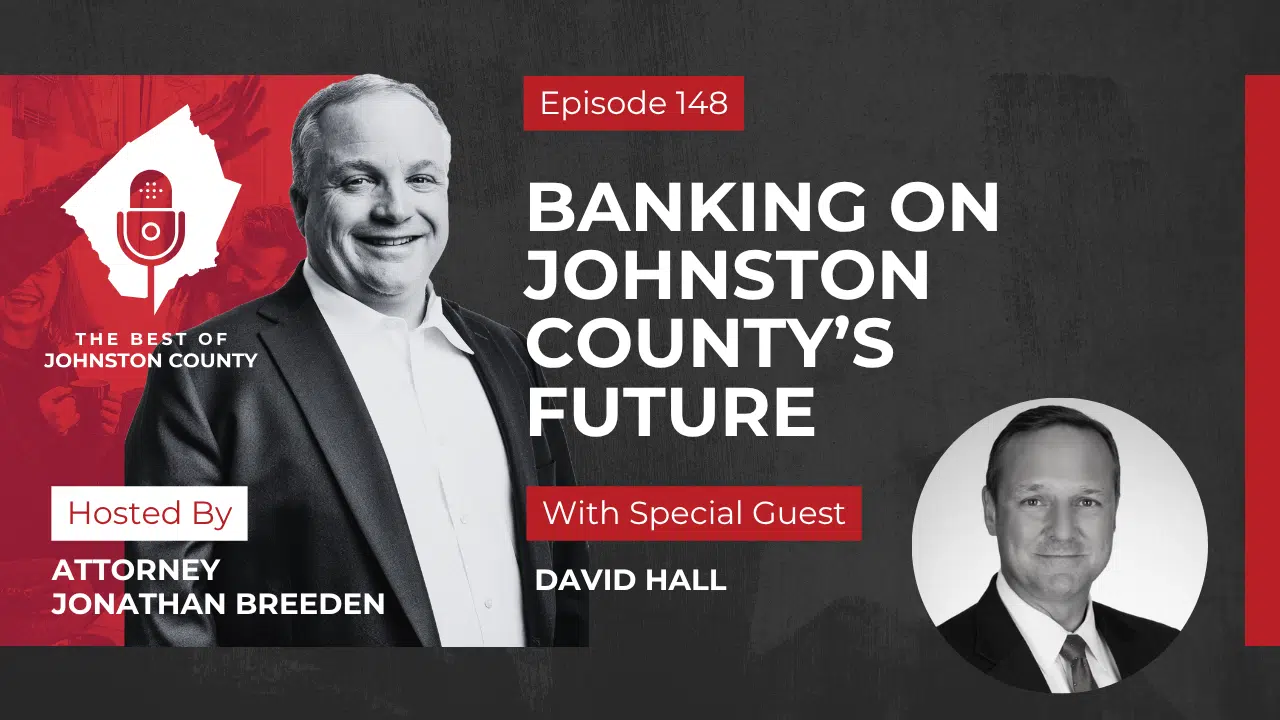
Banking on Johnston County’s Future
Jonathan Breeden: [00:00:00] On this week’s episode of The Best of Johnston County podcast, our guest is David Hall, a commercial lender with First Federal Bank in Clayton, North Carolina. We talk to David about his time growing up in West Virginia, how he got his first job working in a furniture store in Charlotte, how he got to Johnston County, the reason why he loves community banking and the service that he can provide to the citizens of Johnston and surrounding counties, and some of the economic development projects that are going on that are gonna transform Johnston County over the next 10 to 15 years.
So, if you’re interested in community banking or what is coming for Johnston County and how it’s gonna be transformative, listen in.
Welcome to another episode of Best of Johnston County, brought to you by Breeden Law Office. Our host, Jonathan Breeden, an experienced family lawyer with a deep connection to the community, is ready to take you on a journey through the area that he has called home for over 20 years. Whether it’s a deep dive into the love locals have for the county or [00:01:00] unraveling the complexities of family law, Best of Johnston County presents an authentic slice of this unique community.
Jonathan Breeden: Hello, and welcome to another edition of the Best of Johnston County Podcast. I’m your host, Jonathan Breeden, and on today’s episode, we have David Hall with First Federal Bank in Clayton, North Carolina.
We’re gonna talk to David a little bit about his time growing up in West Virginia, how he decided to get into banking after going to Marshall University what brought him to Johnston County, why he switched to First Federal Bank, some of the growth that he’s seeing and where he thinks that growth is headed, and a little bit about some of the leadership talks he is starting to do at churches and community groups around the area.
But before we get to that, I’d like to l- ask you to like, follow, subscribe to this podcast wherever you see it, whether it be on Apple, Spotify, YouTube, TikTok, X, LinkedIn or any of the other social media channels of the Best Johnston County Podcast. The Best Johnston County Podcast comes out every single Monday and has now for over, well, two and, I mean, golly, 32 months now, by the time [00:02:00] this episode runs.
We’re headed up towards three years. Hard to believe that something started with an idea to put positivity in the world and tell the story of people that live and work in Johnston County has gone on to go on for this long, and people still are willing to come talk to us every week so we can keep bringing this to you.
And we’ll keep doing it as long as people listen. So anyway, so like I said, make sure you like, follow, subscribe, ’cause you don’t wanna miss any episodes. We’ve had a lot of great ga- guests in the past, the majority of the county commissioners, lots of small business owners parks and rec director, Adrian O’Neal tons of great guests.
So go back and listen. A lot of evergreen content that doesn’t get old. So If you love Johnston County as much as I do, this podcast is for you. Welcome, David.
David Hall: Thank you very much, Jonathan.
Jonathan Breeden: All right. Thanks for coming on. We’ve been friends for, golly, 20 years now at least.
David Hall: Jonathan
Jonathan Breeden: Maybe longer
David Hall: we have been friends for 26 years.
Jonathan Breeden: 26 years.
David Hall: I met you standing in the Chamber of Commerce in Clayton when Sally Schlindwein was the director, and you weren’t sure where you were gonna have an office.
Jonathan Breeden: That’s right. I hadn’t even taken the [00:03:00] bar yet.
David Hall: I’d gone to, I went to North State a couple months after that and stayed away for two or three years.
Woke up, came back here to Four Oaks Bank at 4042, and there you were.
Jonathan Breeden: And there I was, right here at 4042.
David Hall: So 26 years later, here we are.
Jonathan Breeden: Well, golly, that is wild. That’s right because I moved to Clayton to study for the bar exam in May, I moved on Mother’s Day, which is also the day I graduated, I think, in May of 2000, and I knew I had to get away from my friends and stuff down in Buies Creek, and I thought, “If I’m gonna stay with the bank, I need to get away.”
So I moved to Clayton, started going to chamber events. Sally Schlindwein Melanie Marlow.
David Hall: Yep.
Jonathan Breeden: You.
David Hall: Yep.
Jonathan Breeden: Kevin, Kevin Creech. These are some of the very first people
David Hall: Yep
Jonathan Breeden: that I met. Kevin had just gotten on with Farm Bureau. We had had a class together at NC State. He was about the only person I knew in Clayton.
So golly, that’s, that’s hard to believe, right? So anyway, and I met your wife, who was not
David Hall: Yes
Jonathan Breeden: your wife at the time.
David Hall: No.
Jonathan Breeden: She was o- Kim. That was also one of the first
David Hall: Yes
Jonathan Breeden: people I met. So it is golly, that’s, that’s crazy. It’s hard to believe.
David Hall: Yeah.
Jonathan Breeden: But we’re still here.
David Hall: We are.
Jonathan Breeden: And we’re [00:04:00] still trying to help our community, which is what we were trying to do 26 years ago.
So, tell us a little about yourself. I know you grew up in West Virginia.
David Hall: I did.
Jonathan Breeden: So a little bit about that and how you got into banking.
David Hall: Well, grew up in West Virginia, in southern West Virginia, a little town called Bluefield, right on the Virginia/West Virginia border. For some of you that don’t know, there is a Bluefield, Virginia.
Jonathan Breeden: Yep.
David Hall: And there is a Bluefield, West Virginia. And our two biggest rivals in the high schools are liter- literally about four miles apart. So, after growing up there, went away to Marshall. Actually went to Marshall a- hoping to be a football player. Got a preferred walk-on offer to come down.
Unfortunately, David, was a Prop 48, and Jonathan knows what a Prop 48 is. I didn’t qualify academically. I had to take an 099 math class, an 099 English class. I got to participate in practices, but I didn’t get to be really on the team. Did all that got through my freshman year, and a lot of people may not realize, but that was the year that Marshall’s [00:05:00] program turned.
The plane crash was in 1970. That year they went on a run and made it to the Division AA national championship. So by the time I was eligible in January to come back, the quality of the recruit that was waiting there in January after making a run to the national championship was, it was a completely different night and day.
The program just changed overnight. It got finished up that year. I did run track in the spring that, or in the fall, in the spring that year And then decided it might be better for me to transition over to rugby. And so, but I did have my first year there, I got to be part of the group with the team, enjoyed it.
Still closely connected to a lot of my good friends, continued to play. My roommate there was a, a successful baseball pitcher from Ohio that played on the baseball team. Was a, just a phenomenal athlete, so I had a great experience at Huntington West.
Jonathan Breeden: Well, that’s great. So you graduated from Marshall.
David Hall: Yes. Well, I graduated from Marshall, and I know most people don’t realize in ’91 and ’92 the economy wasn’t [00:06:00] great. It was a little bit slow. I was dating a young lady whose family owned, believe it or not, a chain of furniture stores. And they were gonna open a store in Charlotte, North Carolina, and I didn’t have a job, and I wasn’t dating her anymore.
But her family called up and said, “Hey, we’re gonna open a store. Do you have a job?” I said, “I don’t.” So they gave me a job. And so I went to Charlotte and sold furniture. Was a furniture salesman.
Jonathan Breeden: I bet you were probably good at that.
David Hall: I was very good at… I’ll tell you what it did do, Jonathan. My heart
Jonathan Breeden: I bet you were good at that
David Hall: I have told people a million times my best day in furniture would not, you know, it, it was such a hard industry to be in. My worst day in banking was easier than my, my best day in, in furniture. But it was a straight commission job, so if you didn’t sell anything, you didn’t eat. And so it did prepare me, but I knew that’s not what I wanted to do.
I was in Charlotte. I had NationsBank, I had First Union. Banking was really big. In North Carolina, you were either gonna be in furniture, you were gonna be in NASCAR, or you were gonna be in banking. And I’d already tried furniture, and they weren’t gonna let me drive the car, so. But no, I really wanted to get [00:07:00] into banking.
I, you, you saw what a big deal it was, and I don’t know if I really wanted to, to be a banker. Jonathan, really what I wanted to do is I wanted to have a job that my kids could come home and be proud of. Not that it was a job making a tremendous amount of money, but a job where they could just come home and say, “Well, what does your dad do for a living?”
They could just say, “He works at the bank.” Because I didn’t have that privilege as a child growing up.
Jonathan Breeden: Right.
David Hall: Some of the things that my, you know, my parents had to do to make a living weren’t the things that you’d be real proud of or real, real respectful of. And so for me, you know, I think it was one of the hardest things ’cause as a child, the first thing that another parent will say if you, if somebody comes over to visit David, the first thing you’re gonna start talking to them about is, you know, everything, “What do your parents do?”
And so you’re always in that awkward moment when you’re at a parent who maybe is doing better in life or in a better position
Jonathan Breeden: Right
David Hall: in life.
Jonathan Breeden: Right.
David Hall: And so for me, going into banking was more about I wanted something that people would respect something that I thought was a respectable profession and that something that my children would look back and say, [00:08:00] “My dad’s a banker.”
Jonathan Breeden: All right.
David Hall: “Love that my dad’s a, an entrepreneur and he’s Elon Musk and he’s making all these inventions. He just works down…” I just wanna be a
Jonathan Breeden: Yeah
David Hall: the everyday dad.
Jonathan Breeden: The everyday dad, right?
David Hall: Every day.
Jonathan Breeden: Well, and you know, and banking is, is reasonable hours.
David Hall: It is.
Jonathan Breeden: You know, not a ton of nights, not a ton of weekends.
David Hall: Nope.
Jonathan Breeden: I mean, it can be, but it doesn’t have to be. Most bankers don’t work nights and weekends.
David Hall: They don’t. And I think I think for a lot of us, probably even like you, Jonathan, going into, into law I think what attracts a lot of people to banking, it’s really a, a job of service. I mean, what we do, y- you’ve been, you saw when I was part of Four Oaks, the things we do in the community I think it extends and probably why I wanna do what I wanna do at the end of my career and help other people is because that’s all I’ve done.
Jonathan Breeden: Right.
David Hall: And I think that’s the thing is you get, you get to make an impact first on the individual if they’re struggling, to help them put together their debts, maybe buy a first house or start their business. And then as you move up, you know, you get to have more influence in the community, the town, the county, and, and then you start doing things like, you know, even though I didn’t get to have a direct role [00:09:00] in the park, we’ve all knew, you know, 15, 16 years ago, we needed a park out there.
Jonathan Breeden: Absolutely. We absolutely
David Hall: And so
Jonathan Breeden: needed a park out here, and, and it, we now have a
David Hall: That’s it
Jonathan Breeden: the, the beginnings of a park, and it’s very nice with pickleball courts and basketball courts and a picnic shelter and a fishing pond and you know, like
David Hall: Yeah
Jonathan Breeden: I mean, that’s, that’s tremendous.
David Hall: And they told us that would never happen, that they wouldn’t
Jonathan Breeden: Well, right. And for the first, yeah, no, I mean, worked on that. I mean, I, I worked,
David Hall: I spoke to a couple county commissioners you know, I know.
Jonathan Breeden: Yeah, no, no. We, we, we both
David Hall: Yeah
Jonathan Breeden: worked on that for, along with a whole lot of other people- Yeah … in this community for, for eight years starting in 2018. To, to get to see that park out here in Cleveland come to fruition is, is, is tremendous.
So what brought you to Johnston County?
David Hall: Actually, a job. I was working for Centura Bank, which was originally out of Rocky Mount, North Carolina, which was a, very good Eastern North Carolina bank. They bought a small bank in Charlotte. Didn’t have a big footprint there.
They had three traditional offices, and we had four or five in-store branches that were in grocery [00:10:00] stores. And so I wanted to be a commercial lender. They didn’t have any opportunities in that market. It was really hard to break in. It’s not as easy to be a commercial lender in some banks as people think.
Some banks, if you get hired in on the retail side and a branch man, that’s where you’re gonna stay. And so they didn’t have a lot of opportunities, and I had a friend that had left to take a job with Triangle Bank, which was headquartered here too in Raleigh. A lot of people don’t realize the building across the street with the blue roof on it from Crabtree was the Triangle Bank headquarters.
So I took a job with them here in Clayton. Well, actually, I took a job with them to work in Dunn but I lived in Clayton. That’s how desperate I was to be a commercial lender. I’d never been to Dunn So I drove down one Saturday, met the people there at the Triangle Bank, said, “You know what? If I wanna be a commercial lender, this is where I’m gonna start.”
Jonathan Breeden: Hey, that’s awesome.
David Hall: And so, you know, lived in Clayton just because, you know, it was closer to Raleigh.
Jonathan Breeden: Right. Central located.
David Hall: And I was, I had become single, and I’m single, and then I didn’t know if Dunn would be the exact market for me at 30. So I stayed in Clayton, and I like Clayton a lot. I mean, hard not to like Clayton.
Jonathan Breeden: [00:11:00] I got you. Well, you ended up with Four Oaks Bank in 2003.
David Hall: Yep.
Jonathan Breeden: And you get assigned out here to 40/42, and then you really were in charge of this branch for.
David Hall: 18 years.
Jonathan Breeden: I mean, 18 years, I think, right?
David Hall: Yeah.
Jonathan Breeden: You were here from 2003 to 2021.
David Hall: Right.
Jonathan Breeden: And you and I watched this entire.
David Hall: It grew up.
Jonathan Breeden: Area just explode.
David Hall: It did, John.
Jonathan Breeden: I mean, you wrote a lot of the business that allowed it to do.
David Hall: I sure did. I sure did.
Jonathan Breeden: So what was it like working with Four Oaks all those years? And of course, it got bought
David Hall: Yeah
Jonathan Breeden: became United Community.
David Hall: I’ll be honest, I think Four Oaks, you know, I look back on Four Oaks as probably the funnest 18 years of my life. You know, it was some, some tough times there getting through ’08 and ’09 and ’10, but I worked with such good people. You know, Ayden Lee really was a good person. You know, he wasn’t a man of a lot of words but he was a gentleman of really high character.
And I think working with him and Cliff Painter Cliff was our chief credit officer, and almost like a second father, and they really took me under their wing.
For the first time in my whole banking career when I got to Four Oaks, I felt like I belonged, and I felt like I belonged in Johnston County. It was a home. I always tease everyone, they tease me for being from West Virginia. I’m like, “Yeah, I don’t think [00:12:00] we have a whole lot to tease about- … with people back home, guys.”
… But I think it was the commu- the sense of community, the people. I felt like I was at home. You know, even when I had a chance to go to Raleigh and move and sell the house, and, and didn’t wanna go there and start, I ended up right back here. And- Right … you know, when our, Haley was born and Kim and I, she was born in ’05, and she was getting ready to start kindergarten in ’10, and Kim said, “You know, I, I didn’t really ever decide just to come to Clayton, you know, we just kinda ended up here in ’91, and then, you know, is this where you, you think we wanna be?”
And I, I scratched my head. I said, “Well, I can’t think of anywhere I’d rather live.” I mean, I can be to the beach in two hours.
Jonathan Breeden: Yeah.
David Hall: And I can be in the mountains in three hours, and there’s a lot of growth and opportunity around me. You know, the area I’m from, everybody has to leave. You know, I didn’t have a choice about staying.
I mean, if I had stayed, I wouldn’t, I wouldn’t have had anything. There was no opportunity. There was no job. I mean, so, you know, here it’s great. I mean, if you have a family and you have young kids or kids, they, they can go away to college [00:13:00] and go wherever, wherever they want to, and they come right back here.
Jonathan Breeden: Right.
David Hall: And they’ve got a job. There, you know, RTP’s here. Cary’s here. Holly Springs. What we’ve got going on in, down here in Clayton with the pharmaceuticals, what’s going on across 95
Jonathan Breeden: Right
David Hall: towards Selma and going east, I mean, I can’t think of a greater place I’d wanna live. And- You know, I’m sorry to the people of Johnston County, but you’re just as much like Bluefield, West Virginia as any place I’ve ever been.
So. I- But it’s, it’s like home, it’s
Jonathan Breeden: Hey, look, I’ve been to Bluefield, West Virginia. Th- some of the nicest people.
David Hall: It is a great
Jonathan Breeden: A couple great restaurants. It is. Like, like, it’s fine. I, I mean
David Hall: It used to be a big town. You know, a, a lot of people don’t understand about my hometown was at one time it was really the biggest place in the southern part of West Virginia.
I wasn’t from a coal mining town, I was from a railroad town, and all the coal mines feed into Bluefield. And honestly, Bluefield probably up until the 1940s or ’50s was one of the biggest towns on the East. I mean, it was, in West Virginia and that part of the country, they had, you know, there’s 12, 14 story buildings.
We had a lot of money in, [00:14:00] that was coming through there. This is when we were building all the, the skyscrapers in New York. All the coal that was being used to make the steel.
Jonathan Breeden: Yeah.
David Hall: ‘Cause you have to use a certain type of coal to get steel.
Jonathan Breeden: Right.
David Hall: To get the coke.
Jonathan Breeden: Yeah.
David Hall: To get it clear enough, and that’s what drove it.
Jonathan Breeden: Right
David Hall: and so, but yeah, it’s a lot like home, and I really enjoy it.
Jonathan Breeden: So, so in 2021, somewhere there Four Oaks gets bought by United Community
David Hall: Yes
Jonathan Breeden: out of Georgia. And then- And- And I, I think you were with United Community briefly.
David Hall: I did. I stayed with United for two years and, you know, I just their banks are, all banks are d- you know, they’re not the same.
And I’m not saying that any bank, one bank’s better than another bank. It’s really what do you prefer. And I think what I got hooked on was small community banking. My first community bank job would’ve technically been with Triangle Bank. And you know, they got, got, I s- I left Centura and went to work for Triangle.
Centura bought Triangle. So that might be why I wasn’t still there.
Jonathan Breeden: Right.
David Hall: So I had to go find another job. And you know, so I think the biggest difference [00:15:00] is, is with a bank like us or a bank like KS or a bank like Norstate, the, the le- the, the distance between people working every day out there on the street and the CEO is very small.
I like to say that people that work at community banks, whether it’s my community bank, First Federal, or KS, or Norstate, or some of the others that were out there, those really are some of your best bankers. We’re trade generalists. We know a little bit about a whole lot.
Jonathan Breeden: Right.
David Hall: And we don’t, we, we, we watch the sauc- you know, we make the sausage and then we sell the sausage.
Right. Right. And we see it all. There’s- Right … I tell people the difference between a, a, a big bank and a little bank is the distance between senior management and the bottom. There’s a very thin gap between us, and I think that’s one of the saddest things that’s happened in the last probably 10 or 15 years is the demise of the community bank.
There’s only really three true community banks in this general market right now, and that’s KS, that’s us, and that’s Larry at Norstate up in Garner.
Jonathan Breeden: Yep.
David Hall: The rest of the banks, you know, you can say you’re a community bank, but at [00:16:00] $25 billion- Yeah, that’s, you know, that’d be like comparing you to some of the major law firms out there.
Jonathan Breeden: No, I agree.
David Hall: And They’re all the same. And it’s not that one’s bad or one’s good.
Jonathan Breeden: Right.
David Hall: It’s what do you wanna be?
Right.
Here and at Four Oaks, and even at KS, you get to make a real impact on your company, and you get to make a real impact on your community. Because we’re gonna be out in the community.
You know, it’s not the big national banks that are gonna spend the money in this community. It’s gonna be the local banks that are gonna pay for, I don’t know how many years I’ve paid for every T-shirt at the Cleveland Athletic Association.
Jonathan Breeden: Yeah.
David Hall: We had every one of them. It’d be the red Four Oaks team against the green Four Oaks team.
Jonathan Breeden: Yep.
David Hall: Strawberry Festival, 16, 17 years we wrote the check for that.
Jonathan Breeden: Yep, you did.
David Hall: And that’s what community banks do. And I hate it when a community bank goes away because the only person that benefits from it is the big banks, and the people that hurt the most are the, is the community.
Jonathan Breeden: Right. And I mean, and I understand.
David Hall: I understand.
Jonathan Breeden: Right. And I understand why community banking has gone away, right? My great-grandfather started Waccamaw Bank, a community [00:17:00] bank, way back in the ’40s or ’50s if I’m not mistaken, and eventually it becomes, you know, it becomes UCB.
David Hall: Yeah.
Jonathan Breeden: Which then becomes BB&T, which becomes Truist. You know. And fortunately, some people, you know, if you’re in Columbus County, started Waccamaw Bank back probably 20 years ago as a community bank there. And I understand the economies of scale and, you know, a series of bad loans can put community banks in a real bad spot.
Particularly if you go through an ’08, 2009, 2010, and they got a lot of land and they’re holding a lot of houses that aren’t worth a whole lot. And so I get it. And, you know, and I don’t like the fact now if you’re trying to borrow money, somebody in Atlanta is deciding whether it should be awarded to you or not
David Hall: that’s right
Jonathan Breeden: versus somebody in Smithfield or Raleigh or whatever. And you know, and I get it both ways, but I do miss the community bank as well. But I also like some of the things that United Community Bank, ’cause I was with Four Oaks forever with [00:18:00] you, I’ve stayed with United Community.
David Hall: Yeah.
Jonathan Breeden: I like some of the things that they’ve been able to do because they are bigger, some of their technology, some of their interfaces that a community bank just does not have.
So there is a give and take there.
David Hall: And you know, I think the big equalizer is really technology is because for the most part, we can all go get the same technology now. I think, you know, really what’s pushed it, Jon, more than anything, it’s like anything else. When the federal government has oversight of something- they want it to be as easy to oversee it as they can make it.
If you go back to just 2000, there were over 10,000 banks in the United States of America. You know, today there’s 4,000, and in 10 or 15 years it’ll be 2,000, and then another 10 or 15 years it’ll be even less. And, and where we’re headed, you know, I, you know, I think one of the things that, that makes our country distinctly gives us a big advantage o- over all other countries is access to capital. Access to capital for people in Dunn and access for capital for people in [00:19:00] Selma or Princeton or, you know, pick whatever town.
Right.
You know, I think that’s been the great equalizer for e- what makes this country different, people don’t wanna talk about it, it’s that access to capital. Now, if you hear the government, what they’re gonna tell you is that, you know, it’s safer to have these really big banks ’cause they’ve got a lot of capital and it’s easier for us to oversight, see them.
And, you know, in common sense says that probably makes sense. But I told somebody recently, it reminds me of the story we’re told is you don’t put all your eggs in one basket. ‘ Cause what they don’t tell you is what is the downstream impact on a smaller bank or regional banks who are do- ’cause we b- get lines of credit from bigger banks.
So you’d say, well, if one big one, you know, it’s safer not to have it fail. I, I don’t know.
Jonathan Breeden: Right.
David Hall: You know, but I think that’s- Right … part of it and, but I do think the great equalizer is technology, as we’re seeing with, you know, the, all the banks. You, you got the online banks and there’s a big misconception out there that people think fintech’s a bank.
You don’t have the protection with some of these f- these fintech companies that you have. [00:20:00] You may have an account, but it may not be a protected account. So I would tell people, be careful online. You know, there are good banks online, and there are some just fintech companies that you have very little protection.
Jonathan Breeden: Right. Where there’s, where they’re not FDIC insured
David Hall: That’s right
Jonathan Breeden: so if something happens to the bank. And, and you know, and banks do fail.
David Hall: Mm-hmm.
Jonathan Breeden: I mean, you know, we had the one in California
David Hall: Mm
Jonathan Breeden: just a couple of years ago. I mean, it, it does happen.
David Hall: It really happens.
Jonathan Breeden: I mean, it’s, it’s rare, but, but, but it does happen.
Have family law questions? Need guidance to navigate legal challenges? The compassionate team at Breeden Law Office is here to help. Visit us at www. breedenfirm. com for practical advice, resources, or to book a consultation. Remember, when life gets messy, you don’t have to face it alone.
Jonathan Breeden: So talk about some of the, you know, I mean, you got your pulse. You’re writing a lot of business out there now. You know, we’ve got what’s gonna be a Costco and a Target and that.
David Hall: Absolutely.
Jonathan Breeden: You know, and possibly a Chick-fil-A there in Clayton between sort of Culver’s and the Walmart.
David Hall: Yeah.
Jonathan Breeden: On [00:21:00] 70 where the old ABC store was. Talk about how that project alone could transform Clayton from a retail perspective.
David Hall: I really do think that’s the first real big, big step. You know, I think the Walmart many years ago, but you know, not having a Target, not having a Costco. You know, our biggest challenge if you ask Chris or anyone in the county is how do we keep workers here?
You know.
Jonathan Breeden: Right.
David Hall: How do we keep shoppers here? You know, we’re sitting here, you know, in Clayton, and you get on 70 and you ride up, and you go right into Garner, and you spend all your money up there, and then you drive right back down. So I think that is a huge, I think that’s a big turning point for our town, and I think for Costco having the, the vision to say, “I think that’s a good place to have one.”
And that by itself is gonna bring people into the area. I know that sounds silly, but you will have people say, “Ah, they got a Costco.” There’s a lot of people that are looking to move to our area. Clayton is growing. This area out here is growing. It’s a good environment to raise a family in, good opportunity, close to Raleigh without being in [00:22:00] Raleigh.
So I think that’s a big deal. I think the expansion that we’re seeing down at the airport, I think the Knapheide and the others on the other side, you know, the new French company that’s making the big metal vats for pharmaceutical companies that opened up. I think they just their grand opening last week, and they’ve already announced they’re gonna hire additional people, and these jobs are all.
You hear numbers like 80,000, 90,000. And they’re with companies that are gonna provide good benefits, and I just think that’s the key. The more opportunity we can get to keep our people here. And I think that’s a very good step, and what they’ve done on the other side, on Selma.
Jonathan Breeden: Right.
David Hall: Yeah, so they’ve got the two ends, and I think that is a big step for us as a county.
Jonathan Breeden: Well, everything Adventure Development’s doing in Selma with the, the retail there-
David Hall: Mm-hmm
Jonathan Breeden: and the industrial that they’ve done and, and now they’re gonna get into some, some housing and some townhouses and stuff there in Selma. Selma just got a Culver’s. They got a new Chick-fil-A there in Selma, along with a
David Hall: And that’s
Jonathan Breeden: target and all that. I mean, that’s, that’s tremendous ’cause it gives people a reason to stop. It brings people from, over from Goldsboro. People from Clayton can [00:23:00] now get there versus going to Raleigh to shop. We get sales tax. We get jobs from that. I mean, it’s really a tremendous opportunity for Johnston County.
David Hall: I agree.
Jonathan Breeden: With everything that’s going on there. You know, and then of course, you know, there’s this sort of what people don’t even realize, like this sort of I-40, I-95 corridor there with Four Oaks, Benson, and Dunn, and what’s going to happen with Vulcan.
Where they’re gonna make the magnets that they use in a lot of the military equipment and military security stuff right there in Benson.
David Hall: Yeah.
Jonathan Breeden: And that’s a transformative project for that part of the County.
David Hall: Well, I think what you’ve got going on in our County right now is we’re at, we crisscross. We’ve got everything going east and west from here going east to the coast, which the state has really driven to get that, you know, down to two and a half hours or whatever they can to get to the coast, and also open up all that area that’s out there.
Then what we see running north and south, I mean, you got it 42, but north and south on I-95 and 40, I think, like you said, Vulcan was a [00:24:00] big deal. I think it was maybe a year ago about this time. I do know that they’re, from what I’ve read online, they’re starting to bring equipment into the workforce or to the training facility in Four Oaks.
Jonathan Breeden: Right.
David Hall: Cause they’re bringing their equipment in and they’re gonna train their people right there.
Jonathan Breeden: Correct.
David Hall: And then carry that over to Benson. And I did talk to a gentleman today, said if you go down around the plant, you’ll notice it’s becoming a little bit of a village out there around it. But I don’t think that even the people of Benson or even the people towards Four Oaks or towards Dunn realize the impact that a Vulcan will have on them.
I mean, there’s a $1.5 billion committed into this facility. I mean, when we built that the Novo plant, the first one, not the first, I guess the second one.
Jonathan Breeden: Right, the first expansion.
David Hall: The first big one.
Jonathan Breeden: Was $2 billion.
David Hall: Yeah, you know, so you look what that did and you come down here and the other thing I think that makes that project so amazing is the magnets go into everything that has an engine or anything, your iPhone a car the magnets create, I guess, the rotation and some of that and that’s gonna just be transformation.
I don’t think that the people [00:25:00] understand with $1.5 billion being pumped into that area, what, how transformational it’ll be. And, and I know listening to the group when they were talking in Benson and that I-95, I-40 alliance, it’s a very long name, but
Right. No,
you’re right. But the goal is, you know, they know that if we could put something in Benson that, you know, that’s gonna trickle down.
It’ll trickle down- Right … into Dunn, it’ll trickle down into into Erwin it may. And I didn’t realize until that meeting, I think you did, that Four Oaks and Benson and Dunn are all seven miles apart. ‘
Jonathan Breeden: Cause of the train. ‘
David Hall: Cause the train. And so the hope is that you can get something into Benson that will benefit other communities that maybe aren’t big enough to pull it.
And so we’ll get the trickle down. If you can get something into Dunn and those areas, it’ll end up trickling back over towards Roseboro. Those people may, will come to work here and, but they’re gonna still live there and their paychecks will go home with them. And so the communities that surround there should hopefully get better.
And I think my understanding is that there is plans for another one of the workforce buildings where they do the [00:26:00] training further down the, down 95 I guess. I’m not sure exactly
Jonathan Breeden: Okay
David Hall: which area, but I think that’s the plan is to keep having these facilities where we can bring in advanced manufacturing, we can provide the training for our people right there.
And I think that’s the biggest transformation people understand is that the blue collar, the trades and all of that, you know, we’re sitting in a very unique position with JCC. They do a great job certificating for these kids to, to get their degrees and, you know, they’re… You’re, you’re people making $100,000 a year in the next four to five years are gonna be people welding, people pulling power, people working on heating and air.
I see a lot going on with, you know, I see AI impacting what you do and what I do a whole lot more than what they do. I mean, AI allows me to be very efficient on what I do. It allows someone who has knowledge in an industry to really have a lot of power at your fingertips and, and that’s gonna impact the white collar jobs first.
We’re already seeing it with IT. We’re already seeing it with, you know, it’s gonna change what thing kids are [00:27:00] gonna do in school. Do I go pursue a degree in coding or do I just let Claude code, just Grok, Grok code it for me? So I think, you know, we’re in a great position and our people are too, with JCC here, with as many people that we have moving in here and with all the opportunities not to have to go to four years of college and end up 100,000.
We got- No, yeah … 800,000 kids that are pa- delinquent on student loans a day and 10 million in the United States. That’s… People don’t understand, $1.7 trillion of student loan debt is what this country’s sitting on. It’s the fifth largest bank in the Uni- in, in, I guess, the United States or the world, $1.7 trillion sitting in student loans.
So somebody needed to manage it and we’ve got, you know- 10 million student loans that aren’t being paid
Jonathan Breeden: Right. No, you’re absolutely right and, you know, this County has been so forward-thinking with the
David Hall: oh, yes.
Jonathan Breeden: workforce training in Clayton Northern, and then the new, that workforce training facility in Four Oaks is as cutting edge as anywhere you will see in the [00:28:00] country.
David Hall: It is.
Jonathan Breeden: And it’s right there in Four Oaks. I just don’t think the people of Johnston County realize.
David Hall: They don’t.
Jonathan Breeden: What we have and what we’re sitting on. And I know a lot of people say, “Well, we don’t like the growth.” Like, it’s coming and at least this county is starting to grow jobs. so that we don’t, we can sort of turn those cars around going to Raleigh.
I mean, but it’s tremendous. I mean, the future is so bright. We have a really good board of commissioners. We have really good mayors and town councils and, you know, and they’ve had some problems in Benson, but they’re gonna get that fixed.
David Hall: They’re gonna get it fixed.
Jonathan Breeden: and you know, it’s gonna be fine. Like, I mean, it’s just exciting to think about where we’re going and what we’re doing, and the opportunities are gonna be there for your children and my children. You know, they don’t have to leave.
David Hall: No, they don’t.
Jonathan Breeden: They can stay right here and that’s tremendous. And to have been a small part of it, me, you
David Hall: all of us
Jonathan Breeden: and all of us, of what we’ve done over the last 25 years is truly a blessing in a lot of ways.
David Hall: Well, and it goes back to what you said, you know, what, you know, kind of what brought me to First Federal. You kind of hit on it.
You know, what we’ve all done out here. You know, we’ve all stood out in the rain when the Strawberry Festival was new. We’ve [00:29:00] all, I remember sticking a pie in your face.
Jonathan Breeden: Yeah.
David Hall: At the Johnston County Brewery. You know, we did it on the side of the road over there. We’ve done some events. Our chamber has had its challenges.
Jonathan Breeden: Yeah.
David Hall: but we all keep the rotary, I remember, you know, they said, “We need a rotary.” The next thing you know, I mean, we’ve got a rotary.
Jonathan Breeden: We got a rotary, right.
David Hall: It’s the same group of people, but the future is so bright for our County.
Jonathan Breeden: No, it’s tremendous. And, It’s tremendous.
David Hall: You know, and I think that the other thing that makes us unique here, and even in Clayton proper, you know, Garner, I love the people in Garner. Worked up there and did a lot of business with people up there, and there’s a line where, I mean, we’re sitting over here right now with Garner Mellon dressed in Johnston County, John.
Jonathan Breeden: I know, and I’ve had that problem marketing for you.
David Hall: Came marketing .
Jonathan Breeden: 20 years. I, I’ve been here for 18 years Right. No, believe me, believe me. I, I’ve been, it’s a … But it has gotten easier with Google Maps.
David Hall: Well, it has, and I think the other thing that we provide is we have enough of a distance from Raleigh that we’re still independent. You know-
Jonathan Breeden: Right …
David Hall: we have a n- nice selection of restaurants. If you wanna go into Clay, there’s n- if you wanna have a drink, I mean, you [00:30:00] know, I, you know, not that I’m a big drinker, but I remember I moved here I got invited for my first pig picking. There’s not a lot of pig pickings in West Virginia. We don’t do pig pickings.
Now we kill a hog- … but we don’t have pig pickings. So I’m like, “Okay, I’m gonna go to the pig picking.” I’m in Angier. I don’t even know where Angier is. So I get on 210 down towards Smithfield, stop at a convenience store, and I walk in.
Jonathan Breeden: Yeah.
David Hall: I’m like, I’m looking, I’m like, “Where’s the beer?” And he says, “About four miles that way.” I’m like, “What are you-“
Jonathan Breeden: It’s a dry county.
David Hall: He’s like, “You can’t buy…” I’m like, “You can’t buy beer here?” And he said, “No, you can’t buy beer here.” So you know, it’s, it’s come a long ways. It’s changed. But I do think that what makes us unique is we’re far enough from Raleigh that we’re independent. We have our own identity. We have a vibrant downtown.
Jonathan Breeden: Right.
David Hall: We’ve got suburbs off to us that grow. And I think, like you said, the County has been very forward-thinking. I mean.
Jonathan Breeden: Right.
David Hall: JCC and all the other things that we’ve done, I just can’t imagine there’s a better place to live. I really can’t.
Jonathan Breeden: No, it’s tremendous. I absolutely love living here. Can’t imagine really living anywhere else. So, let’s talk about this speaking thing. You and I could talk all day, but.
David Hall: Yeah, yeah.
Jonathan Breeden: But that’s, starting to get a little suspicious …
David Hall: I [00:31:00] told my wife, I’m like, “We just got, I hope that somebody’s keeping the time on this.”
Jonathan Breeden: No, I tell you what, we could talk all day. And we could go for an hour and a half, but I’m not Joe Rogan, and I don’t know if they’d like to listen. But talk about it. You started speaking to some churches on leadership.
David Hall: Yeah.
Jonathan Breeden: I mean, sort of what is that, and you know, who are you looking to talk to?
What are you gonna tell them?
David Hall: Well, you know, I think I kinda backed into it. You know, really what I do, I think my job is really to kinda inspire and to motivate the team, and I put a lot of energy into it when I only had three or four people. And then as you said, I was out here for 18 years, and along that line we’ve opened a couple offices in Garner, and then I would have those, and I would help out in our Holly Springs location.
And through that, you know, you realize there’s kind of a, you know, people don’t realize success is easy to say. It is. And there’s systems that you can follow and you’re gonna be successful. And so is failure and I think over my time of being, I’ve done this now for over almost 32 years I’ve been a banker.
And all of it’s about inspiring people to go meet a goal and you know, really what I do, I don’t, you know, me and the CEO have [00:32:00] disagreements sometimes, but I grow people. You know, we look at strategies to grow deposits or strategies to grow loans, but a lot of times it’s really taking the time to grow the people and inspiring them.
You know, you would think, you know, banking is unique and that if you really wanna get in, you can back your way into it without any college education. You really have to come through the teller side or the customer through that side, and you can work your way up. So sometimes maybe I don’t end up with a lot of employees that, you know, have formal educations or anything else.
They’re coming from all kinds of different backgrounds and like me, they see this as, you know, ” Boy, if I could just get a job in banking, you know, that may change the whole trajectory of my life.” You know, we’ve always worked in blue collar jobs, and we’ve always had to work at the fast food place or the Walmart.
But working at a bank Monday through Friday, 9:00 to 5:00, you know, you got benefits and holidays. It’s a good job. But what I find is a lot of times that the people just didn’t have a lot of, they don’t have a lot, they- they’ve not been inspired in any way, you know? They’ve not been [00:33:00] encouraged in any way.
And so really what we work on, I think what I work on more than anything else, is just trying to grow people, and that’s what I’ve done in my job. What I noticed, the more I would invest in them, the more I would encourage them, the more I would share with them on how to overcome adversity and everything else, the better we kept performing.
And they’re like, “Why are you doing better?” Well, it wasn’t that I was doing better. We just kept doing this every Thursday. Every Thursday at this office for 18 years, they had a sales meeting, and usually it was me trying to inspire them, and I made a fool of myself a lot of times doing silly things. But what I also re- there is a process for being successful.
I c- you can s- you as a, you, any of us, we can spot success, you know? And, and a lot of people don’t think that they can, and I think there’s a process to that. And, you know, I, in my mind, I would’ve loved to have been the next John Maxwell, Jonathan. But-
Jonathan Breeden: I understand. I, I-
David Hall: But I don’t think that that is not what God’s plan for David Hall was.
He’s like, “Yeah, that was what you did for your li-” You know, I guess in, in my thinking too is, you know, I’ve done that for [00:34:00] businesses too. A lot of what I do is go and encourage a business. I can think of one in particular, and he wouldn’t mind me saying it, but I won’t say it. But, you know, I go and encourage business owners when they’re struggling, and they’re like, “I don’t know if I’m gonna make it, Dave.”
And I’m like, “You’re gonna make it. We just gotta get through this.” It’s not as much as, you know, people think it’s… One of the reasons the community banking environment is great too, we’re in it with you. We are in it with you, and I spend as much time encouraging cheering on my customers that are business owners.
Jonathan Breeden: Right.
David Hall: Because like you know, there’s no book that says this is the way you run a b- there’s all kinds of books, but there’s not a direct book on
Jonathan Breeden: No
David Hall: how do you run this business. Believe me. You know, my buddy Will Stevenson that owns the Team Power Sports in Garner. He used to come, he’s like, “Man, if there was a book, I’d buy that book.”
And usually the book is other business owners sitting together talking about how we overcome these challenges. How do you attract people to a market that you can’t advertise because you’ve got a Garner mailing address, but you’re in Johnston County, and there’s three different zip codes all around. If you go this way, it’s Clayton.
If you go that way, it’s [00:35:00] Smithfield. If you go this way, it’s Raleigh. There’s not a book for that. So, you know, I, I think that’s part of it, too. And, and the more I want to talk to businesses, I think the more God says, “No.” You know, I believe that everybody has a job that you’re sent, that you do, and I also believe that everybody has work that they’re sent here to do, you know?
And if you’re a person of faith Jesus didn’t come here to do a job. Jesus came here to do work, and his work was to share the message that there’s a better way and there’s a better day. And I, and so for me, I think being a banker has been my job. And when I wanted to do it and I wanted to talk to organizations, I could go stay in nice places.
It, it just didn’t feel right. And, but when I do it for a nonprofit or I do it for a group or maybe people who grew up disadvantaged like me, there’s a warmth inside that I get, so I know I’m doing the right thing.
Jonathan Breeden: All right, so how can people reach out to you about what you’re doing at First Federal
David Hall: Yeah
Jonathan Breeden: having you come talk to their group-
David Hall: Well, I mean,
Jonathan Breeden: about leadership and building systems
David Hall: probably the best way to reach out to me would be through my work email, which is [00:36:00] dhall@ffbnc.com.
Jonathan Breeden: All right. That sounds like a plan.
David Hall: And I’d be glad to come talk to your church or your, your nonprofit group
Jonathan Breeden: Right
David Hall: and see if we can help you if I can.
Jonathan Breeden: All right. The last question we ask everybody on this podcast, what do you love most about Johnston County?
David Hall: I love the people. I love the people Jonathan, the people and the sense of community, you know. When I first got here and I met you, you were an attorney, and then I was at home one Friday night, ’cause I’d rush home after the Clayton football game and turn on Friday night,
Jonathan Breeden: Football Friday on WRAL
David Hall: that’s it, and Jonathan Breeden coming to you live- … Triple S High School. I love the sense of community. I like going to the Clayton High School football game. I like hearing the band. I like smelling the popcorn. I like the small town feel of America. I think that’s really the b- that small town America is the backbone of America.
Jonathan Breeden: I agree. I agree 100%. Well, we’d like to thank David Hall for being our guest on this week’s episode of the Best of Johnston County podcast. As we’ve mentioned earlier, please like, follow, and subscribe this podcast wherever you see it. Give us a five-star review down below. And if you know of any g- guests, reach out to us at [00:37:00] socialmedia@breedenlaw.com.
If there’s anybody you think would be a great guest on the podcast, we’d love to hear from that. We would definitely look to invite them. And as we’ve said earlier tag us in your Instagram stories, bestofjohnstoncounty as well. Share this podcast with your friends and neighbors. If you share it with one person, we’ll grow our reach, and we’ll meet more people, and more people will learn what is great about Johnston County and why this is the best place to live.
Until next time, I’m your host, Jonathan Breeden.
Thank you.
That’s the end of today’s episode of Best of Johnston County, a show brought to you by the trusted team at Breeden Law Office. We thank you for joining us today and we look forward to sharing more interesting facets of this community next week. Every story, every viewpoint adds another thread to the rich tapestry of Johnston County.
If the legal aspects highlighted raised some questions, help is just around the corner at www. breedenfirm. com.
Jonathan Breeden and David Hall have known each other for 26 years. They met at a Clayton Chamber of Commerce event before Jonathan had even taken the bar exam, back when both were still building careers and finding their place in Johnston County.
A lot has changed since then.
They have watched communities grow, businesses arrive, banks merge, and projects that once seemed impossible finally begin to take shape. Through it all, David has built a career around something that matters deeply to him: serving people.
Today, he is a commercial lender with First Federal Bank in Clayton. But his path to community banking started far from Johnston County.
Finding a Career Worth Building
David grew up in Bluefield, West Virginia, and eventually attended Marshall University. He originally hoped to play football there, but his path changed as the program evolved and he moved in a different direction.
After college, the economy was slow and David needed a job. An opportunity brought him to Charlotte, where he began selling furniture on straight commission.
It taught him how to sell, but it also taught him what he did not want to spend his life doing.
David was drawn toward banking for a deeply personal reason. Growing up, he wanted a career his future children could easily understand and respect. He wanted them to be able to say, simply, that their dad worked at the bank.
Over time, though, banking became about much more than having a respectable profession. It became a way to serve.
Whether helping someone manage debt, buy a first home, start a business, or navigate a difficult season, David discovered that banking gave him the opportunity to make a difference in individual lives and eventually in the wider community.
Why Community Banking Still Matters
A job opportunity eventually brought David to Johnston County, where he built a long career with Four Oaks Bank. For 18 years, he worked from the 40/42 area and watched the surrounding community grow.
For David, those years reinforced why he loves community banking.
The difference, he explained, is proximity. At a smaller bank, the distance between the people serving customers every day and senior leadership is much smaller. Bankers become generalists who understand their customers, their businesses, and the communities around them.
That local connection also shows up beyond loans and deposits.
David remembers Four Oaks Bank sponsoring Cleveland Athletic Association teams and supporting the Strawberry Festival year after year. Those investments were not simply marketing expenses. They were part of participating in the life of the community.
As consolidation continues throughout banking, David worries about what can disappear when local institutions go away. Larger banks can offer advantages, including technology and scale, but community banks offer something harder to replicate: local relationships and local decision-making.
For David, access to capital remains one of the great opportunities available to American communities. When local business owners can connect with bankers who understand where they live and what they are trying to build, that access can have an impact far beyond a single loan.
A County Reaching a Turning Point
The conversation soon turned from banking to something Jonathan and David have both watched closely for decades: Johnston County’s growth.
David sees the planned retail development in Clayton, including Costco and Target, as an important turning point. For years, residents have traveled toward Raleigh and Garner to shop. More major retail options in Johnston County could help keep shoppers, jobs, and economic activity closer to home.
But retail is only one piece of the story.
David and Jonathan discussed development around the airport, new industrial investment, pharmaceutical growth, projects around Selma, and the expanding economic corridor around I-40 and I-95.
One project David believes could be particularly transformative is the major investment planned around Benson. He sees that development as something that could create opportunities not just for Benson, but also for surrounding communities including Four Oaks and Dunn.
The bigger picture is a county with growth happening in multiple directions at once.
For families who have lived here for years, that growth can feel overwhelming. But Jonathan and David also see another side of it: the possibility of creating enough good jobs that the next generation does not have to leave Johnston County to build a career.
Creating Opportunity Without Four-Year Debt
That future also depends on workforce development.
David pointed to Johnston Community College and local workforce training efforts as an important part of preparing people for the jobs being created across the county.
He believes skilled trades and advanced manufacturing can offer significant opportunities for young people who may not want, or need, a traditional four-year degree.
As artificial intelligence changes some white-collar professions, David expects skilled trades to remain especially valuable. Welding, electrical work, heating and air, manufacturing, and other hands-on careers could offer strong paths without requiring students to take on significant college debt.
Jonathan agreed, pointing to workforce training investments in Clayton, Northern Johnston County, and Four Oaks as evidence that local leaders are preparing for what comes next.
The goal is not growth simply for the sake of growth. It is creating opportunity that allows people to build lives and careers here.
Growing People, Not Just Numbers
After more than three decades in banking, David has also begun thinking more intentionally about the work he wants to do beyond his day-to-day role.
Leadership and encouragement have always been part of his career.
For years, he held weekly sales meetings with his teams. But those meetings were not only about deposits, loans, or numbers. David focused on motivating people, helping them work through adversity, and showing them that success could be built through repeatable habits and systems.
Eventually, he realized something important.
“I grow people.”
That philosophy extends to the business owners he serves. When customers are struggling, David sees his role as more than evaluating their financial situation. Sometimes it means sitting beside them, encouraging them, and helping them believe they can make it through a difficult season.
Now he wants to bring that experience to churches, nonprofits, and community organizations through leadership talks focused on encouragement, systems, success, and overcoming adversity.
For David, banking has been his career. Helping people grow may be part of the larger work behind it.
Why Johnston County Feels Like Home
After 26 years of friendship and decades of watching Johnston County change, Jonathan ended with the question he asks every guest.
What does David love most about Johnston County?
“I love the people.”
For someone who grew up in West Virginia, Johnston County has become home because it still carries something David values deeply: a sense of community.
He loves high school football games, hearing the band, smelling the popcorn, and experiencing the small-town connections that remain even as the county grows.
“I like the small town feel of America,” he said. “I think that small town America is the backbone of America.”
That may be the thread connecting David’s entire story.
Banking, leadership, economic development, and community service all come back to people. Johnston County may look very different 10 or 15 years from now, but the opportunity is to make sure growth creates stronger communities, meaningful careers, and reasons for the next generation to stay.
After spending more than two decades helping build that future, David still believes the best part of Johnston County is the people who call it home.
AND MORE TOPICS COVERED IN THE FULL INTERVIEW!!! You can check that out and subscribe to YouTube.
Connect with David Hall
- Email: dhall@ffbnc.com
- LinkedIn: https://www.linkedin.com/in/david-hall-2a55503b/
Connect with Jonathan Breeden:
- Website: https://www.breedenfirm.com/
- Phone Number: Call (919) 726-0578
- Podcast: https://breedenlawpodcast.com/
- YouTube: https://www.youtube.com/@BestofJoCoPodcast
Thank you for joining us for this episode of The Best of Johnston County Podcast. Stay tuned for more conversations that inspire connection and growth.
Listen On