
April 20, 2026
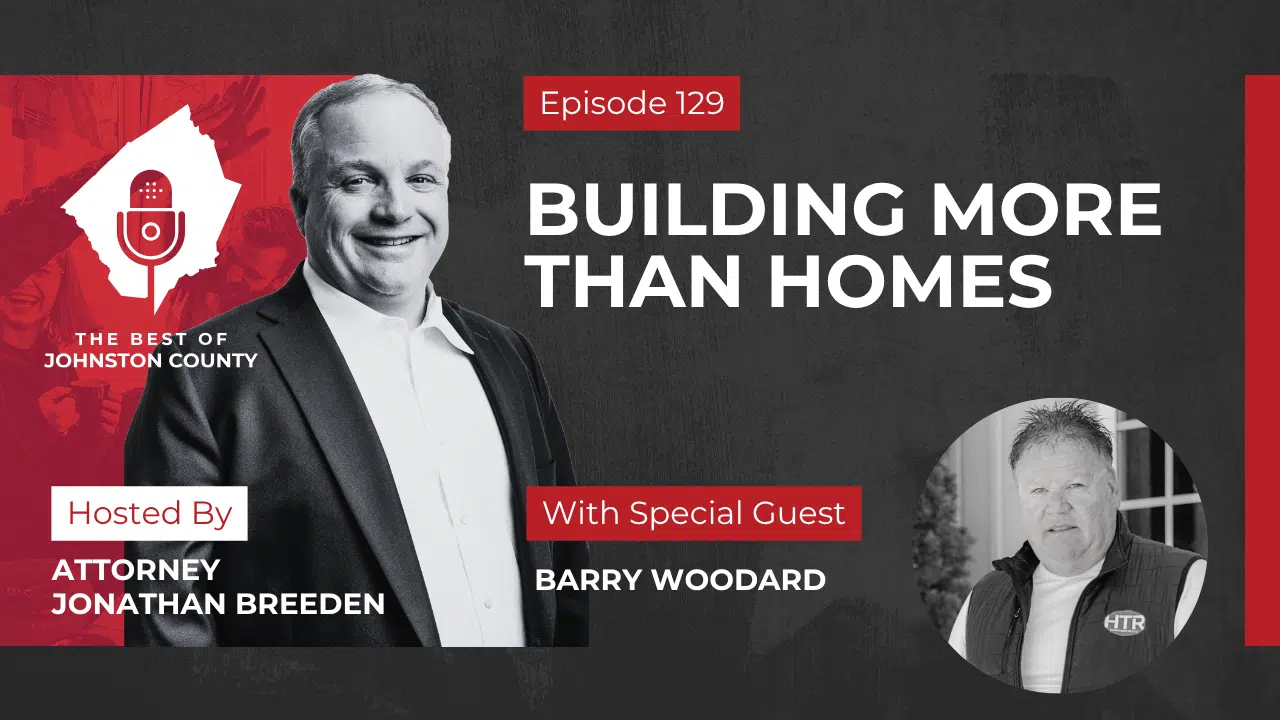
Building More Than Homes: How Barry Woodard Helped Shape Johnston County’s Growth
Jonathan Breeden: [00:00:00] On this week’s episode of The Best of Johnston County Podcast, our guest is Barry Woodard, the owner and founder of Hometown Realty in Clayton. We talked to Barry about growing up in Johnston County, going off to college, coming back here, starting his real estate career, and then starting Hometown Realty with his cousin.
We also talked to him a little bit about how he got drug in to running the Harvest Festival. As a young man, not knowing anything about festivals or downtown development. Some of the growth of Johnston County and where he sees the County going in the next 5 to 10 years. So if you’re interested in any of this, listen in.
Welcome to another episode of Best of Johnston County, brought to you by Breeden Law Office. Our host, Jonathan Breeden, an experienced family lawyer with a deep connection to the community, is ready to take you on a journey through the area that he has called home for over 20 years. Whether it’s a deep dive into the love locals have for the county or unraveling the complexities of family law, Best of Johnston County [00:01:00] presents an authentic slice of this unique community.
Jonathan Breeden: Hello and welcome to another edition of The Best of Johnston County Podcast. I’m your host, Jonathan Breeden, and on today’s episode, we have the co-owner of HTR Realty, hometown Realty at Downtown Clayton, North Carolina, Barry Woodard, and we’re gonna talk to him a little bit about growing up here in Clayton, you know, some people actually did grow up in Johnston County and around Clayton. How, he and James Lipscomb came together to form HTR, which is probably one of the biggest, if not the biggest realty company in Johnston County back in 2001.
What their goals were. Have they achieved those goals and where they’re going in the future with HTR. But before we get to that, I’d like to ask you to like, follow, subscribe to this podcast wherever you see it, whether be on Apple, Spotify, YouTube, TikTok, LinkedIn, or the other social media channels of The Best of Johnston County Podcast.
The Best of Johnston County Podcast comes out every single Monday and has now for about 30 months. So go back and listen to some of our previous episodes, including one of the very [00:02:00] first ones we did with one of Barry’s partners, Paul Flaherty and HTR Commercial. We also have had the vast majority of the county commissioners, Congressman Brad Knott.
We’ve had Ed Aldridge from Johnston County Economic Development and River Wild. We’ve had a lot of great guests on this podcast. If you love county as much as I do, this podcast is for you. Welcome, Barry.
Barry Woodard: Thank you so much, Jonathan.
Jonathan Breeden: Yeah, this is gonna be fun. We could do three of these and we’re definitely gonna have to have you back because we could just talk and talk and talk and talk and tell stories.
But anyway, and we’ve done some of that before we started recording. So anyway, so tell the audience who you are and what you do.
Barry Woodard: Well, I grew up in Clayton. I was born in 1963, so I’m 62 years old. I’m not 70. I remember when Clayton was just a small town. We lived off of well water. We had 13 wells in Clayton, and that’s what our water was.
And I was telling somebody the other day, it was the second purest water in the state. Everybody knew everybody. There’s a fun fact here. You probably had never. In 1970, 94% of the residents of Clayton were originally from Clayton, 94%. [00:03:00] And that number today is probably the opposite.
Jonathan Breeden: You’re probably right.
Barry Woodard: Probably 6%. So that’s how much in the last 50, 60 years. Johnston County and Clayton specifically has changed.
Jonathan Breeden: I can believe that. I absolutely can believe that. I remember, I mean, just, I mean, I came here in 2000 and I just think about how much Clayton has changed since then. I mean, it’s a lot bigger now and then of course you have, the town is a lot bigger, but the area surrounding the town is so much bigger. I mean, when I got here, flowers really wasn’t a thing yet.
Barry Woodard: Yeah.
Jonathan Breeden: And now it’s got hundreds and hundreds of houses.
Barry Woodard: I remember in the nineties when we were selling, I mean Clayton was primarily a starter home community. I mean, back in the nineties, that’s what it was. And I mean, you could get a pretty decent ranch style house for under a hundred thousand dollars back then.
And when we would take people out to flowers, it was a good five mile hike from downtown Clayton. And people going, where are you going? I mean, this is too far out. I don’t wanna live out here. And, and, and now it’s become a destination.
Jonathan Breeden: Yeah.
Barry Woodard: You know, five, six miles from town.
Jonathan Breeden: [00:04:00] Well, I mean, Becky Flowers has done a, done a great job of read and all, and all of her. All of her team. I mean, they’ve built a tremendous community there with the sidewalks and walkability and the clubhouses and the businesses they’ve drawn. I mean, I mean, it is a model planned community. And, and, and they deserve a, a ton of credit. I know you, you’ve done some work with her out there too.
And I mean, I gotta, I gotta give it, I gotta give it to her and her team because it’s really nice and I didn’t realize. What it was gonna become when they started it. But golly, it’s really nice.
Barry Woodard: None of us did. Had no clue.
Jonathan Breeden: Yeah. I mean, it’s, it’s, it’s massive. You know how many houses are there? I mean, it’s over a thousand, right?
Barry Woodard: Oh, way over that.
Jonathan Breeden: Right. Yeah, I know. I dunno how many houses
Barry Woodard: it was. Several thousand acres. And I don’t even think she’s even, I mean, she may be over halfway through developing it, so, my God, it’s still a way, it’s still a ways to go.
Jonathan Breeden: Golly. That’s crazy. So, anyway, so, would you go to college?
Barry Woodard: Elon.
Jonathan Breeden: Elon? Okay. I didn’t know that.
Barry Woodard: So another fun fact. So, I went to Johnston Community College when I left Clayton High School. And I got associate’s degree there at Johnston Community College and I decided in 1986 [00:05:00] I would go in the restaurant business with my brother-in-law. So, where Clayton Steakhouse is now on Main Street, across from my office.
We opened up a restaurant called Bed Nico’s. It was my dad’s middle name, and it was primarily a delicate descent, but we also did dinner, a different menu at night with steaks or seafood, and we had specials and we also served breakfast. So we would open up at five in the morning and we would close at 9 at night.
And back then Johnston County was dry. And so I did that for one year and it almost broke me as far as it was the hardest work I’ve ever done in my life. I sold the business to my food distributor salesman, him and his wife and I went back to school and got my degree.
Jonathan Breeden: Okay. What’d you get a degree in?
Barry Woodard: Business marketing.
Jonathan Breeden: Okay. So what’d you do after that?
Barry Woodard: My mom had a clothing store ladies, high-end ladies clothing store called The Town Shop. It’s been there for, it was there for 35 years. She had a bridal shop and she had a tuxedo store and she had several commercial rental properties and residential rental properties.
And so she was getting ready to retire and I got outta college and she said, Hey, will you come in and kind of run the business [00:06:00] while I do that, and I said, sure. So my wife and I stepped in her role when she retired back in 1992.
Jonathan Breeden: Okay. So you took over the clothing store?
Barry Woodard: I did.
Jonathan Breeden: Okay.
Barry Woodard: And I hated it.
Jonathan Breeden: You hated it. You hated the clothing store.
Barry Woodard: It was so confining, retail just is so confining. You can’t get outdoors. I mean, you gotta be there for your customer. She preached that to me. You know, you’re only people come there, you gotta be there.
Jonathan Breeden: Right.
Barry Woodard: And so, it was very confining.
Jonathan Breeden: Right. Well, yeah. Well she owned, and I think she still does, I guess the building where the Harbor Pizazz shop is.
Barry Woodard: That’s, I own it now.
Jonathan Breeden: You own that. Okay.
Barry Woodard: Yeah, mom passed away a year ago.
Jonathan Breeden: Okay.
Barry Woodard: And so, that’s my building now and Harbor Pizazz is still there.
Jonathan Breeden: Okay. Well that’s a great store. I’m always promoting Harbor and Pizazz and, you know, I mean, I’ve taken more stuff there with tags on it than I want to admit. So you can get stuff that is brand new there that people have never worn and very nice stuff, and it goes to support domestic violence victims in Johnston County.
Okay. Yeah. So I, I knew that was one of the properties that, and, you know, y’all let them be there for, golly, they’ve been here at least 10 or [00:07:00] 15 years
Barry Woodard: Oh, over that. Yeah. And we’ve always been very, very, very fair to them as far as their rents and stuff are concerned. Right. Because Mr. Dwayne Poole, who helped found, you know, get that organization off the ground here in Johnston County, came to us and we are mutual family friends.
And we’ve always supported them in what they do. And, and they’ll tell you To this day, we’ve really not changed a whole lot about what we did, decided that way.
Jonathan Breeden: Yeah, that’s, I mean, that’s great. So when did you decide to get into real estate?
Barry Woodard: Yes.
Jonathan Breeden: Other than you were helping your mom with some of the properties she had?
Barry Woodard: Yeah, so my sister, Valerie decided her and her husband Danny said, we’re going to JY Mon and Fayetteville get our real estate license. I said, well, you know, what is it a weekend class? She said, Saturday and Sundays. I said, I wanna go. So, in 93 I signed up with them and we drove to Fayetteville for six weekends in a row and I went and got my real estate license
Jonathan Breeden: in 1993.
Barry Woodard: Yeah. And, okay. And so James, my Lipscomb, my partner, he is my first cousin was actually already in real estate and he had taken some of our farm, one of our farms in Archer’s Lodge. Started to develop a neighborhood called [00:08:00] Archer’s Point. And so I, I had an all mom’s financial stuff in books and all that stuff, and I, I was looking and I was going, wow, you know, these $5,000 lots, we’re making some really good money on this.
I mean, the lot was $5,000 back then.
Jonathan Breeden: Right, right.
Barry Woodard: You know, compared to 105 to 150 now.
Jonathan Breeden: Right.
Barry Woodard: And I, I called James, I said, Hey, I’m getting my real estate license. I’m coming to work with you. He said, you are? I said, well, yeah, I kind of own the lots and the land. I mean, what, do you know what, it only makes sense that we partner and so we did we, we started with re max and with Randy White back in 94, I guess 94.
And we were there until the time when we NT who owns NT Permit Appraisal.
Jonathan Breeden: Yeah.
Barry Woodard: And myself bought that lot on Main Street. There was a trailer there. That first Citizens Zone, and they used it as a drive-through because they didn’t have a drive-through where the Chamber of Commerce is used to be First Citizens Bank, no drive-through. So they put a trailer on that lot and that was the drive-through for First Citizens Bank.
And they built the bank on Highway 70, they donated the building to the Chamber of Commerce [00:09:00] and that lot came up for sale. And Thad and I bought it.
Jonathan Breeden: Okay.
Barry Woodard: And, then our vision was to go and put a couple of buildings downtown. Larry Christoff also was involved with us.
Jonathan Breeden: Right. I know Larry Christoff was part owner of that building.
Barry Woodard: We did his building on the corner. We did our building in the middle and we did Larry’s building on the side. And there was a restaurant downstairs. We had an engineer in firm upstairs. I forget what Larry had upstairs, but he had a Main Street bistro.
Jonathan Breeden: Right. I remember main Street Bistro, yes.
Barry Woodard: And so this was in 2001 and we were still remax. We had a yard sign in our front window and. The Chamber had some big corporate event and some of Remax Brass came down and saw our sign and said, Hey guys, you got a franchise.
You’re further than a mile from your home office and you got a franchise in order to stay. And, James and I got a large family. We grew up in Clayton. We knew a lot of folks. We had good name recognition and good standing people knew we did things the right way. So I said, you know what, it’s time to go out on our own.
And that’s when we formed Hometown Realty.
Jonathan Breeden: Oh man. All right. I didn’t know that ’cause I get here in 2000 and that’s about when Hometown Realty starts. I do [00:10:00] remember you re max briefly.
Barry Woodard: Yeah.
Jonathan Breeden: And yeah. And then you built that building and.
Barry Woodard: Well, I’m gonna have to credit my wife for building the building because she wanted a children’s boutique.
Jonathan Breeden: Right.
Barry Woodard: And so my office right now is, was her shoe department. So she had a store called Buttons and Bows.
Jonathan Breeden: Yeah.
Barry Woodard: And it was a children’s boutique. And I had the office next door, James and I, and Duke McNichol was one of our partners back then. And we started with three of us in 2001. And within about 6 or 7 months, about 9 or 10 of the agents from our old office came to us and said, Hey man, it’s boring here.
Y’all were the life of the party. Y’all kept stuff stirred up. We wanna come work with y’all. We had no clue, you know, had a house, other agents, ’cause we were just in this one area of that building.
Jonathan Breeden: Right.
Barry Woodard: And had no, I mean, we had nothing. All, all, you know, we had two builders Marty Gilbert and Darrell Evans.
Jonathan Breeden: Yeah.
Barry Woodard: And a couple of neighborhoods. And that’s all we had. And that’s all we knew.
Jonathan Breeden: That’s all you needed.
Barry Woodard: Yeah. At the time we thought that yeah, we could make it, you know, as long as we can, you know, we can get by.
Jonathan Breeden: Yeah. Yeah.
Barry Woodard: And and the next thing we knew. We started growing and we [00:11:00] just kind of had to figure it out as we go and had no plans to end up where we are today.
Jonathan Breeden: Okay.
Barry Woodard: Yeah.
Jonathan Breeden: So, I mean, what was the plan just to sort of I mean, you have a dream? I mean, I know you.
Barry Woodard: No.
Jonathan Breeden: You’re really, you’re both the two most community oriented people I probably know. Well, I mean, you know, like, so what was the plan?
Barry Woodard: So I was already involved with the Chamber of Commerce. I was already involved with downtown development. I mean. I had no sooner got outta college. Jim Jenkins, who ran Champion Products, called me and said, Hey Barry, I need you to come chair the Clayton Harvest Festival. I’m going, what is that? I mean, I’ve never been, I’ve been outta town. So I said, what is it?
He said, well, it was Old Soybean Festival and it’s a Clayton Harvest Festival now, and we need some youth to come and take some leadership. So got really involved in the community early.
Jonathan Breeden: Okay.
Barry Woodard: And that was before we even were in real estate. And then James was on the town council for a while, matter of fact.
Jonathan Breeden: Yeah, I remember that.
Barry Woodard: We had take a number for the complaint department for the town of Clayton for a couple years while he was on the board. And it’s amazing after he got off the board how much our business grew, you know, because that’s a no-win situation when you’re, you know, when you’re on that.
And Clayton was just beginning to start growing from a bedroom community to starting to get a little [00:12:00] bit of an identity. And I remember the Brick Mason who came from outta state to do our brick work. ’cause we did old antique brick. On our building, we wanted it to match with what was going on.
He said, this is the closest thing to Mayberry I’ve ever seen. And I remember Mr. Elton Pittman and Pittman Jewelers would come by our shop every day while we were building that building and stop in and talk to all those contractors in there. And they just loved it. And really honestly, Clayton wants to like a little Mayberry.
Jonathan Breeden: Right.
Barry Woodard: In essence. And the character’s still there that if you look at a facade. Downtown Clayton. It’s not changed a lot over the years. I mean, we’ve added a few buildings and we’ve improved a few areas and paid a few parking lots, but really the overall aesthetics of it has not changed at all.
Jonathan Breeden: Right, no, you’re right, and and there’s so many great businesses down there now. When I got here, it wasn’t full completely, but now everything’s full. Everything’s new. You know, we’ve got new awnings and you got fair game, you got the guy selling guitars. I mean, you’ve got bars, you got restaurants. I mean, you know, I know that, I guess James’ son is doing Jones [00:13:00] Cafe now.
Barry Woodard: Well, his nephew
Jonathan Breeden: Nephew’s. He running.
Barry Woodard: James bought it, but he’s running.
Jonathan Breeden: Right, right. Yeah. So I mean, taking over the old Jones Cafe with the hot dogs and stuff, and I mean, you know, I mean, it’s really amazing you’ve not been to downtown Clayton. it’s phenomenal now. And but you’re right. The buildings themselves have not really changed. The tenants have changed.
Barry Woodard: Yeah.
Jonathan Breeden: And you know, I mean, yeah, the, the town did a nice job with the, the parking lot there next to your building where they do the, do the rides for the Harvest Festival. I mean, that was sort of dirt and they paved it and they did a nice job with that. Maybe. 20 years ago now.
Barry Woodard: It’s been, it’s been a while.
Jonathan Breeden: Yeah. You know, so, I mean, I think the town has, has done a good job. And of course the town, you know, we’ve talked about this with Butch Lawter, the town was going bankrupt, you know, if, if you wanna go back to the actual town itself was in bad trouble 2000, 2001, 2002.
Luckily they got some New town members got, you know, different mayor and, and, and things, you know, they got things going back on the right track. Yeah. But you know, I mean, you’ve seen a, you’ve seen a lot, but I don’t think anybody. They grew up in [00:14:00] Johnston County. You know, I mean, I mean there were 61,000 residents in 1990 and now there’s almost 300,000.
Barry Woodard: Yeah.
Jonathan Breeden: I mean, that’s unbelievable.
Barry Woodard: You wait till the next five years. Oh yeah. If you think you’ve seen something now you, you just wait. ’cause obviously it was struggling. Johnston County has always been like the redheaded stepchild to Raleigh in triangle.
Jonathan Breeden: Right.
Barry Woodard: And there’s still a certain segment of. Of people that think, oh, you’re in, in Johnston County.
I mean this, you know, it’s Johnston County, right? Johnston County’s got an identity now. They used not to have, it’s a destination now, right? We’re on a level playing field with the apexes and the Holly Springs and the Wake Forest. We’re on that level playing field with them. We have the same stuff to offer and what we don’t have to offer is on the way.
Jonathan Breeden: Yeah. No, and and you’re no doubt, I mean, I know that I mean there’s probably gonna be a Costco in Clayton in the next. Three years possibly a Chick-fil-A with that as well. With that. Well,
Barry Woodard: one’s going to flowers now. Chick-fil-A’s going out to flowers.
Jonathan Breeden: Oh, they are? Okay. I knew there was some debate about whether that was gonna happen, but that is gonna happen
Barry Woodard: pretty much.
Sure that’s gonna happen.
Jonathan Breeden: Okay.
Barry Woodard: I mean, I don’t know if there’s an ink deal or not, but I feel
Jonathan Breeden: Okay.
Barry Woodard: Confident enough to say it today. I think it’s going there.
Have family law [00:15:00] questions? Need guidance to navigate legal challenges? The compassionate team at Breeden Law Office is here to help. Visit us at www. breedenfirm. com for practical advice, resources, or to book a consultation. Remember, when life gets messy, you don’t have to face it alone.
Jonathan Breeden: Okay. Alright, that’s cool that would be good. And you know, I mean, Clayton’s getting. More great restaurants and more shops and I mean they’re building more outflows. I know y’all are building some stuff out at flowers right now as well. So what do you say to the drawbridge crowd that dislikes you and James and what y’all are doing? Because you continue to build houses and they don’t want anybody else to move here.
And they want to tell farmers they can’t sell their land. You know, ’cause we can’t support it. There’s too much traffic. I mean, what do you say to that?
Barry Woodard: So it’s interesting ’cause I can relate somewhat. We live on a family farm a mile from here. We have about 60 [00:16:00] acres right off corn Wallace Road and Clayton just went out 300 foot from us and satellite annexed I don’t know, 3-400 acres. And there’s gonna be probably 650 houses out here. And I told my wife, I said, I cannot be hypocritical about this. Said, the only thing I can do is have a sense of reasonability about it.
And the way we approach stuff is the national builders found Clayton. And when they did that, it was all bets off. Everything went through the roof crazy. There was managed growth within the custom builder section. And the majority of our builders are more mom and pop cut, you know, local custom builders. They employ local people. The dollar turns, they reinvested in the community, they donate to the community. And it’s more of a managed plan that we have.
We cannot control outside forces that Wall Street controls, and I think everybody’s got a right to do with their land, what they want to do. I mean, it’s their land to do, but I do have a more moderate approach to it. I think everything’s gotta be done in reason. And there needs to be reasonability. It doesn’t need to be all one way or all the other way.
There has to be a happy [00:17:00] median where not everybody’s happy about the situation, but the overall is a win for both parties. And so those people that don’t like growth, it’s here and it’s staying here and it’s gonna keep coming here. And we’ve gotta be able to maintain and manage it in a reasonable manner.
And I think that’s the way the county commissioners and the town councils at the different cities need to approach it. And, you know, reasonable, right? And, and, and I, I’m all about paying our fair share for infrastructure cost. And I realize, you know, the houses we’re having to build now probably are, you know, supporting the tax base.
But we are so far behind on commercial growth. And if you think about it, this just didn’t start in the last five years. This started 30 years ago. When we first started in business, nobody knew what was gonna happen, happened here. I mean, it just went way beyond all forecasting expectations and it continues to do that.
And so we’re playing catch up and have been playing catch up and you know, there’s gotta be some approach that makes common sense for everybody, for it [00:18:00] to work
Jonathan Breeden: well. And I, and I think. This new set of county commissioners with Butch Lawter and Patrick Harris and April Stevens have done a good job of trying to start getting us to catch up.
I do think that the group that was there before maybe got caught a little flatfooted. I’m not trying to criticize, but I just think they did. And I think it was this new set that has sort of been like, okay, we’re gonna have to get on this. Because what I keep trying to tell people is, you know, we’re not doing law on this episode.
I do law on some of the. Episodes is, you’re not going to stop this. This is going to happen. You just have to be able to manage it.
Barry Woodard: Exactly.
Jonathan Breeden: And, and try to direct the growth where you want it to do. And, and I think the county commissioners have done a pretty good job, and I’m not a huge fan of the town Council Clayton know, they, they, they fire town manager. They hire an interim, they fire him six months later, pay him $300,000 to go away. The voters got rid of a lot of those town council members. But yeah. You know, but like I do think with the new wastewater treatment plant [00:19:00] there and they got a great police chief there.
Now I do think that the town of Clayton is doing better. I don’t like the massive tax increases that they continue to pass. Over and over and over. I don’t think that’s fair to the citizens, but I don’t live there. I don’t wanna pay those taxes. But I do think that, that they’ve got a handle on it. I think the town manager in Clayton now is good.
They got a good engineering department and you know, they definitely got, you know, good economic development. I think. I think everything is going. As well as it has gone for the town itself and for the county right now, in my opinion.
Barry Woodard: Yeah, there, there’s a fine line ’cause you’ve got big time developers who are eyeballing this area now and they deal with other municipalities all over the country.
And the one thing we get kicked back on from a lot of these investors, these big developers, it’s, it’s hard to do business here locally. So it’s, it’s more difficult. It cost us more. Sometimes they, they’re not as advantageous about moving in here because of that, but we need the tax, we need that commercial tax base.
That’s what generates the income.
Jonathan Breeden: Correct.
Barry Woodard: That should lower our taxes and lower our tax base. But if [00:20:00] it’s difficult to get in and you put, you know, some roadblocks in the way, and I’m not saying, you know, you don’t need some of them, but there again, I’m gonna go back to the being reasonable about it, how you approach it.
And I’m gonna, you know, Steve Biggs, I don’t know if you ever knew Steve Biggs.
Jonathan Breeden: I knew Steve.
Barry Woodard: But lemme tell you, I was a big advocate for Steve Big I know he went through some things, and I know he had some haters and I know he had people that love it. But he had a vision. He had a vision for Clayton, and he came to me when I was, I mean, I just, I mean, first got in real estate.
He said, I need you to chair downtown Development Association, and here’s what goals I would love for you to try to achieve. And they were very lofty goals. But you know, every one of those goals he had has been met right now. And it took some time and he left and it carried on. But he had that initial vision because he had done it before.
In another town, another small town. He had seen it happen. And he did have that forethought. And so, I really respected that about him. You know, I don’t know, as far as the politics, I tried to stay outta that. I still stay outta politics. I you will never get me involved in the politics [00:21:00] unless I absolutely think something’s wrong.
You know? That’s the only time I get involved. But it, it, it usually you know, I’m a more, you know. Just let me do my thing and I’ll, I’ll leave you alone.
Jonathan Breeden: So I mean, where do we go from here? I mean, you know, you’re building out of flowers and I know James, your partner is, he is doing lots of land development.
I mean, where are we going in the next 4-5 years around Clayton? I know you’re not just in Clayton, but I know you’re mainly in Clayton.
Barry Woodard: Well, no, we’ve got offices all the way to the coast.
Jonathan Breeden: Right. I was about to say, I mean, you.
Barry Woodard: We gotta place Morehead City in beach.
Jonathan Breeden: You part owner of a mortgage company. I mean.
Barry Woodard: We’re going East. Everything is pushing east because Affordability’s pushing East, land here in Clayton and Cleveland and even Wilson’s Mills. Has just gone out of sight, just outta sight. And when you have it to put a lot on the ground, that’s over a hundred thousand dollars. It forces you to build a house that’s over 6, 7, $800,000 but to make the justification for the lot cost.
Jonathan Breeden: Right.
Barry Woodard: And so everybody can’t afford that. And so you’re going, you’re seeing [00:22:00] more developments going into Harnett County’s crazy. It’s probably Harnett County’s probably got more new home construction. Everybody’s in Johnston right now. But you’re seeing stuff pushed towards the Four Oaks.
You’re seeing stuff push into Smithfield now Selma starting to really take off Princeton Pine Level starting to take off. Kinley.
Jonathan Breeden: Yeah.
Barry Woodard: Is even starting to take off. And I think it’s important for those leaders in those communities to understand the growth is coming. Let’s get a plan in place and you’re only as good as the consultants you hire. And let me tell you, some of the consultants we’ve hired probably have missed some forecast ’cause obviously we wouldn’t be where we are if we’ve hit some of these forecasts.
So it’s really important to know. That maybe you need to take a multiple of whatever you’re anticipating it to be in the next 10 years and bump it just to be sure when you’re planning that far in advance, and then you’ve got a plan in place to try to recruit some of these commercial businesses and restaurants and hotels, stuff that generates tax base because if we don’t have that, we just gonna keep going up on our taxes.
Jonathan Breeden: Well, I mean, I think it’s awesome with Selma and Adventure Development and what [00:23:00] they’ve done there. You know, with all the new restaurants and Shores and Shops and New Chick-fil-A and a Longhorn Steak House and an Olive Garden and all that right there on 95.
Barry Woodard: Doesn’t have any of that.
Jonathan Breeden: Right. Clayton didn’t have any of that yet.
Barry Woodard: There the hole in the donut.
Jonathan Breeden: Right. But I, but you know, part of the Clayton’s issue is it’s all at white oak and White Oak’s Not that far.
Barry Woodard: That’s
Jonathan Breeden: why. But it is coming. I, I think it is coming. And I, and I think that development with the Costco is going to be the start of a lot more other stuff.
Barry Woodard: Fall
Jonathan Breeden: asleep if the Costco comes,
Barry Woodard: but yeah, fall asleep. So we bought a building in downtown Selma five years ago, and Lindsay Dell has her own team. She, she came to me unannounced one day and said, I want own my office. And said, where do you wanna go? She said, Smithfield or Selma. I said, I kind of like Selma.
’cause it had, it had the same vibe as Clayton had 30 years ago when we first did our first project, and we did that five years ago, we went in and did this building, opened an office up, and you could see Selma kind of doing the same thing as far as developing that downtown area and getting an identity.
Because if you think about it, most people that move to this area [00:24:00] want to go see what the downtown, if there is a downtown, what it’s about. It kind of gives you some kind of cultural idea of what’s going on in Clayton and Clayton’s very diverse. And, and the downtown, it’s like you say, is very vibrant.
You can go on a Friday, Saturday night and it’s like Glenwood South. I mean, it’s packed and you wanna see that it is almost so bad you can’t even hardly cross the street for lunchtime though. So much traffic on that street. So we, we were worried about losing foot traffic and car traffic in downtown Clayton 25 years ago.
We were scared that downtown was gonna fold up like some of these other Eastern North Carolina towns. And boy has it turned on about face over the last 25 years.
Jonathan Breeden: Well, it’s been great. The Front Street extension helped with that too,
Barry Woodard: tremendously.
Jonathan Breeden: I mean, that road was a tremendous help to help people get from flowers at 42 East to downtown without having to get on 70 and fight that and those stoplights and, and all of that.
So, let’s talk about a little bit about, we could talk all day. We’ll definitely have to have Barry back. I mean, I could do hours with him, but let’s talk about some of the community involvement you’ve been involved in. You’ve done a lot of different things. You’ve been named a Main Street champion twice.
You’ve been named Citizen the year twice. What [00:25:00] are you currently involved in that you’re the most passionate about when it comes to the Clayton community right now?
Barry Woodard: You know, we support a lot of youth sports programs especially with clients and, and our agents within the community. We’ve got several of our agents that have taken the torch from James and myself, and they, they’re really involved in the Chairman of Commerce.
They’re involved in other you know, nonprofit groups. We do a lot with the rescue animals. So we, we spread out our net pretty far with you know, supporting different charities. And I don’t really have necessarily a specific platform. I look where the need is and we try to fill the void.
So if we see something that’s in need. Somebody comes to us and said, this is a need. Then we’ll try to figure out a way to partner with some of our other vendors who do business with us and get that need. Just like one Compassion. They do a tremendous job of helping a lot of folks, and so we support that group and we actually go in Christmas and pass out.
It’s so fulfilling to do that, but I did it for so long, Jonathan. I mean, I was chair of the Harvard Festival for 21 years. Yeah. [00:26:00] You know? Yeah. I
Jonathan Breeden: worked
Barry Woodard: on that committee
Jonathan Breeden: with you a couple
Barry Woodard: times. I was, I was,
Jonathan Breeden: believe me, you, Sally Slick.
Barry Woodard: Yeah. The days I went through three chamber, three chamber directors during my first year of presidency of the Chamber of Commerce, I was 27 years old, 28 years old.
I didn’t know anything about, I mean, we, we had to borrow money from the Johnston County pageant to keep the chamber afloat. That’s how bad a shape it was in. And I mean, and then went through three directors.
Jonathan Breeden: Yeah.
Barry Woodard: Ended up with Melissa Oliver.
Jonathan Breeden: Yeah.
Barry Woodard: And then Sally came after Melissa left to go to the bank.
So it was a lot of transition in a short period of time. So, yeah, I’ve seen Clayton at the bottom.
Jonathan Breeden: Yeah.
Barry Woodard: And now it’s come a long way and I think people need to understand, you know, would you want it to be back in 1980 where we were, or would you rather be in a vibrant community that’s got a lot of growth, excitement and activities for the quality of life. And it’s just a culmination of things.
Jonathan Breeden: No, I agree. And, I think Clayton’s done a great job. I think Western Johnston County’s done a great job. I mean, I really think that things are going extremely well for Johnston County and for the town of Clayton, and it’s gonna [00:27:00] continue. You know what I mean? I think it’s gonna continue. I think we’ve got a lot of the right stakeholders in place. I think the town of Clayton with their new wastewater treatment plant that’s coming online and some of the new infrastructure improvements that are coming there.
I mean, they’re getting ready, you know, the 42’s finally finished. I took them, I don’t know, 15 years to widen that road. But like, I think it’s done now. I mean, the finally got the bridge over the Neuse River. Remember that was a 10 or 15 year project. So I mean, I think there’s a lot of positive things going on here that we can look forward and see.
And you’re right, the commercial is very important for the tax base because commercial buildings don’t go to school. They don’t need Department of Social Services. They rarely call the police. You know what I mean? I mean, it just, that’s where it’s at. And you have to have the rooftops and the average income to bring the commercial to follow.
And I think now you’re starting to see that as the average income goes up, the number of rooftops goes up and you know it’s just gonna continue. And there’s no reason to go to Raleigh for anything if you don’t want to, other than maybe [00:28:00] to work. And you know, I know Chris Johnson working real hard to try to.
Barry Woodard: Excellent.
Jonathan Breeden: He does get more development. And Chris Johnson done a great job. He’s been a guest on this podcast. You go back and listen to that episode. But yeah, it’s tremendous. And one compassion, Reed Smith, River Wild, all the things they’re doing, Ed Aldridge, I mean, they’re do a ton for the community and always have and you know, big fan of what they’re doing and they’re at the music festival and the different things that they do every year.
Barry Woodard: There’s so much as well there so much going on. There’s all the time, so much going on in downtown Clayton. I mean, almost every week.
Jonathan Breeden: Right.
Barry Woodard: You say there’s something going on Farmer’s Market or something’s going on about every week. And I tell you that the biggest challenge I see and, and obviously wastewater treatment’s been addressed, schools is obviously a concern, but roads and road improvements.
Are gonna be the biggest challenge in the next 10 years we face, because we’re still growing and our road capacity, we’ve way outgrown it. And it could be an inhibitor to growth,
Jonathan Breeden: right?
Barry Woodard: And it probably will be to a certain degree until. We really get a focus on how we are gonna improve our infrastructure road wise.
Jonathan Breeden: Well, the last question we’ll ask everybody is, what do you love most about Johnston County?
Barry Woodard: I love [00:29:00] the heritage. I love I, I mean, I love, I love the history of it. I, you know, the, the people who were here to help grow it and help build it. And then I welcome all the newcomers too, and just, you know, welcome. I mean, it’s, it’s, it’s all about coming somewhere where you, you really want to be a part of. I love that.
Jonathan Breeden: Well, how can people learn more about Hometown Realty? Hometown commercial and I guess James’ Land Development
Barry Woodard: Yeah.
Jonathan Breeden: And all that stuff.
Barry Woodard: Well, Lipscomb development’s totally different. He’s got restaurants, he’s got land. I don’t do, I don’t do all that, but our main office is downtown Clayton, right across from Clay Steak House.
That’s where we started. We’ve got an office out at Flowers Plantation by the Food Lion Shopping Center. We’ve got a team office right here next door to you. And we’ve got an office in Selma. We’ve got an office in Garner. We’ve got an office in Raleigh. We’ve got an office down at the Crystal Coast.
You know, we’re 300, roughly 300 agents strong. But we’re community based. We’re, we’re, we’re, we’re family. First type of business and we manage from the heart, not from the number.
Jonathan Breeden: I can understand that. And it’s HTR. What’s the website?
Barry Woodard: My myhtr.com.
Jonathan Breeden: Myhtr.com All [00:30:00] right. So if you’re interested in what’s happening in Clayton or what might be coming, or if you have a project you might need some help with, whether it’s selling a house or building a house or even doing commercial development. Reach out to Barry and his partner James, and any of their other 300 team members and they will be glad to help you out. We really appreciate Barry Woodard coming and being our guest on this week’s episode of The Best Johnston County Podcast.
As we mentioned earlier, please like, follow, subscribe this podcast wherever you see it, whether it be on Apple, YouTube, Spotify, TikTok, LinkedIn, or any of the other social media channels of The Best of Johnston County Podcast, if you’d be so kind, just to tag. The Best of Johnston County Podcast, your Instagram stories that will help expand our reach as well.
Until next time, I’m your host, Jonathan Breeden.
That’s the end of today’s episode of Best of Johnston County, a show brought to you by the trusted team at Breeden Law Office. We thank you for joining us today and we look forward to sharing more interesting facets of this community next week. Every story, every viewpoint adds another thread to [00:31:00] the rich tapestry of Johnston County.
If the legal aspects highlighted raised some questions, help is just around the corner at www. breedenfirm. com.
From Small-Town Roots to Big Vision
Barry Woodard’s story starts the way many Johnston County stories do, with deep roots.
“I grew up in Clayton… I remember when Clayton was just a small town… everybody knew everybody.”
Back then, nearly everyone who lived in Clayton was actually from Clayton. Today, that’s completely flipped. That shift alone tells the story of how dramatically the county has changed.
What makes Barry’s perspective different is that he didn’t just watch that transformation. He helped build it.
The Unexpected Path Into Real Estate
Barry didn’t set out to become a real estate developer.
He tried the restaurant business. It nearly broke him. He stepped into his family’s retail business. He hated it.
It wasn’t until a weekend real estate class changed everything.
“I said, I’m getting my real estate license. I’m coming to work with you.”
That moment, simple as it sounds, became the starting point for what would eventually grow into one of the largest real estate companies in the county.
Starting Hometown Realty Without a Plan
When Barry and his cousin launched their company, there was no grand blueprint.
No long-term strategy. No vision for scale.
Just relationships, reputation, and a willingness to figure it out.
“We had no plans to end up where we are today.”
Within months, agents followed them. The business grew. And what started as a small operation became something much bigger.
Not because of aggressive expansion, but because of trust.
Growth Isn’t the Enemy — Mismanaged Growth Is
Few topics spark more emotion than growth in Johnston County.
Barry doesn’t dismiss the concerns. In fact, he understands them. But he also brings a grounded perspective.
“I cannot be hypocritical about this… everything’s gotta be done in reason.”
His approach is simple. Growth is coming whether people like it or not. The real question is how it’s managed.
He emphasizes balance. Not unchecked development. Not total resistance. But a middle ground that considers both progress and preservation.
“There has to be a happy median.”
Why Johnston County Is No Longer Overlooked
For years, Johnston County sat in the shadow of Raleigh.
That’s no longer the case.
“Johnston County’s got an identity now… it’s a destination.”
With rising home prices pushing people outward, the county has become a natural landing place. And with that comes new businesses, new infrastructure, and new expectations.
Barry sees the next wave already forming.
“You wait till the next five years.”
The Real Challenge Ahead
Growth itself isn’t the biggest issue.
Infrastructure is.
Roads, schools, and commercial development are now the pressure points. Without them, growth becomes strain instead of opportunity.
“We are so far behind on commercial growth.”
That gap matters because commercial development supports everything else. It stabilizes taxes, creates jobs, and builds long-term sustainability.
Without it, residential growth alone cannot carry the load.
A Life Built on Community Involvement
Long before real estate, Barry was already invested in the community.
He led the Harvest Festival for over two decades. He served through the Chamber of Commerce. He continues to support local nonprofits, youth programs, and community initiatives.
But his philosophy has evolved.
Instead of focusing on one cause, he looks for where the need is greatest.
“I look where the need is and we try to fill the void.”
That mindset reflects something deeper. Not just involvement, but responsibility.
What Makes Johnston County Special
When asked what he loves most, Barry didn’t hesitate.
“It’s the heritage… the history… the people.”
There’s a respect for what came before, paired with an openness to what’s coming next.
That combination is what defines Johnston County today.
A place that remembers where it started, while still making room for where it’s going.
Closing Reflection
This conversation isn’t just about real estate.
It’s about transformation.
About what happens when a small town becomes something more, and the people inside it have to decide how that growth unfolds.
Barry’s story reminds us that growth doesn’t have to erase identity. When done right, it can actually strengthen it.
And maybe that’s the real takeaway.
Progress isn’t the problem. Losing what matters is.
AND MORE TOPICS COVERED IN THE FULL INTERVIEW!!! You can check that out and subscribe to YouTube.
Connect with Barry Woodard:
- Website: https://www.myhtr.com/
Connect with Jonathan Breeden:
- Website: https://www.breedenfirm.com/
- Phone Number: Call (919) 726-0578
- Podcast: https://breedenlawpodcast.com/
- YouTube: https://www.youtube.com/@BestofJoCoPodcast
Listen On