
February 23, 2026
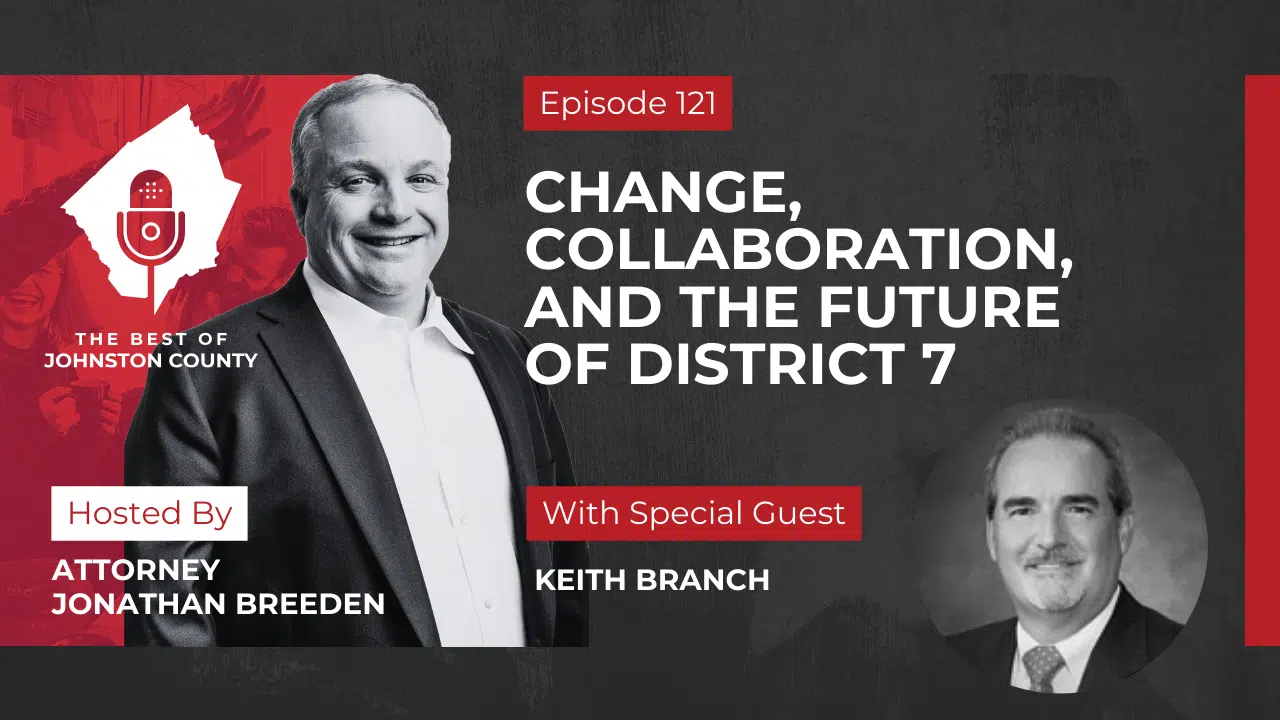
Change, Collaboration, and the Future of District 7
Jonathan Breeden: [00:00:00] On this week’s episode of The Best of Johnston County Podcast. We continue our candidate series with the last candidate for the Republican Primary on March 3rd, 2026. Keith Branch, who’s running against sitting County Commissioner Butch Lawter for the District 7 County Commissioner seek for Johnston County.
We talked to Keith a little about him growing up at Smithfield, that he’s a graduate of Triple S high school. His time at NC State his time with the state auditor. His two terms on the Johnston County School Board and his 9 or 10 months as a Johnston County Commissioner in 2017.
We also talked to him about why he’s moved back to Johnston County and why he wants to be your Commissioner for the next four years. So if you’re interested in this race and the future of Johnston County, listen in.
Welcome to another episode of Best of Johnston County, brought to you by Breeden Law Office. Our host, Jonathan Breeden, an experienced family lawyer with a deep connection to the community, is ready to take you on a journey through the area that he has called home for over 20 years. Whether it’s a deep dive into the love [00:01:00] locals have for the county or unraveling the complexities of family law, Best of Johnston County presents an authentic slice of this unique community.
Jonathan Breeden: Hello and welcome to another edition of The Best of Johnston County Podcast. I’m your host, Jonathan Breeden, and on today’s episode we have County Commissioner candidate Keith Branch. He is running against Butch Lawter in the March 3rd, 2026, Republican Primary for the District seven Johnston County Commissioner seat.
The winner of this race will be the. District seven representative, which is a good part of Clayton and some of the areas around it, but mainly around Clayton from December the seventh, 2026 until the first Monday in December of 2030. Anybody that is a registered Republican in Johnston County or unaffiliated can vote in this race, an unveil person can just go and ask for a ballot for the Republican ballot and they can vote as in many races in [00:02:00] Johnston County, there is no Democrat. So the winner of this primary on March 3rd will be the District seven County Commissioner for the next four years. But before we get to talk to Keith about why he wants to be your county commissioner, we’d like to ask you to like follow, subscribe to this podcast wherever you see it.
Whether it be on Apple, Spotify, YouTube, TikTok, X, LinkedIn or any of the other social media channels of The Best of Johnston County Podcast, The Best of Johnston County Podcast comes out every single Monday and has now for around 28 months. So go back and listen to some of our previous episodes with the vast majority of the County Commissioners, County Economic Development Director Chris Johnson, Airport Authority Chairman and Economic Development Chairman Ed Aldridge small business owners, Woody computing, Woody’s IT, we talk a lot about a lot of great people. Tim Sims, local dentist. We’ve had a lot of great guests over the years, so go back and listen. If you love Johnston County as much as I do, this is the podcast for you.
Welcome Keith.
Keith Branch: Thank you, sir. Good to be here.
Jonathan Breeden: Yeah. We’ve talked about this for several months now, but we [00:03:00] got, we got got it in, so, I guess. Tell the public who you are and what you do.
Keith Branch: Okay? Alright. Okay. So my name’s Keith Branch and it has already been mentioned. I am running for District seven County Commissioner for this term. And basically I’m lifelong Johnston. I grew up in Smithville. I’m a Smithfield Selma graduate. I worked with the North Carolina State Auditor’s office for 10 years. I have an accounting degree from North Carolina State University. And during part of that time as a state auditor with the state auditor’s office, I was a fraud investigator for the state.
There was four of us. The other time I actually was a financial auditor for community colleges, university system, clerk of courts, any state department or anybody that got state or federal funding, basically we could audit their financial records. I ended up, after that period of time getting involved in insurance.
My dad died when I was a young kid and he was a insurance agent, so, big believer of life insurance. So I got into insurance opened up an Allstate agency from scratch in Clayton in [00:04:00] 1998. Sold that agency in 2015. During part of that time, I actually moved from Smithfield to Wilson Mills, serving on the Wilson Mills Planning board.
And also during that time in 2008, I was first elected in the county to serve on the Johnston County Board of Education one reelection and served eight years in total. I’m a term limit person, so I think eight years and you’re done, you move on to something else or move out of the way. I was fortunate enough to get elected as county commissioner after those two terms with the Board of Education.
I’m one of only two people in the history of the county to serve on both the governing boards. Unfortunately after being county commissioner for nine to 10 months. I got a new job with a major Fortune 500 insurance carrier, and they told me to go to work with them. I could not be an elected official, so unfortunately I had to resign since that happened back in 2000 and 17, I’ve had the desire to get back [00:05:00] to being at the level of governing as county commissioner. ‘Cause it’s something that I’m passionate about. I love helping people. I love making a difference in our community. Obviously being from Johnston County my entire life, I’ve seen, you know, where we started and where we’ve gone to and, you know, I want to continue to be a part to make life better for folks.
Jonathan Breeden: Yeah. So I guess one question I’ve got is. Why did you sell the Allstate Agency? You were doing great.
Keith Branch: Yeah.
Jonathan Breeden: I’m just curious. Yeah, like, like I was a little surprised, you know, we’ve been friends for 25 years, but I was like, why’d you sell it? I don’t know if I ever asked you.
Keith Branch: Well, I really wasn’t. I really wasn’t even looking to just Tom Madeline, who was my mentor in Smithfield got me started in the business called me one day ’cause they knew I was involved in, you know, in politics. And he is like, Keith, you know, what’s your plans in the future? You know, my son would like to kind of get an agency. And at that time, Allstate had changed the way they do some things and was not as, as customer friendly in my opinion. And you know, when you own an agency like that and things happen.
[00:06:00] It’s not really about Allstate, it’s about Keith Branch. So some things that were, some decisions they were making I just didn’t agree with. So, you know, my thought was I was 50 years old at the time. Hey, I got time to do something else, but, you know, kind of forgot about the rule about once you’re in your 50’s nobody wants to talk to you.
So, so I struggled for a couple years trying to land on my feet and that’s when I landed a really good job. But unfortunately, you know, that restriction came with it, so.
Jonathan Breeden: Okay. I was just curious, like, like, I mean, you were doing great, I mean, yeah, yeah. You had great employees and you know, so. So I mean, I remember when we first gotta know each other, when you were really got, I mean, I knew you from the Clayton Chamber, but like really gotta know you when you were running that first rant campaign for school board in 2008 you know, you were gonna get on there and help Donna White and Larry Strickland, our student, say house members who were up against a very liberal board and needed a few more reasonable conservative votes. And you ended up being one of those votes and ultimately they ended up, [00:07:00] Larry becomes chairman and they did a great job for Johnston County.
Keith Branch: Absolutely.
Jonathan Breeden: And now they’ve done a great job at the legislature for the last 10 years. Larry Strickland’s chairman of the appropriations, Donna with the health committee and all that. But, why did you, why were you originally gonna run for, why did you originally run for school board?
Keith Branch: Okay, so, well first of all, back up talking about the Chamber. I was actually served as president of the Clayton Chamber two different times. I mean, at that point in time, believe it or not, there was nobody on the Board of Education. I had kids in the school system.
Jonathan Breeden: That’s true.
Keith Branch: I had served on the PTA at Will’s Mills Elementary with my kids. I’d serve on the PTA at Smithfield Middle School with my kids. I’d serve on their advisory boards. I was always very involved in the schools and I felt like, two things. It was important to have somebody on the school board of Education that had kids in school that really knew what was going on and was involved day to day.
And then also getting back to my experience with the state auditor’s office. I can’t ex, I can’t explain. How much that experience comes into play when you’re [00:08:00] serving as a board member of a governing body. So, you know, it was a great opportunity. It was a great board that, that to me was a true example of if you got a board that’s unified, you can get a lot of stuff done.
We dropped dropout rates. We increased graduation rates. We actually won a national award because of how much we had decreased the dropout rate. You know, I came in and you know, implemented hiring an internal auditor. We were one of the largest school systems in the state and didn’t have an internal auditor.
One of the few that didn’t, I found out the other day that they did away with it again. And just like, you know, Johnston County, something I have a concern about. They’ve been using the same auditing firm for over 20 years. The school system was doing the same thing, and when I came in. You know, kind of explain, you know, some of the concerns with that.
That meant putting it out for bid, put it out for bid, got a new auditing firm to do our audit and saved money. When I was county commissioner for the short time, you know, I brought up that same concern and unfortunately didn’t have the support to move forward with [00:09:00] it. But I just, you know, because of some of my experiences, I looked at some of those things different.
Jonathan Breeden: Well, I mean. I, I, you know, I, I know you moved away for four or five years. I mean, I guess you moved to Montgomery, Alabama. When you got married in 2020.
Keith Branch: 2020. Yep.
Jonathan Breeden: In 2020
Keith Branch: had a COVID wedding.
Jonathan Breeden: Right. And you came back to Johnston County in 2025. You now live in Clayton.
Keith Branch: Right.
Jonathan Breeden: You know, I know you were following it ’cause you and I were texting and talking even while you were in Alabama a lot. The school board now gets $115 million from the county. When you were on the county commissioners 10 years ago, it was like 60 million.
Keith Branch: That’s correct. Yeah.
Jonathan Breeden: Right.
Keith Branch: Yeah.
Jonathan Breeden: The population of students has not doubled.
Keith Branch: Right.
Jonathan Breeden: And the population of students has been largely flat the last four or five years, despite the growth,
Keith Branch: right?
Jonathan Breeden: Because we have ALA other charter schools, news charter school. We have the, we have the charter school behind Walmart and Clayton. We’ve got the explosion of [00:10:00] homeschool. We now at Thales Academy, at Flowers Plantation. We got a lot of alternatives here, but yet every year. The school board gets more and more money. Have you looked at that? I mean, like is, I mean,
Keith Branch: I’ve not,
Jonathan Breeden: it’s a lot.
Keith Branch: Yeah. I’ve not really looked at the detail of what the requests are, being honest, but I mean, I think that’s why it’s important to have somebody that’s a county commissioner that’s serving that role because I understand what’s what and what’s really needed and what’s and what’s not needed.
And one of the things I did for a short period of time, I was county commissioner, was I actually billed. Collaboration between the two boards that had never done, been done before. We, I actually was able to implement quarterly meetings between the boards. It would be like, you know, three would meet this time with each other and next time three others would meet.
And again, that was something I started and as soon as I left, they stopped it. But that was a great way. To find out, you know, what the school system was up to and what they thought their needs were gonna be, and us to kind of have a heads up and review things back and [00:11:00] forth. So, yeah, I was surprised when I saw some of those numbers, but it’s no different than the county budget has increased 81% since 2018.
Now it’s $412 million. It’s a 80 per 81% increase since 20 18. And you know, so it’s the same thing. I realize we’ve had a lot of growth, but 81% is a huge increase.
Jonathan Breeden: Well, yeah, it went from 220 million to almost 420 million in that period of time. Some of that’s inflation.
Keith Branch: Yeah.
Jonathan Breeden: But not all of it.
Keith Branch: That’s right.
Jonathan Breeden: You know, and so there’s that is, that is a lot. So I mean, we have the growth issues here. Right. And I believe that Johnston County is going to grow.
Keith Branch: Absolutely.
Jonathan Breeden: It absolutely is gonna grow.
Keith Branch: Yeah. You’re not gonna stop it.
Jonathan Breeden: It’s, and you’re not going to stop it.
Keith Branch: Right.
Jonathan Breeden: There are some people that have drawbridge thoughts that we’re just gonna. Roll up the drawbridge. Not only anybody in that’s not gonna happen. So how do you think the commissioner should manage growth?
Keith Branch: Well, I mean, you know, basically we, we’ll get, well, you know, again, getting back to the UDO, I mean, I’ve not read the 600 [00:12:00] pages of the UDO. I don’t know how many people actually probably really have.
But I think it gets back again to collaboration. The way that all, all should have been handled was basically. You got all these different organizations that have representation, whether it’s the Board of Realtors, whether it’s the builders, the farmers, and all those people. And I know there was some of this done, but evidently not a really good job based on the confusion.
And you know, again, we talked about this a few minutes ago, but perception, if it’s perceived to be, I mean it is. And so there’s perceived that communication was poor. I wasn’t involved, but on the outside it looks that way. What should have been done was they should have brought a representative from each one of those groups together.
And get in a room and just figure it out. You know, you’re not gonna win all of it. You get some, you get some and just make it work and then go back to your groups and this is how it’s going to be. And I think that’s, there’s gotta be more collaboration. I think we definitely have you know, gotta make sure we don’t kick the can down the road on, you know, the infrastructure and some of these things are, you know, appears going to be an [00:13:00] issue if we’re not careful.
Jonathan Breeden: I mean, I am. I am a believer in density, right? Density takes less farmland. It concentrates the houses in one, in, in certain areas. Now there people agree, I think Butch Lawter probably agrees something with me that we gotta, we’ve gotta figure out a way to, to do this. You know, but you have the other people, Adam Caldwell, who’s running for district 3, Bill Stovall, that are not for that.
I mean, what, what do you think about. Building the houses where they should be built, the density levels, stuff like that.
Keith Branch: Well, I mean, you know, at, at the end of the day you know, you, you can’t tell people they can’t sell their farmland. If they want to sell their farmland, they can sell their farmland.
Otherwise, you’re going to be in court all the time trying to battle that. So, I know everybody has their own food for thought. You know, I live in. You know, Carolina overlook and those houses are really close together. And, you know, personally I don’t have a problem with it. I know some people do.
I mean, it’s just personal preference. But you know, [00:14:00] I mean, I think some of those things probably need to be studied and, and make sure we’re making. The right decision is for now, but also for years down the road because at at the end of the day, you’re, you’re, the growth is not gonna stop. I mean, you know, North Carolina, just recently I saw in a a magazine article as far as move people moving into the state, it’s number one now, has been in the last couple years.
Raleigh is the best place for college graduates to live. To get a good job outta college. Well, we all know that they can move down to this area and get a lot more bang for their buck, and that’s what’s happening. So, I mean, we gotta figure some of those things out, but I’m, I’m not going to try to sit here and, and, and make you think that I know the answers ’cause I don’t, but I don’t think anybody does.
But we do have to figure it out.
Jonathan Breeden: Well, what about the, the watershed issue? We, we have a shortage of water.
Keith Branch: Mm-hmm.
Jonathan Breeden: We’re buying water from all over the place right now.
Keith Branch: Right,
Jonathan Breeden: right. There is talk of spending $800 million to take water from Goldsboro [00:15:00] and bring it towards Clayton. Is that a good plan?
Keith Branch: I mean, I really can’t speak to you intelligently, but I’m being honest with you. I really,
Jonathan Breeden: okay. Alright. Well that’s fine.
Have family law questions? Need guidance to navigate legal challenges? The compassionate team at Breeden Law Office is here to help. Visit us at www. breedenfirm. com for practical advice, resources, or to book a consultation. Remember, when life gets messy, you don’t have to face it alone.
Jonathan Breeden: Looking at the other stuff, water treatment capacities. They have added a little bit to that. There’s, they, they, they added it and they’re building a new one. You know, if you looked at our plans for trying to get access to the Cape Fear River as another river, versus you can only get so much outta the noose.
And that was a problem when you were the commissioners before.
Keith Branch: Yeah.
Jonathan Breeden: You know, you think they’re, they’re, they’re, they’re, they’re going the right direction with this.
Keith Branch: I mean, you know, I mean, I, I honestly, Jonathan, I mean, until I sit down and I, I studied all the different [00:16:00] options, which I’ve not had the opportunity to do.
Jonathan Breeden: Okay.
Keith Branch: I mean, I can’t intelligently talk to you what’s the best thing to do? What’s, what’s not best thing to do here? Here’s my thoughts with with this type of stuff, and this is what works so good. When I was on the school board, you need different expertise. On your boards and you know, my expertise is financial background.
I know you know Butch who’s been served for the last eight years, his expertise is engineer. So a lot of those, those type things you’re talking about, obviously he’s gonna know more about it because that’s his background. That’s not my background. But what my concerns are is we have all these needs and these things going on, and you know, we’re sitting on the stockpile of money that’s sitting there.
I mean, our fund balance has increased 340% since 2018 in a two year period, 23, 24. We made $27,000, I mean, I’m sorry, $27 million in interest off of those reserves. So, you know, you know, [00:17:00] some of these things, I mean, I feel like we, we’ve got to come up with a plan and I’m not sure what the best plan is, and I realize we gotta take time to make sure we do it right. But I, I feel like we’ve done a lot of kicking down, kicking down the road.
Jonathan Breeden: Well, I mean, they, they, they 30% of the fund balance is already promised, I think, to projects that they’ve done. ’cause they still gotta pay for the jail, they gotta pay for the law enforcement center and they’re gonna pay $103 million in straight, well, I mean, not cash, but a cash equivalent for a new high school in Clayton.
I mean, I know that’s some of what they’re doing with the fund balance and you know, they wanted to make sure they got their AAA bond rating. How much should the fund balance be?
Keith Branch: Well, if you look at the 2024 fund balance in the audit report, which is what I go by, I mean, I know, you know, there’s all kinds of talk about all these different things, but I mean, the audit report basically shows at the end of 24.
There was 80 something percent in fund balance and 72% of that 238 [00:18:00] million was unreserved. So, you know, as far as, you know, assigned to different projects and stuff, you know, I know there’s, there’s been talk about those things over the years, but at the end of the day I can tell you this, we have 15 to 20% more in fund balance compared to revenues than all the other counties that we’re compared to as far as AAA bonding.
Counties that are growing. That was one of the charts that I sent you the other day. So, you know. I’ve been saying 15% is what the policy is. And the reason I’ve been saying that, that’s what the audit report says. You know, I’ve been corrected and said no. In 2021, you can look at the minutes. It was changed that the county policy’s 20%, and our financial advisor, Davenport says 20%.
Well, the auto report’s been wrong since 2021 because it says. 15%. So, but, you know, bond ratings basically 35%. You can do your research all day long. That’s what it says. There’s other things that [00:19:00] come into play as far as the bond rating besides that, as far as what’s going on in the, you know, the, the county and, and you know how it’s all performing together.
And so, you know, if you start saying, you know, 50%. Tile is plenty of fund balance and you know, the end of 24, we’re sitting on 72%,
Jonathan Breeden: right? And so for the public listing, the fund balance is the county savings
Keith Branch: basically.
Jonathan Breeden: And the percent is the percent of the county’s operating budget for that year. So the operating budget for this year is around $420 million.
Keith Branch: Actually pay 412
Jonathan Breeden: it’s $412 million. And they have about. 250 million in savings give or take, I, that’s a ballpark. I’m not, well, I don’t know exact
Keith Branch: report for 25 that and come out so I don’t
Jonathan Breeden: Right, right. So, they
Keith Branch: I’ve not seen those numbers. I don’t dunno.
Jonathan Breeden: Right. You know, the county, it’s got a lot of building. It’s behind on buildings. I mean, we need a DSS building when you were there 10 years ago.
Keith Branch: Right.
Jonathan Breeden: You know. [00:20:00] Why didn’t the board 10 years ago move? We needed a jail 10 years ago. The board you were on didn’t move forward on that. We needed to dess building 10 years ago. The board you on didn’t move forward on that.
Why weren’t y’all moving forward on those things at that time?
Keith Branch: Well, I mean, back then we’re in a lot different financial situation. When I left the board with the fund, bounce was 25%. And so, you know, one of the, the main things that was trying to be achieved was to get to that mid 30 percentile to get the aaa bond rating.
Because of you know, that makes the interest less on the debt. So, I mean, we were in a totally different financial situation than things are now. You know, and, and I understand those are big projects and things that have to be done. But the other thing you know, with me is like, if you’re sitting on fund balance and you need to, you need to do some of the small things that need to happen.
I’ll give you an example of something, you know, and again, I’m a school person. I’m gonna support the school system. I understand what you’re saying. That increase is, is large and you know, it’s, you know, there’s some questions to be [00:21:00] looked at and answered for that. But when I was on the board of Commissioners just for that short period of time, again, it was only nine months.
So some of those things you’re talking about, how, how are they even have time to really get into Right.
Jonathan Breeden: No, I understand. But, but I mean, that board did, that board even after you left, didn’t do anything. Yeah. It wasn’t, it wasn’t till a couple years later that they started making some progress.
Keith Branch: Right. But some of the things that I think that, you know, in the interim while you’re trying to figure out some of those big projects you know, instead of that money just sitting there utilizing it for some things that need to be utilized. I know one thing that, that we did when I was a commissioner before I left.
You know, triple S I don’t know if you remember the debacle with the field house where it was mold, so they had to tear it down.
Jonathan Breeden: Oh, that was terrible.
Keith Branch: And so, you know, we had just built, you know, Cleveland High School, we had just built car folder. They had a million dollar field houses, you know, and the other schools, you know, facilities were either in good shape or had been redone.
And you know, I’m riding with another commissioner one day to do something and we go by Triple S. And they’re putting a mobile unit out there for the field [00:22:00] house. And so, you know, we went back and we, you know, talked to other commissioners about it. And to make a long story short, we, you know, were able to provide, you know, money to the school system to go ahead and build Smithfield Selma, a field house.
A lot of people don’t realize. Probably nobody knows I was even involved in that, but that’s how that happened. I know for a fact, and I heard you mention this in one of the other podcasts. I know for a fact over the years, the noose charter has asked for monies. And it’s not like a large amount. I mean, it’s a large amount to us sitting in this room, but it’s not a large amount in the scheme of things.
And it’s been denied. And you know, in my opinion, the school system is the number one economic driver in the county. If you don’t have a good school system then you’re not gonna have growth. And you’re not gonna have industry come in because they research those things before they open up industry and they bring their employees.
The employees won’t know how the school system is. So the Neuse charter is part of our school system. I mean, they are considered a public school. They get so much money per pupil. You know, basically from the school system, that’s money from the state, but they [00:23:00] don’t get money for buildings. And you know, I don’t understand why that doesn’t make sense to help those type situations because again, it’s all about working together as accounting and collaboration.
You know, one of the things I’ve been hearing as I’ve been out campaigning is some of the townships are concerned because they feel like they don’t, you know, are overlooked for some different situations as far as we’re all working together, and I just think things need to be balanced and we’re all working together as one and we all need to do what we can do to make it the best county it can be altogether.
Jonathan Breeden: Well, I mean, I agree with you. I think the commissioner should have, I mean, what Neuse Charter was looking for a gym, you know, and, and it was like it was 2 or $3 million. And I’ve been there and I’ve taken the tour and, and, and what they have for a gym is, is, is really not sufficient for, especially for a high school.
Keith Branch: Right.
Jonathan Breeden: and, and the commissioners didn’t do it. And, and Neuse Charter a nonprofit. Now I know ALA is for-profit. I look at those a little bit differently. But the nonprofits, [00:24:00] I mean, absolutely. I think the county should, should do that. Students are there. You, you know, I think the county should finish the engineering building at JCC so that the high school kids there have a place to be.
You know, we did, they did half of it, but not the other half because the school board didn’t wanna a lot money to finish that, but I think that engineering building needs to be completed so that there’s a high school wing at JCC. I mean, there’s over, I think it’s a thousand high schoolers go to JCC every day and that’s their school.
Keith Branch: Yeah.
Jonathan Breeden: But they don’t have a dedicated space. Like I, I don’t know. Like, I mean, these are, I don’t have a vote. I just sit here and talk to people.
Keith Branch: Yeah.
Jonathan Breeden: But I mean, these are some of the things I think that they probably should do.
Keith Branch: Yeah. Yeah. I mean, you know, I agree. I mean, it’s like I said, I mean, just. I know that, you know, those big projects, like you’re talking about, like the, you know, social services differently.
I mean, those things take time. We need to, and we need to work toward ’em and figure it out, but in the meantime, I don’t think we just sit around and not, and not utilize the people’s money for what it needs to be utilized. I mean, to me, if we’re sitting on all this money and earning [00:25:00] all this interest on it, instead of using things, we’re telling our taxpayers that we know what to do with your money better than you do.
We know how to earn money on it better than you can, and so it’s just not the way it’s supposed to be, in my opinion.
Jonathan Breeden: Well, I understand that, but I mean, how do we pay for a new courthouse annex that’s gonna be built in the next two years, Anna? New DSS building and stuff like that, if we don’t have the savings balances that you would like to see go away.
Keith Branch: Yeah. Well, I’m not, I don’t want ’em to go away. I mean, but you know, basically if you listen to like the Davenport report that was done just a week or so ago, I mean, basically you gotta show that you have reserves to show that your financially strong. I mean, obviously, I mean, you know, you gonna have to, you know, build some those things and do just like the way we build schools.
I mean, the same ways. So, I mean, you know, I’m not saying that it needs to go back to 25%. But I mean, you know, going from 25% to 72%, I mean, it’s a big difference.
Jonathan Breeden: Well, should the school should, I mean the, the county has a couple, [00:26:00] and we’ll have to wrap this up here in a second ’cause I can talk to Keith all the time.
I talk to Keith all the time as it is.
Keith Branch: Yeah.
Jonathan Breeden: But the county can have a vote of the public and even numbered years for general obligation bonds. That’s one way to do it.
Keith Branch: Yeah.
Jonathan Breeden: But the county can also go to the local, go local government commission. And get some other type of bond. And so that’s how they did the jail.
That’s how they’re doing Clayton High School. And that’s how I think they’re planning to do the DSS building and the courthouse. Xanax. Do you understand the difference between the bonds and, and the rates and all that? ’cause I don’t,
Keith Branch: Yeah, I’m not,
Jonathan Breeden: I mean, because you were, I mean, ’cause you were on the school board, so you know about those types.
Keith Branch: Yeah. Yeah. But I’m not sure that I understand the
Jonathan Breeden: Okay.
Keith Branch: The difference with that
Jonathan Breeden: because I was hoping somebody could explain
Keith Branch: I would’ve to do some, some research on it.
Jonathan Breeden: Yeah.
Keith Branch: I mean, you know, I don’t know. I mean, you know, it’s, we have a great county. There’s a lot of good things going on.
You know, I think sometimes when you getting back to the term limit thing, I think it, it is real easy to lose focus and keep priorities like they need to be and that type of stuff. And I think that happens sometimes. And you [00:27:00] know, I just think, you know, somebody with my background and experience in the financial world with auditor’s office and internal controls, I mean, you know, and just kind of making sure things run like they need to run and, you know, fresh eyes are important.
And no organization. Does any better than it does When change occurs, change brings growth, and if you don’t have change, you become stagnant. And I know you so we gotta end up, but I’ll kind of just explain to you something. The last thing I’ve done. My con, my last contract I’ve been doing with insurance, I went to an organization that had been in existence since 10 years or for 10 years when I came in.
And I basically just went in, changed processes, build a team made everybody feel like they were involved, and basically we doubled the size of that business in 3 years compared to what it was after 10.
I didn’t change anything other than some processes and getting everybody involved and making it a team and you know, you know, [00:28:00] some of these folks that are running for different positions that have these thoughts of grandeur.
It doesn’t work that way. You’re one person on a board. You have to work together, you have to collaborate to get things done. You’re not always gonna have things your way. But you have to work together and that’s the way things that you get things done.
Jonathan Breeden: I can understand that. How can people learn about your campaign and reach out to you?
Keith Branch: Well basically my email is dkeithBranch@gmail.com. My phone number is (919) 756-2998. I’m on Facebook under Keith Branch. I don’t have a, a separate campaign, email account, or any of those type things. But you reach out to me, I, you know, I’ll be glad to, you know, call you back or respond.
I think that you can talk to anybody in the county that’s dealt with me and they will let you know. That if they reach out to me, I’ll respond and I help ’em with their needs.
Jonathan Breeden: Well, you’ve always helped me. There’s no doubt about that. What’s, what’s the last question we ask everybody? What do you love most about Jonhston County?
Keith Branch: About Johnston County? I mean, honestly, I love the people. I mean, you know, being from here my entire [00:29:00] life and just seeing how it’s changed, I honestly there’s one reason why I do public service, and it’s the only reason I’ve ever done it. I love making the difference in people’s life. I’ve always had the attitude that when I’m involved in something.
Or doing something, I wanna make it better than it was before. And that’s what I’ve always tried to do and I want people to feel like I’m accessible and approachable and when they reach out to me that if I’ve not been able to resolve their issue, I can at least help ’em try to resolve it and get ’em to the right person.
Jonathan Breeden: We would like to thank Keith Branch for being our guest on this week’s episode of the Best of Johnston County podcast. Keith Branch will be on your Republican primary ballot on March 3rd. Early voting is already started by the time this episode runs, so you can go out and vote today or tomorrow whenever you hear this podcast, reach out to the Johnston County Board of Elections to find your local early voting site, and then all the voting sites will be open on March 3rd for you to go vote if you wanna vote in this rate.
If you’re a registered Republican or a registered unaffiliated, [00:30:00] you can vote in this race. Just go in if you’re unaffiliated and ask for a Republican ballot and you can vote. As we mentioned earlier, Keith Branch is running against sitting Commissioner Butch Lawter for the district seven seat.
Everybody in the county’s gonna vote the districts, you just have to live in the district to run, but everybody gets a vote. No matter where you are in Johnston County, you can vote in this race along with the other contested Commissioner Race, which is the District three race and a very hotly contested sheriff’s race.
So you, you should get out and vote in this primary. If you care about the future of Johnston County. As we mentioned earlier, please give us a five star review down below. Also follow, like, subscribe to us wherever you see it. So be aware of future episodes of The Best of Johnston County Podcast and tag us in your Instagram stories.
Best of Johnston County. Until next time, I’m your host, Jonathan Breeden.
That’s the end of today’s episode of Best of Johnston County, a show brought to you by the trusted team at Breeden Law Office. We thank you for joining us today and we look forward to [00:31:00] sharing more interesting facets of this community next week. Every story, every viewpoint adds another thread to the rich tapestry of Johnston County.
If the legal aspects highlighted raised some questions, help is just around the corner at www. breedenfirm. com.
A Lifelong Johnston County Perspective
Keith Branch isn’t new to public service.
A Smithfield-Selma graduate, NC State accounting major, former state auditor, two-term school board member, and former county commissioner, Keith has spent much of his career around public finance and governance.
He began with the North Carolina State Auditor’s Office, where he worked as both a financial auditor and fraud investigator. Later, he built an Allstate agency from the ground up in Clayton before selling it in 2015. Along the way, he served eight years on the Johnston County Board of Education and briefly as a county commissioner in 2017 before resigning due to employment restrictions.
Now, after returning to Johnston County from Montgomery, Alabama, he says the desire to serve never left.
“I love making a difference in people’s lives,” Keith said. “When I’m involved in something, I want to make it better than it was before.”
The Financial Conversation: Fund Balance and Priorities
One of the most substantial parts of our conversation centered around the county’s financial position.
Keith emphasized his background in auditing and internal controls, pointing to what he sees as a significant increase in the county’s fund balance over the past several years. He noted that the county’s budget has grown considerably since 2018 and expressed concern about how much reserve is appropriate versus how much should be reinvested into community needs.
His perspective is shaped by experience.
During his time on the school board, he helped implement an internal auditor position and pushed to rotate external auditing firms, arguing that financial oversight requires fresh eyes.
Now, he believes that same mindset should apply at the county level.
He is not advocating for eliminating reserves. Instead, he questions whether sitting on large balances while delaying smaller, needed projects is the right approach.
Growth Is Coming. The Question Is How We Manage It.
There is no stopping growth in Johnston County.
With North Carolina leading the nation in inbound migration and the Triangle continuing to expand, District 7, centered around Clayton, is directly in the path of that momentum.
Keith acknowledges that farmland will continue to sell and development will continue to happen. In his view, the focus should not be on halting growth but on collaboration.
“You’re not always going to have things your way,” he said. “You have to work together.”
He believes major policy decisions, including those around land use and development standards, require better coordination between stakeholders. Farmers, builders, realtors, and residents all need representation at the table before major decisions are finalized.
For Keith, process matters as much as outcome.
Schools as the County’s Economic Engine
As a former school board member, education remains central to his thinking.
He described the school system as the county’s number one economic driver. Strong schools attract families. Families attract business. Business strengthens the tax base.
During his previous service, he helped push initiatives aimed at reducing dropout rates and improving graduation outcomes. He also referenced working collaboratively with commissioners to address capital needs, including funding improvements at Smithfield-Selma High School.
He expressed interest in strengthening collaboration between the Board of Education and the Board of Commissioners again, something he says faded after his departure.
In his words, “It’s all about working together as one county.”
Change as a Catalyst
When asked why now, Keith returned to a consistent theme: change creates growth.
He believes no organization performs at its best without periodic new leadership and new perspective. Drawing from his private-sector experience, he described how adjusting processes and empowering teams doubled the size of one business unit he managed.
The lesson, he said, applies to government as well.
“You’re one person on a board,” he explained. “You have to collaborate to get things done.”
His campaign is rooted less in sweeping promises and more in the idea of financial scrutiny, communication, and teamwork.
Why He’s Running
Keith is running in the March 3, 2026 Republican Primary against incumbent Commissioner Butch Lawter for the District 7 seat.
Every registered Republican and unaffiliated voter in Johnston County can participate in that primary.
For Keith, the decision to run comes back to service.
“I love the people,” he said. “I want people to feel like I’m accessible and approachable.”
He wants to bring his auditing background, governing experience, and collaborative approach back to the county level.
Thank you for joining us for this episode of The Best of Johnston County Podcast. Stay tuned for more conversations that inspire connection and growth.
AND MORE TOPICS COVERED IN THE FULL INTERVIEW!!! You can check that out and subscribe to YouTube.
Connect with Keith Branch:
- Email: dkeithbranch@gmail.com
- Phone: (919) 756-2998
- Facebook: Keith Branch
Connect with Jonathan Breeden:
- Website: https://www.breedenfirm.com/
- Phone Number: Call (919) 726-0578
- Podcast: https://breedenlawpodcast.com/
- YouTube: https://www.youtube.com/@BestofJoCoPodcast
Listen On