
July 6, 2026
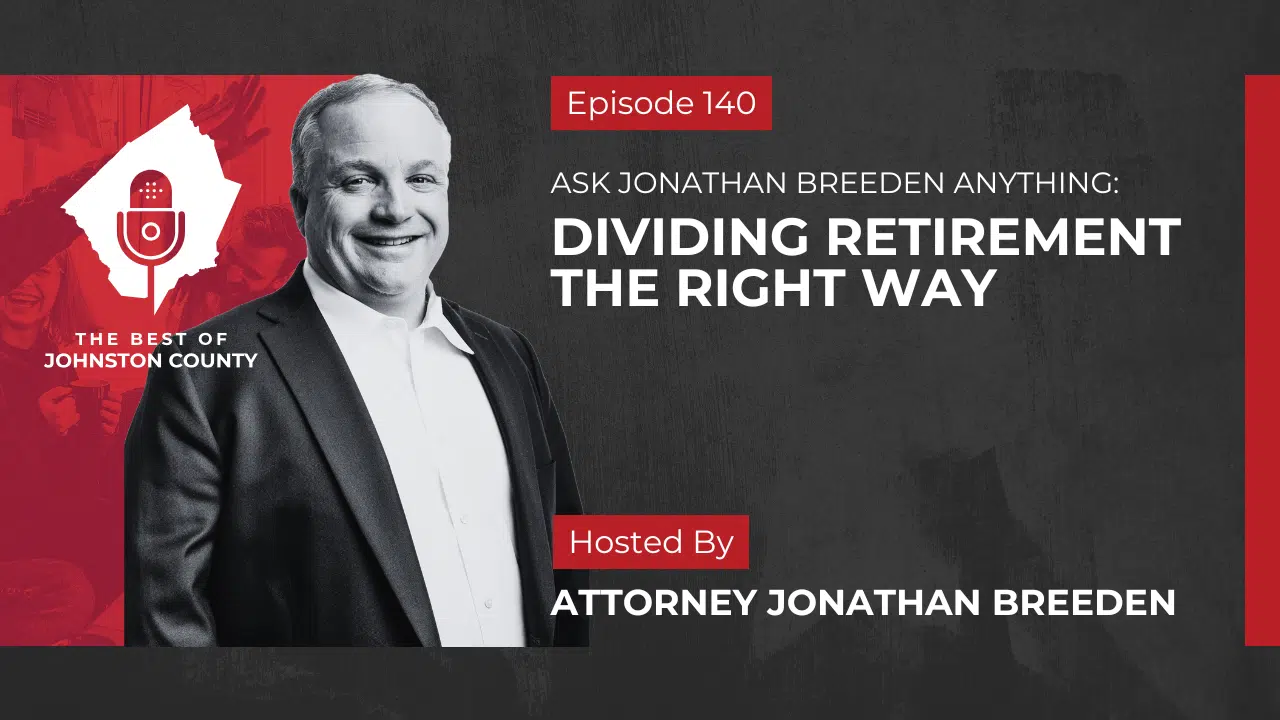
Dividing Retirement the Right Way
Jonathan Breeden: [00:00:00] On this week’s episode of The Best of Johnston County Podcast, we’re doing a special edition episode that we like to call Ask Jonathan Breeden Anything.
And in this one, I talk to Raena Burch a little bit about 401ks, how they’re divided in a divorce, what counts as the marital portion of a 401(k), what happens to pensions in a divorce, and other types of retirement accounts. So if you’re interested in what happens to your 401(k), your IRA, or your pension if you were to go through a divorce, listen in.
Welcome to another episode of Best of Johnston County, brought to you by Breeden Law Office. Our host, Jonathan Breeden, an experienced family lawyer with a deep connection to the community, is ready to take you on a journey through the area that he has called home for over 20 years. Whether it’s a deep dive into the love locals have for the county or unraveling the complexities of family law, Best of Johnston County presents an authentic slice of this unique community.
Jonathan Breeden: Hello, and welcome to [00:01:00] another edition of the Best of Johnston County Podcast. I’m your host, Jonathan Breeden, and on today’s episode, we’re having a special edition episode that we’d like to call Ask Jonathan Breeden Anything.
And on this episode, I, Jonathan Breeden, am gonna answer some family law questions as it relates to retirement accounts and how they get divided in a divorce, from our social media coordinator, Raena Burch. But on most episodes of the Best Johnston County podcast, I, Jonathan Breeden, interview interesting community members, community leaders local politicians, small business owners, about the services they provide to the citizens of Johnston County and why they love Johnston County as much as I do, and they almost always say the people.
But this is a special edition one where we’re gonna talk a little bit about what happens to retirement accounts in a divorce. But before we get to that, we’d like to ask you to like, follow, subscribe to this podcast wherever you see it, whether it be on Apple, Spotify, YouTube, TikTok, LinkedIn, X, or any of the other social media channels of Best Johnston County [00:02:00] podcast.
The Best Johnston County podcast comes every single Monday, and has now for over 30 months. So go back and listen to some of our previous episodes. We’ve had the vast majority of the county commissioners, we’ve had a lot of local businesses like Just Dog People local dentist Tim Sims. We had Woody Bailey talking about IT stuff.
We had the county economic development director. Lots of great information on this podcast. If you love Johnston County as much as I do, this is the podcast for you. Welcome, Raena.
Raena Burch: Welcome, Jonathan.
Jonathan Breeden: All right, we’ll see how this goes.
Raena Burch: Are you ready? This is a big, this is an important topic for a lot of people.
Jonathan Breeden: Well, it is, and I don’t really know what the questions are, so we’ll see how this goes. That’s my favorite part. Maybe I know the answers.
Raena Burch: That’s my favorite part, you don’t know what they are. So okay. So first question, how do courts determine what part of a 401(k) or pension is considered marital property, and what part belongs to just one spouse?
Jonathan Breeden: Okay. If the 401(k) or pension is earned during the marriage
Raena Burch: Mm-hmm
Jonathan Breeden: and there is no prenup, and in 99.9% of divorces, there’s not a prenup.
Raena Burch: Yeah.
Jonathan Breeden: Then it is [00:03:00] considered marital property. All property, whether it be real or money or whatever.
Raena Burch: Yeah.
Jonathan Breeden: That is amassed between the date of marriage and the date of separation is considered marital property. So if you are contributing to a 401(k) during the marriage and your employer is matching the 401(k).
Raena Burch: Yeah.
Jonathan Breeden: Based on the work you did during the marriage, then it is going to be marital, as is the growth, right? A lot of it, you know, like the market has done really well over the last 10 or 15 years.
Raena Burch: Yeah.
Jonathan Breeden: And so, you know, I mean, I think it’s maybe doubled twice in the last 15 years
Raena Burch: Oh, probably.
Jonathan Breeden: Or I mean, not, maybe not quite.
Raena Burch: Yeah.
Jonathan Breeden: Twice, but it’s a lot. It’s done really well.
Raena Burch: Yeah.
Jonathan Breeden: So that growth is also part of what would be in the marriage. And so the vast majority of the time when we’re doing a divorce the entire 401(k) is marital.
Raena Burch: Got it.
Jonathan Breeden: But not always.
Raena Burch: Okay.
Jonathan Breeden: Times you see it where it’s not is when you get married and you already have a [00:04:00] 401(k). And you just continue contributing to the 401(k) you already had.
Raena Burch: Yeah.
Jonathan Breeden: And in that situation, you look at what the 401(k) was on the date of marriage. You attempt to try to figure out what the growth on that amount would’ve been during the marriage. You could look at the history of the stock market. You could look at what was actually in the 401(k).
Raena Burch: Yeah.
Jonathan Breeden: Which funds, was it American Fund ABC.
Raena Burch: Yeah, definitely.
Jonathan Breeden: 234. And, you know, American Fund ABC was worth $20 a share on the date of marriage, and now American Fund ABC is worth $50 a share, so you can sort of figure out what it would’ve been, what…
You know, you’re gonna get some of the growth on the separate part
Raena Burch: Yeah
Jonathan Breeden: as well. You can’t just look at it and say
Raena Burch: You can’t just look at the contribution, it’s also the growth.
Jonathan Breeden: Right. Well, and you also can’t just look at it and say, “Well, I had- 30,000 on the date of marriage and I have 100,000 on date of separation, so 70,000’s marital, right?
Because [00:05:00] some of that 100,000 is the growth on the 30,000.
Raena Burch: Yeah.
Jonathan Breeden: And so the growth during the marriage of the separate part of the 401is still your separate property.
Raena Burch: Interesting.
Jonathan Breeden: So what we have to do is go in and see if we can figure out, and if there’s a lot of money involved and it gets complicated, you can hire CPAs and financial people
Raena Burch: Oh, okay
Jonathan Breeden: to do it. But most of the time, for most people, we can figure out what was in it, what it was worth, you know
Raena Burch: Yeah
Jonathan Breeden: everything that’s ever happened to stock market’s online. Every fund, what it was worth every day
Raena Burch: Yeah
Jonathan Breeden: is online, and we can usually be able to figure it out as to what it was. But, that’s the majority of them.
Raena Burch: Gotcha. Okay. And so it sounds like, you know, if you already have a 401, this might be people who are getting married later on in life or getting married again or, you know.
Jonathan Breeden: Right. Well, or people that started working professionally at 22 or 23
Raena Burch: Yeah
Jonathan Breeden: where there was a 401.
Raena Burch: Yeah.
Jonathan Breeden: We provide that for the employees here. We got a lot of young employees here
Raena Burch: Yeah
Jonathan Breeden: that have 401s that are not married.
Raena Burch: Yeah.
Jonathan Breeden: So you know, it just depends on when you get into a, a thing where that is being offered.
Raena Burch: Yeah.
Jonathan Breeden: And [00:06:00] now under the new big beautiful bill that was passed last year by Congress, the Trump signature piece of legislation
Raena Burch: Mm-hmm
Jonathan Breeden: if you’re offering a 401k to any of your employees they are automatically enrolled into the 401at one year.
Raena Burch: Oh.
Jonathan Breeden: And so they have to physically opt out of it, or they will automatically be enrolled-
Raena Burch: Gotcha
Jonathan Breeden: because the Congress and President Trump wanted to see more people involved in saving for their retirement sort of automatically
Raena Burch: Yeah
Jonathan Breeden: so that they’re not so reliant on Social Security.
Raena Burch: Yeah. Okay. Good to know. I did not know that the growth on the 30,000 is separate from the… Okay. That’s very interesting. So, okay, second question. If a retirement account is only in one spouse’s name, can the other spouse still get a portion?
Jonathan Breeden: Yes. The entire account that is amassed during the marriage, as we just talked about.
Raena Burch: Yeah.
Jonathan Breeden: Is to be divided as part of the total marital assets. And so, yes, the other spouse is entitled to [00:07:00] a portion of that 401(k). What often happens is you try to figure out sort of what the 401(k). A 401(k) is not cash, right?
Raena Burch: Yeah.
Jonathan Breeden: It is tax-deferred retirement account. So at some point, somebody’s gonna pay taxes on it when it comes out.
Raena Burch: Yeah.
Jonathan Breeden: So we have to see if we can’t figure out what a cash value would be on the 401(k) versus the actual cash value of a house.
Raena Burch: Yeah.
Jonathan Breeden: Which is now, you sell the house, you get the cash.
Raena Burch: You get it now, yeah.
Jonathan Breeden: Right. And you don’t owe 30% taxes on it or whatever your tax rate is. So we have to sort of figure out what is it actually worth in real dollars compared to the other assets that are real dollars, like cars and houses and collectibles and stuff like that. So we do work on that, but yes, regardless of whose name it is in the other side is entitled to it. Now, sometimes, or a lot of times, if the equity in the house matches the 401(k), or we can figure out some way to do it.
Raena Burch: Yeah.
Jonathan Breeden: We’ll just leave the [00:08:00] 401(k) with the person it is and give the other person assets to offset it.
Raena Burch: Yes.
Jonathan Breeden: Like, you get $150,000 401(k) and I get $125,000 equity in the house.
Raena Burch: Yeah.
Jonathan Breeden: And then we don’t have to actually divide it.
Raena Burch: Yeah.
Jonathan Breeden: But now if you end up getting part of your spouse’s 401(k), that’s not coming to you as cash.
Raena Burch: Yep.
Jonathan Breeden: That’s coming to you as a qualified 401(k) through a, what’s called a qualified domestic relations order.
Raena Burch: Yeah.
Jonathan Breeden: And for you to access it, you’re going to have to pay the taxes on it to pull it out, and you will have to pay an early withdrawal penalty of 10% if you draw it out before you’re 59 and a half.
Raena Burch: Yeah.
Jonathan Breeden: Unless you get it in a divorce, you get one time to withdraw as much as you want without paying that 10% early withdrawal penalty.
Raena Burch: Gotcha. So that actually goes into our next question.
Jonathan Breeden: Okay.
Raena Burch: So what is, like, so you just said it, but for everybody else listening, we call it, in the business, we call it a QDRO, right?
Jonathan Breeden: Right.
Raena Burch: A Q-D-R-O.
Jonathan Breeden: Right.
Raena Burch: So what does that stand for?
Jonathan Breeden: A [00:09:00] qualified domestic relations order.
Raena Burch: Okay. So what is a qualified domestic relations order, and why can failing to get one properly drafted cost someone thousands of dollars?
Jonathan Breeden: Well, a Qualified Domestic Relations Order is an order that divides qualified money. And qualified money is money where the tax has been deferred. So a 401(k) is tax-deferred. The taxes have not been paid on this yet.
Raena Burch: Yeah.
Jonathan Breeden: And need to be paid. And so in order to create a new 401(k) account from your spouse’s 401(k) account, you have to draft what is somewhat of a convoluted, complex order that has a lot of gobbly gook in it.
Raena Burch: Yeah.
Jonathan Breeden: I mean, really. Luckily, many of the bigger funds have models you can use to go by.
Raena Burch: Yeah.
Jonathan Breeden: Because it’s basically governed by federal tax law, it has to have a whole bunch of stuff that doesn’t make a ton of sense to [00:10:00] me, because I’m not a tax attorney.
Raena Burch: Yeah.
Jonathan Breeden: And I’m not a CPA. But you have to have it in there.
Raena Burch: Yeah.
Jonathan Breeden: Because the IRS wants to make sure that they’re tracking this, so they know how to get paid on it, right?
Raena Burch: Yeah.
Jonathan Breeden: When it gets cashed out. And they know where it’s at, who’s getting it, and where it exists. So this is very important. And so these orders, order the plan administrator
Raena Burch: Mm-hmm
Jonathan Breeden: fidelity, let’s say, they’re the biggest one.
Raena Burch: Yeah, they’re the biggest one.
Jonathan Breeden: To create a new account in the separate spouse’s name that is also qualified. And so Fidelity then has two. They will then put this money in there, and then it will be under the complete management and ownership of the new spouse once it’s approved.
But the QDRO, it may take two or three or four attempts to get it approved by the plan administrator, ’cause the plan administrator is answering to the IRS. Yeah. And they don’t need any problems with the IRS.
Raena Burch: No.
Jonathan Breeden: A judge will. A district court judge in North Carolina has to [00:11:00] sign the QDRO. And everybody has to agree to the wording on it. And the district court judge is happy to sign it if you bring it to him, but they don’t know whether it’s gonna be accepted or not.
Raena Burch: Yeah. And they’re also not a tax attorney.
Jonathan Breeden: Right. Right. And they’re also happy to sign amended QDROs.
Raena Burch: Yeah.
Jonathan Breeden: If your first one gets rejected for some reason.
Raena Burch: Yeah.
Jonathan Breeden: And but the plan administrator gets up to 90 days after they receive the order. So you settle the case. You and the other side settle the case. You enter in a consent order for equitable distribution of property.
Raena Burch: Yeah.
Jonathan Breeden: That says that $100,000 of this 401(k) with Fidelity is gonna be transferred to wife.
Raena Burch: Yeah.
Jonathan Breeden: And wife’s gonna have it. Okay, you do that. Then one attorney or somebody has to draft up the QDRO.
Raena Burch: Yeah.
Jonathan Breeden: Get everybody to sign it as a consent order, ’cause it’s a court order of the court.
Raena Burch: Yep.
Jonathan Breeden: You take it to the judge, the judge signs it, then it goes to the plan administrator. The plan administrator gets up to 90 days to determine whether it qualifies as a [00:12:00] properly drafted, Qualified Domestic Relations Order.
Raena Burch: Mm-hmm.
Jonathan Breeden: And if they don’t believe that it does, for whatever reason, they will send it back with a letter saying, “You did this wrong,” and the process starts over again. You edit the order. You get everybody to sign it, both spouses, both attorneys. You submit it back to the judge. The judge signs the amended one.
You send it back to the plan administrator. They get another 90 days to decide whether it’s right.
Raena Burch: Yeah.
Jonathan Breeden: And maybe it’s right, maybe it’s not.
Raena Burch: Yeah. Kind of sounds like the DMV when like every time.
Jonathan Breeden: Right.
Raena Burch: You come in, they’re like.
Jonathan Breeden: Right.
Raena Burch: “Oh, you also need this.”
Jonathan Breeden: Correct.
Raena Burch: “And you also need this, and like, each time it’s a new thing.”
Jonathan Breeden: You’re right, Raena. You’re absolutely right. But then hopefully at some point, at first, second, sometimes third try, you get a letter saying, “We have accepted this as a qualified domestic relations order. We are going to process it, and we’re going to move X amount of money from husband’s account to wife’s account.”
Wife gets a letter, she gets a login to the website once it’s created, a password, and [00:13:00] then she can use it however she wants. She can cash it immediately and pay all of the taxes. Now, I advise against that because it will change your tax bracket in a hurry
Raena Burch: Yep
Jonathan Breeden: especially if you are taking it all in a lump sum. And you may have been in a 15 or 18% tax bracket, and all of a sudden you’re in a 37% tax bracket. Yeah. So I do believe if you are the one receiving this money, you need to talk to a financial planner, you need to talk to somebody at Edward Jones or wherever and get them to help you come up with a plan, because immediately cashing it is probably the worst thing you can do.
And unfortunately, that is what the majority of our clients do.
Raena Burch: Oh, yeah.
Jonathan Breeden: It’s like they won the lottery.
Raena Burch: I was about to say, it’s like the lottery.
Jonathan Breeden: Right.
Raena Burch: Yeah.
Jonathan Breeden: And, and it just, it, it’s just not a good idea because they get t- they, they just change tax brackets. If you need to access it, then you need to come up with a plan [00:14:00] so you don’t end up getting knocked out of a bunch of tax brackets
Raena Burch: Yeah
Jonathan Breeden: and all of a sudden your taxes, you know, if, if you were to take some small amount every year, yeah, you may have to pay that 10% early withdrawal, but it’s better than being jumping 20 or 25% on a tax bracket.
Raena Burch: On a tax, yeah.
Jonathan Breeden: The other thing is, these are appreciating assets. The stock market does go up.
Raena Burch: Yeah.
Jonathan Breeden: And so it is one of the few things that you can almost count on actually increasing in value. Houses have been largely flat in this area
Raena Burch: Yeah
Jonathan Breeden: for the last three or four years, as interest rates are 6 or 7%.
Raena Burch: Yeah.
Jonathan Breeden: But the stock market keeps going up 6, 7, 8, 9% a year. So, you know, it is something that will appreciate when almost everything else that you own, from cars to anything else, are depreciating.
Raena Burch: Mm-hmm.
Jonathan Breeden: And houses and real property are, can often just remain flat.
Raena Burch: Yeah.
Jonathan Breeden: So it can be one of the best investments you can get, but everybody makes their own decision.
Raena Burch: Yeah. It’s up to, it’s up to everybody, but that was good advice. I think people should definitely listen to that.
Have family law [00:15:00] questions? Need guidance to navigate legal challenges? The compassionate team at Breeden Law Office is here to help. Visit us at www. breedenfirm. com for practical advice, resources, or to book a consultation. Remember, when life gets messy, you don’t have to face it alone.
Raena Burch: Okay, four. Are all retirement accounts divided the same way in a divorce, or are there different rules for things like pensions, military retirement, 401(k)s, IRAs, all of that?
Jonathan Breeden: They are divided differently depending on how they are structured and how they are valued.
Raena Burch: Okay.
Jonathan Breeden: Ultimately, all of these things are gonna be valued, and you’re trying to come up, if you can, maybe with a total value to see if something else can offset it. A true pension is never gonna be offset with real property or cars or boats.
Raena Burch: Yeah.
Jonathan Breeden: Or any of that. Unless you’ve got.
Raena Burch: A lot.
Jonathan Breeden: A lot.
Raena Burch: Yeah.
Jonathan Breeden: Because a pension will [00:16:00] pay forever, and people are now living very long periods of time.
Raena Burch: Yeah.
Jonathan Breeden: So, most of the time when you see a pension, the pension is divided by taking the number of years that the person worked at the firm. Okay, you take the number of marital years that coincide with the person working at the place, whether it be the military or the post office or wherever the pension is.
Raena Burch: Yep.
Jonathan Breeden: And you actually do it in months. And so if you were married 10 years, you put 120 months as the numerator.
Raena Burch: Mm-hmm.
Jonathan Breeden: I hope I’m right about this. I’m not good at math, but a numerator.
Raena Burch: The top one.
Jonathan Breeden: Right. If the person worked there for 20 years, the denominator becomes 240.
Raena Burch: Mm-hmm.
Jonathan Breeden: You divide 240 into 120, you get 50%.
Raena Burch: Yeah.
Jonathan Breeden: And then the spouse is entitled to half of that. So they would get, they would be entitled to 25% of that pension if they were there for half of the time that it was earned. And then you would do a pension division order. Similar [00:17:00] to a qualified domestic relations order, but a little bit different ordering that pension fund to pay the pension, to pay a certain percentage of the pension to the other person when the spouse starts collecting.
Raena Burch: Yeah.
Jonathan Breeden: Right? So you get divorced at 45, and the pension won’t pay till 65. The wife can’t start then getting paid
Raena Burch: Yeah
Jonathan Breeden: right? Like, the wife has to wait until the husband chooses to start receiving. Now, husband may decide to work till 70, 71, 72
Raena Burch: mm-hmm
Jonathan Breeden: before, and, and so they’re not gonna pay it before the other person starts receiving it. Yeah. Yeah. So it is a little bit… You can get a pretty good idea of what you’re gonna get, but you don’t really control, if you’re the spouse of, say, the wife, when you’re gonna start getting it, because it’s based on when the husband chooses to retire and start getting the pension.
Raena Burch: Start getting, yeah. Okay. Da- I did not know all of that
Jonathan Breeden: Right. [00:18:00] Well, and with the military
Raena Burch: Oh …
Jonathan Breeden: we probably do a whole podcast on that
Raena Burch: Oh, we could do a whole podcast on that
Jonathan Breeden: Well, we do a whole podcast on military retirement, and we probably will since we always do a podcast.
Raena Burch: Yeah.
Jonathan Breeden: But the trick about the military is now they have this frozen benefit rule.
And it’s based on the retirement that the soldier would’ve received at the rank they were at the date of separation, not at the rank they are when they retire. So what was happening was these military members were getting divorced as-
Raena Burch: An E5
Jonathan Breeden: as an E5
Raena Burch: Yeah
Jonathan Breeden: and retiring as an E8 or an O1 or, or, you know
Raena Burch: Something else
Jonathan Breeden: yeah … or something else, or they’re, they’re getting divorced at a let’s say a, a captain
Raena Burch: Yeah
Jonathan Breeden: and they’re retiring as a colonel. You know, and so the retirement differences are substantial.
Raena Burch: Yes.
Jonathan Breeden: I mean, you’re talking about three or four times per month.
Raena Burch: Yeah.
Jonathan Breeden: And, you know, spouse that wasn’t there for the last 10 or 15 years while they were earning that was getting a big benefit.
Raena Burch: Yeah.
Jonathan Breeden: And they don’t do that anymore. Yeah. So now the military figures out what their [00:19:00] retirement would be if they would’ve had their full retirement at whatever rank they were at the date of separation.
Raena Burch: Gotcha. I’m a former military spouse, and even I didn’t know that, so that’s good information. Okay, last question. What’s the biggest mistake you see people make when dividing retirement assets?
Jonathan Breeden: I think the biggest mistake is they don’t get them valued correctly. And they cash them, right? I mean, they just get it and they cash it, and that’s it. I think it needs to be valued correctly. Pensions are worth way, way, way more than anything else because of the sort of lifetime value of them.
And when they do finally get the 401(k) or the IRA or whatever, the first thing they wanna do is cash it like they’ve won the lottery.
Raena Burch: Yeah.
Jonathan Breeden: And then they end up blowing it on stuff.
Raena Burch: Yeah.
Jonathan Breeden: You know what I’m saying? And it could have benefited them tremendously down the road. I mean, if you get a 401(k) at 40 years old and you don’t touch it, it will be worth two, three, maybe four times what it [00:20:00] was when you got it.
Raena Burch: Yeah.
Jonathan Breeden: When you go to retire at 65 or 70.
Raena Burch: Yep.
Jonathan Breeden: I mean, literally.
Raena Burch: Yeah.
Jonathan Breeden: And so, but if you cash it and you spend it, which is what people do, it’s gone.
Raena Burch: Yeah.
Jonathan Breeden: And it could have been the nest egg for a very nice retirement if you could have just left it alone.
Raena Burch: Yep. All right. Well, that’s all the questions I have.
Jonathan Breeden: All right. Well, great. So anyway, if you’re listening to this, you have any questions about what would happen if you got divorced, or if you’re in the middle of a divorce and it relates to these retirement accounts, which are often the largest single asset, give us a call here at the Breeden Law Office at 919-661-4970.
As we mentioned earlier, please like, follow, subscribe to this podcast wherever you see it so that you’ll be aware of future episodes of the Best of Johnston County podcast. Best of Johnston County podcast comes out every single Monday, and we love bringing it to you. We’re gonna continue bringing it to you in the future.
If you do, give us a five-star review down below, that would help us with our visibility, and tag us in your Instagram stories, Best of Johnston County. Until next time, I’m your host, Jonathan [00:21:00] Breeden.
That’s the end of today’s episode of Best of Johnston County, a show brought to you by the trusted team at Breeden Law Office. We thank you for joining us today and we look forward to sharing more interesting facets of this community next week. Every story, every viewpoint adds another thread to the rich tapestry of Johnston County.
If the legal aspects highlighted raised some questions, help is just around the corner at www. breedenfirm. com.
Most people don’t spend much time thinking about retirement accounts until they’re planning for retirement. Unfortunately, divorce often forces those conversations much sooner.
In this special edition of The Best of Johnston County Podcast, Jonathan Breeden sits down with social media coordinator Raena Burch to answer some of the most common questions clients have about dividing retirement assets during divorce. From 401(k)s and pensions to Qualified Domestic Relations Orders, this episode breaks down a complicated subject into practical advice anyone can understand.
What Makes a Retirement Account Marital Property?
One of the first questions people ask is whether a retirement account belongs entirely to the person whose name is on it.
According to Jonathan, the answer usually surprises people.
In North Carolina, retirement savings accumulated during the marriage are generally considered marital property. That includes employee contributions, employer matching contributions, and even the investment growth earned while the couple was married.
Things become more complicated when someone already had a retirement account before getting married. In those situations, the original balance may remain separate property, but determining how much of the account belongs to each spouse requires looking at both the original investment and the growth it experienced during the marriage.
That is why accurate financial records become so important.
Why the Name on the Account Doesn’t Matter
Many people assume that if only one spouse’s name appears on a retirement account, the other spouse has no claim to it.
Jonathan explains that this simply is not how equitable distribution works.
The court looks beyond whose name appears on the account and instead focuses on when the money was earned. If the retirement savings were accumulated during the marriage, both spouses may have a legal interest in those assets.
In many divorces, attorneys work to balance retirement accounts with other marital assets. Instead of dividing every account, one spouse may keep the retirement account while the other receives a greater share of home equity or other property with comparable value.
That approach can simplify the division process while still producing an equitable outcome for both parties.
Understanding the QDRO Process
One of the most important parts of dividing a retirement account is something most people have never heard of before divorce: the Qualified Domestic Relations Order, commonly called a QDRO.
Jonathan explains that a QDRO is the legal document required to transfer money from one spouse’s qualified retirement account into a new qualified account for the other spouse without creating immediate tax consequences.
Although the concept sounds straightforward, the paperwork often is not.
Every retirement plan has specific requirements, and plan administrators carefully review each order before approving it. If the document contains errors or missing language, it is sent back for revisions, restarting the approval process.
Because these accounts involve federal tax law, getting the order drafted correctly can save both time and significant expense.
Thinking Before Cashing Out
One of the biggest temptations after a divorce is treating a newly divided retirement account like a financial windfall.
Jonathan cautions against that mindset.
While individuals who receive funds through a QDRO have a one-time opportunity to withdraw money without paying the typical early withdrawal penalty, they are still responsible for income taxes on the distribution. Taking a large lump sum can push someone into a much higher tax bracket, reducing the long-term value of the account.
Instead, Jonathan encourages people to speak with a financial advisor before making any major decisions. Retirement accounts are designed to grow over time, and leaving those investments untouched may provide far greater financial security later in life than spending the money immediately.
Why Pensions Are Different
Not every retirement benefit is divided the same way.
Unlike a 401(k), a traditional pension represents future monthly income rather than an account balance that can simply be split. Because of that, pensions require their own legal process and are often divided based on how long the marriage overlapped with the employee’s years of service.
Jonathan explains that courts typically calculate the percentage earned during the marriage and award the non-employee spouse a portion of that benefit once the pension begins paying.
Military pensions add another layer of complexity. Changes in federal law now calculate benefits differently than they once did, making it even more important to work with an attorney who understands the rules governing military retirement.
Every retirement plan has its own procedures, and understanding those differences can make a significant impact on the outcome of a divorce.
The Biggest Mistakes People Make
After handling family law cases for many years, Jonathan sees the same mistakes happen over and over again.
The first is failing to properly value retirement assets before dividing them. Without understanding their true long-term worth, people may unknowingly trade away one of the most valuable assets in the marriage.
The second mistake is treating retirement savings like lottery winnings.
Jonathan explains that many people immediately cash out their portion of a retirement account, pay unnecessary taxes, and spend the money within a short period of time. What could have become a substantial retirement nest egg disappears almost overnight.
His advice is simple. Think long term. Retirement accounts are investments designed to appreciate over time, and patience often provides the greatest return.
Final Thoughts
Dividing retirement assets during a divorce can seem overwhelming, but understanding how these accounts work helps people make better financial decisions during an already difficult time.
Throughout this Ask Jonathan Breeden Anything episode, Jonathan reminds listeners that retirement accounts are often among the largest assets a couple owns. Taking the time to value them correctly, understand the legal process, and avoid costly mistakes can make a lasting difference long after the divorce is finalized.
Whether you’re preparing for divorce or simply planning for the future, knowing how retirement assets are treated today can help protect your financial tomorrow.
Thank you for joining us for this episode of The Best of Johnston County Podcast. Stay tuned for more conversations that inspire connection and growth.
AND MORE TOPICS COVERED IN THE FULL INTERVIEW!!! You can check that out and subscribe to YouTube.
Connect with Jonathan Breeden:
- Website: https://www.breedenfirm.com/
- Phone Number: Call (919) 726-0578
- Podcast: https://breedenlawpodcast.com/
- YouTube: https://www.youtube.com/@BestofJoCoPodcast
Listen On