
August 24, 2026
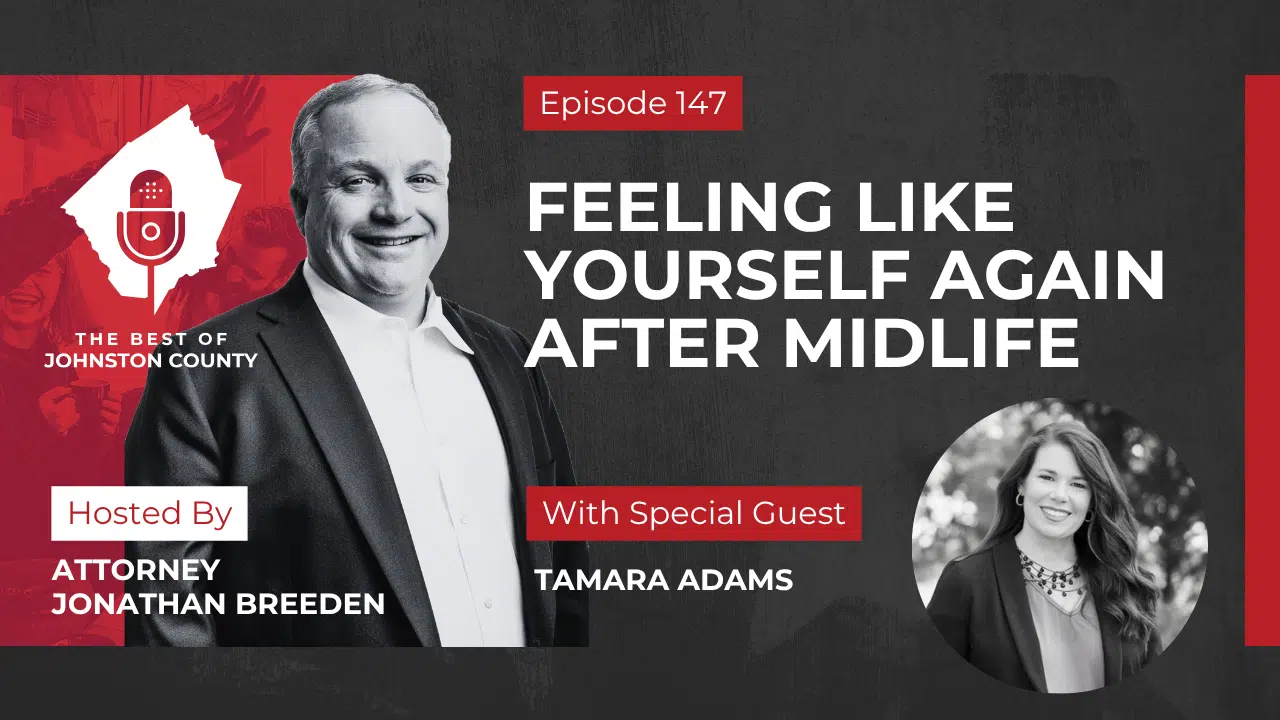
Feeling Like Yourself Again After Midlife
Jonathan Breeden: [00:00:00] On this week’s episode of The Best of Johnston County podcast, our guest is Tamara Adams, the owner of Revival Hormone Health in Garner, North Carolina. We talk to her about her time growing up and becoming a pharmacist, why she decided to start a hormone health business, how hormone health affects your daily life, and how you can feel better pretty quickly if you just know what the problems are.
So listen in.
Welcome to another episode of Best of Johnston County, brought to you by Breeden Law Office. Our host, Jonathan Breeden, an experienced family lawyer with a deep connection to the community, is ready to take you on a journey through the area that he has called home for over 20 years. Whether it’s a deep dive into the love locals have for the county or unraveling the complexities of family law, Best of Johnston County presents an authentic slice of this unique community.
Jonathan Breeden: Hello, and welcome to another edition of the Best of Johnston County Podcast. I’m your [00:01:00] host, Jonathan Breeden, and on today’s episode, we have Tamara Adams, the owner of Revival Hormone Health in Garner, North Carolina. We’re gonna talk to her a little bit about why she started this hormone program, what it is, how her and her partners can help you feel better, live better, and possibly live longer.
But before we get to that, I’d like to ask you to like, follow, and subscribe to this podcast wherever you see it, whether it be on Apple, Spotify, YouTube, TikTok, X, LinkedIn, or any of the other social media channels of the Best Johnston County Podcast. The Best Johnston County Podcast comes out every single Monday, and has now for just under three years.
It’s hard to believe me saying that but it’s getting close to three years. In November of 2026 will be three years. So we’ve enjoyed bringing this to you. Go back and listen to some of our previous episodes. We’ve had Carolina Packers the hotdogs. We’ve had just dog people. We had Judge Addie Rawls talking about what it was like to be a judge, her story, [00:02:00] fascinating stuff.
If you love Johnston County as much as I do, this is a podcast for you. Welcome, Tamara.
Tamara Adams: Thanks so much.
Jonathan Breeden: So anyway, we were talking before we got on there, not exactly sure w- what, what, what, what all you do. We did have GameDay Men’s Health on about a year ago. I understood a little more of what he was trying to do ’cause it was all about testosterone.
So tell the audience who you are and what you do.
Tamara Adams: Sure. We’re gonna- … we’re gonna revolutionize your understanding by the end of our time together.
Jonathan Breeden: I hope so.
Tamara Adams: So I’m Tamara Adams founder of Revival Hormone Health, and I’m a clinical pharmacist practitioner. What we do is we help people feel like themselves again, and then what we find is by the time they feel like themselves again, three, six, nine months after working together, they wanna know how they can feel that good when they’re 80 and not just 50, right?
So then we work towards longevity, making sure that we’re preventing heart attacks, strokes, and that we’re keeping you as healthy as possible for your lifespan so that we’re healthy as long as we live.
Jonathan Breeden: Okay. Well, that’s great. That’s great. Well, let’s [00:03:00] start with how did you end up here? Where, where’d you go to school?
Where’d you grow up? All that good stuff.
Tamara Adams: Yeah. So I’m native to Wake County. I grew up in Knightdale and then went to UNC Chapel Hill Pharmacy School. I worked in hospital pharmacy for a long time, and then as my kids got older, I backed off of that and have been helping my husband in his dental practice for a while now.
I launched Revival Hormone Health about a year ago. Honestly, because I saw time on the horizon. My youngest was about to get his license, and I had 20 to 25 hours a week coming back to me, and I just really was, you know, kind of praying about what is the right next step for me and where God was leading me, and this is where he led me to.
So, that’s, that’s my background.
Jonathan Breeden: Okay. So what were some of your first steps in. Did you go get some more education about this? Like, what did you do to sort of get ready to start this business?
Tamara Adams: Sure. Like most people, my personal story is what kind of drove this interest and this [00:04:00] understanding. Around 2020, began having issues with sleeping, new onset anxiety, increased heart rate, frozen shoulder, and it took me a little while to realize, oh, this is hormones and not just the state of the world in 2020. And as I was figuring that out and learning about it, I realized that there are so many women and men who are out there suffering with hormone issues, especially as they approach midlife.
For me, it was hormone replacement therapy plus some thyroid adjustment that I never quite got at my traditional providers. I also realized how important sleep and nutrition and movement, especially strength training, and stress management was in my overall health and wellbeing. And so as I was having those issues, I sought out training in functional medicine.
I’ve done bioidentical hormone replacement therapy training academy, BHRT [00:05:00] Training Academy for short. Done some additional training with IFM and A4M and other acronyms that you don’t understand if you’re not in that world, but a great deal of training and certifications in order to be ready to, and equipped to provide this kind of service for people.
Jonathan Breeden: Okay. And so who are your ideal clients? Like, everybody says, you know, in marketing, “Who’s your client avatar?”
Tamara Adams: Right.
Jonathan Breeden: Right? You know, here at The Breeden Law Office, our client avatar is mid-career professional who, for whatever release, for whatever reason, their relationship is not working out, and they’re gonna need a divorce or child custody or child support and stuff like that. Who is your client avatar?
Tamara Adams: Yeah, my avatar is surprisingly similar to yours.
Jonathan Breeden: Okay. Yeah.
Tamara Adams: I’m not always, but I serve people anywhere from age 30 to age 60-something. But the common thread is someone who is struggling with symptoms that they have not been able to gain control of in the traditional medical world, right?
Like, [00:06:00] nobody seems to be owning this right now. Like, my primary care provider told me, “We don’t do that here.” My OBGYN was like, “Oh, it’s a phase, and you’ll get through it.” And I realized there was more out there that I was not accessing through my regular channels. So really women who are younger, who are struggling with heavy cycles, irregular cycles, new onset irritability or anxiety is very common in younger women.
Midlife men who are experiencing maybe depression for the first time in their lives, and that’s not common for them, a lot of time that’s an indication of testosterone issues. Women who are menopausal who are concerned about their bone strength, their heart health, and their brain health as they age are becoming more interested in hormone replacement therapy because there is strong data to support that protecting your body and your [00:07:00] heart and your bones and your brain.
Jonathan Breeden: Okay. So how does it work? You know, I mean, do you get an IV? Do I get a shot? Like, exactly how are these hormones replaced?
Tamara Adams: Okay. Good question. So when we work with people, we spend an hour and a half learning about your history, your health history, and then we look at a lot of different labs. So blood labs, sometimes stool, sometimes saliva sometimes DNA.
It depends on what your symptoms are and what your issues are and what our goals are. From there, we look at hormones, meaning sex hormones, estrogen, progesterone, testosterone. We look at thyroid, we look at cortisol, we look at insulin, because they all do this magic dance together. And if one is off, a lot of the rest of them can be off, too.
So we wanna make sure we’re identifying the root cause of your issues and addressing those. So for example, let’s say you have a client here who is struggling in midlife. We [00:08:00] check her levels, and her thyroid is a little off, and she is newly menopausal, and she is struggling with hot flashes and night sweats, and it’s impacting her daily life. What we may do for her is to find out why she’s having thyroid issues, and then address that appropriately.
Usually that would be with supplements or a prescription. If she’s having night sweats and hot flashes, she may need estrogen and progesterone, and estrogen would be topical in a patch or a cream, can be injection, but we don’t typically start that way. And then progesterone is often just an, a capsule you get at your pharmacy.
Jonathan Breeden: Okay. So I know with testosterone, if you start taking it, your body will stop making it. Does that work that way with estrogen too?
Tamara Adams: Great question. It really does not. So the thing in your body that makes estrogen primarily is your ovaries, and so once you’re no longer cycling and you are fully [00:09:00] menopausal, your ovaries have stopped making estrogen.
Other parts of us try to pick up the, the mantle and make estrogen, but they make a different kind of estrogen that doesn’t protect us as much as estradiol, which is what our ovaries make. So it’s not so much that when you start, your body stops making it, it’s that, do we need this now or not? So, a lot of times…
Or, or what we’re finding is that women who are three to four years before menopause, that three to four years is when the most change happens in their bones, and in their brain, and in their heart. And so we’re looking at beginning hormone replacement therapy earlier and earlier if we’re thinking in terms of protection.
And so depending on someone’s family history, that’s a consideration that they may want to make. But back to your question, if you replace it, your body is still making it. We’re not overcoming our biology with [00:10:00] supplementing estrogen and progesterone. But at some point- Our woman’s body is gonna quit making estrogen and progesterone.
And fun fact, men also have estrogen and progesterone in their bodies, just like women have testosterone.
Jonathan Breeden: I did know that. I don’t know how much, but I did know that. I don’t know a lot about medicine. I try to stick to divorce lawyering. But,
Have family law questions? Need guidance to navigate legal challenges? The compassionate team at Breeden Law Office is here to help. Visit us at www. breedenfirm. com for practical advice, resources, or to book a consultation. Remember, when life gets messy, you don’t have to face it alone.
Jonathan Breeden: so if somebody were to reach out to you, what’s the first thing? What is the first thing y’all are gonna do, and what are some of the options they’re gonna be presented with?
Tamara Adams: Sure. We spend about 30 minutes on a phone call. The phone call is totally free. It can be scheduled on our website. But that [00:11:00] gives me a chance to explain in more depth our approach, what this holistic approach looks like because we do include nutrition and health coaching in some of our programs, and it is definitely more holistic than what you’re receiving elsewhere.
So we spend 30 minutes talking about what does this look like, what are you struggling with, and how could we meet those needs. The next step would be scheduling a wellness consultation, and from there we would look at blood labs. We’d spend an hour and a half together figuring out what program is the right fit for you.
What are, again, what are you struggling with, what are your goals, and how do we move forward together? And then you would move into a program, and we have programs that range from three, six, or nine months in length, because we really wanna wrap our arms around you and make as much progress as possible as quickly as possible.
Why take 18 months to feel better when we can do it in six?
Jonathan Breeden: Right. But then do I have to continue it forever? Kind of like if you start on testosterone, you’re pretty much gonna be [00:12:00] on a testosterone regimen for a while, maybe possibly forever, almost like these GLP-1 things now that are out there. But like is that, am I with you forever? You know, we do it for 9 months and then I’m better forever? How does this work?
Tamara Adams: Yeah, great question. So we do start with programs, and after that we move into a membership model. Some women choose to go back to their primary care provider once they’ve gotten stable and they’re in a much better place after we’ve worked together.
Other people just can’t find that type of support in their regular traditional world, and they choose to stay on for membership, which includes just, like, maybe three visits a year, labs as needed, and kind of small tweaks, ’cause by then we’ve got you where you’re feeling great again.
Jonathan Breeden: Right. And most of the stuff is over the counter?
Tamara Adams: Not all of it.
Jonathan Breeden: Okay.
Tamara Adams: We do use quite a bit in terms of vitamins and minerals, nutritional supplementation that we can’t get from our diet.
Jonathan Breeden: Okay.
Tamara Adams: So we do a fair amount of that. Estrogen, progesterone, testosterone, some [00:13:00] thyroid medication is prescription. We do have other things that are available to us over the counter.
But that is one reason why it was important to me to be able to prescribe. For me, accessing estrogen and progesterone was next to impossible.
Jonathan Breeden: Right.
Tamara Adams: And so I wanted to be able to provide that for people when that is what they needed.
Jonathan Breeden: Right. And you have a, I mean, you have a doctor who works with you to help you do that.
Tamara Adams: Yeah. So I’m a clinical pharmacist practitioner, which is a designation by the North Carolina Board of Pharmacy, as well as the North Carolina Medical Board, which allows me to work under a supervising physician under a collaborative practice agreement, much like an NP or a PA. So I can prescribe the things that are under my umbrella, and my umbrella is hormones and cardiometabolic health.
Jonathan Breeden: Okay. All right. And so how can people reach out? I know you’ve got a lot of really cool YouTube videos. I love YouTube videos. I make these, right? These are all on YouTube. You’re probably watching this on YouTube. You know, so, so how can people reach out and, and, and get access to the YouTube [00:14:00] videos?
‘Cause they’re pretty helpful.
Tamara Adams: Sure. Yeah. We are on Instagram and Facebook, and pretty active in both places. I do try to get most of those things uploaded to YouTube as well. On our website, there are some opportunities to get additional information. So we have a flyer, a pamphlet that explains all the different things that we do, and also asks you some questions so you can figure out, are my issues with my nutrition?
Are my issues with my hormones? Are my issues really in my gut? And how far do we need to go in terms of how deep we need to work together in order to, to find resolution to my symptoms.
Jonathan Breeden: Okay. And what is the website?
Tamara Adams: It’s revivalhormonehealth.com.
Jonathan Breeden: Okay. All right. And then is there a dedicated YouTube channel?
Tamara Adams: We’re also on YouTube as Revival Hormone Health.
Jonathan Breeden: Okay.
Tamara Adams: And on Instagram as Revival Hormone Health.
Jonathan Breeden: Revival Hormone Health. Okay. All right.
Tamara Adams: And Facebook as
Jonathan Breeden: Revival Hormone Health.
Tamara Adams: You got it.
Jonathan Breeden: I mean, at least you’re consistent, so people can find you as far as that’s concerned. [00:15:00] The other thing is your website has some pretty interesting blogs.
I read through a couple of those that you’ve written that are fa- I thought fairly educational. And then I know there’s a, there’s sort of a 10-minute video where you sort of do what you did here on, on the homepage of the website explaining what you do. I’ve learned a lot in the last 45 minutes. You know what I mean? Just like I learned a lot when the Game Day-Day Health guy from Clayton was here last year. What a nice guy he was. But so are you… I don’t know. I mean, what’s the future here? Will you just keep growing this? We’re gonna add services?
Tamara Adams: Yeah.
Jonathan Breeden: I mean, kinda what’s the plan?
Tamara Adams: Yeah, so, I have really rounded out our functional medicine hormone offerings, and what I’m finding as people come to the end of their programs and they are feeling like themselves again, is that they get concerned about, “Okay, I’m just 45,” or, “I’m just 55. How can I not turn into my mom or dad who’s pushing 80?
How do I feel this good and this strong and avoid the things that my parents have been facing as they’ve aged?” And that’s when they [00:16:00] really want to maximize their, not so much longevity, but their health, right? They wanna be as healthy as possible as they age. And so one of the things that we are adding to our services this fall is a cardiovascular prevention program.
So we’re really targeted on preventing heart attacks and strokes. Those are the big events, right? You don’t know you have cardiovascular disease until you have a heart attack or you have a stroke. However, there are a lot of signs in advance of that, that where you may have clots in your microvasculature and things like kidney issues, peripheral vascular disease, erectile dysfunction, macular degeneration.
Those are all things that are signs of cardiovascular disease. And so our approach is a little different. Instead of, “Oh, you’re at risk. Let’s start a statin. You’ve got high cholesterol. Let’s be worried,” we actually go look with an ultrasound in your carotid artery and see how thick is the lining and is there plaque.
[00:17:00] Because if there’s plaque there, we can pretty much guarantee there’s plaque in your heart and in your aorta and other arteries that really matter. And not just is there plaque, but we look at is the plaque hard or is it soft? So hard plaque is stable. Think like a volcano If you’ve got a lava that has erupted and it is hard, it’s not gonna move underneath your feet.
But if it is still soft lava, it’s unstable and could erupt or erode at any time. And a plaque in our arteries is a lot like that. So we don’t want soft plaque. We want to turn that soft plaque into hard plaque and reverse it as much as possible. And so the next question is, how do you do that, right?
And so we really target all 21 root causes of cardiovascular inflammation, 90% of which are all natural approaches and not prescriptions at all. And that’s what a lot of times we’re missing in the traditional medicine approach is, here’s your medicine for your blood pressure, here’s your [00:18:00] medicine for your statin, but we’re not looking at sleep apnea or vitamin D deficiency or your genetics or your lifestyle or your nutrition.
Are you insulin resistant? Those are some of the things that we address, try to get those maximized so that we can reduce your chance of a future heart attack or stroke.
Jonathan Breeden: Can you do what you do with the hormone stuff while taking a GLP-1?
Tamara Adams: Oh, absolutely. We actually use GLP-1s, or some of our clients use GLP-1s in some of our programs It’s interesting, the data suggests that women lose more weight on a GLP-1 if they are already maximized and optimized on their hormone replacement therapy first.
So if we get someone’s nutrients in place, their sleep in place, their movement in place, their hormones balanced, then add a GLP-1, they have a lot more long-term success, and require lower doses actually.
Jonathan Breeden: Well, that’s [00:19:00] great. That’s great. That’s great. So how can people reach out to y’all?
Tamara Adams: Yeah. The best way is to schedule an appointment or schedule that free consultation on our website at revivalhormonehealth.com.
Jonathan Breeden: All right. And the last question, I know, I know this business is, is in Garner proper
Tamara Adams: Yeah
Jonathan Breeden: which is in Wake County, but anyway, what do you love most about Johnston County?
Tamara Adams: The thing I love most about Johnston County is GCAA, which I think- … is actually where we met.
Jonathan Breeden: Right. Greater Cleveland Athletic Association
Tamara Adams: several of my children have played sports at Greater Cleveland Athletic Association. We live a mile from the Johnston County line, so I kind of consider myself a, a JoCo native to an extent. But GCAA was just a place where my kids grew so much, and we really got to know the community in the area.
Yeah,
Jonathan Breeden: it was great. It was great.
Tamara Adams: And we were sad to age out actually.
Jonathan Breeden: right, I know. And, and, and, and we’re, my son’s starting to age out, too. We got, we got, like, one more year of playing soccer, and then, and then we’ll be, we’ll be done, but we definitely aged out of [00:20:00] all the rec sports. So anyway, well, we’d like to thank Tamara Adams of Revival Hormone Health for being our guest on this week’s episode of the Best of Johnston County podcast.
As we mentioned earlier, please like, follow, subscribe this podcast wherever you see it. Leave us a five-star review down below, and tag us in your Instagram stories Best of Johnston County. Until next time, I’m your host, Jonathan Breeden.
That’s the end of today’s episode of Best of Johnston County, a show brought to you by the trusted team at Breeden Law Office. We thank you for joining us today and we look forward to sharing more interesting facets of this community next week. Every story, every viewpoint adds another thread to the rich tapestry of Johnston County.
If the legal aspects highlighted raised some questions, help is just around the corner at www. breedenfirm. com.
Sometimes you know something has changed before you understand why.
Maybe you are not sleeping the way you used to. Anxiety shows up when it was never a problem before. Your energy changes, your mood feels different, or you simply do not feel like yourself anymore.
That experience is part of what led Tamara Adams to create Revival Hormone Health in Garner, North Carolina.
Tamara is a clinical pharmacist practitioner who grew up in Wake County, attended pharmacy school at UNC Chapel Hill, and spent years working in hospital pharmacy. But her path into hormone health became personal when she began experiencing her own unexplained symptoms.
Our conversation explored what she learned from that experience, how she approaches hormone health today, and why feeling better is only part of the bigger picture.
When the Symptoms Do Not Add Up
Around 2020, Tamara began dealing with sleep problems, new anxiety, an increased heart rate, and frozen shoulder.
At first, it was not obvious that hormones were part of the problem. As she began learning more, however, she realized there were women and men approaching midlife who were struggling with similar issues.
Her own experience eventually included hormone replacement therapy and thyroid adjustments, along with a greater focus on sleep, nutrition, movement, strength training, and stress management.
That journey also led her to pursue additional training in functional medicine and bioidentical hormone replacement therapy.
Today, she works with people ranging from their 30s into their 60s, but she said there is often a common thread. They are experiencing symptoms they have struggled to address through their traditional medical care.
Looking Beyond One Hormone
One thing I wanted Tamara to explain was what hormone care actually looks like.
Her answer made it clear that her approach is not simply about checking one number and prescribing something.
When she begins working with someone, she looks at their health history and symptoms, along with labs that can include blood testing and, depending on the situation, stool, saliva, or DNA testing.
She looks at sex hormones such as estrogen, progesterone, and testosterone, but she also considers thyroid function, cortisol, and insulin.
As Tamara explained, these systems interact with one another. Her goal is to understand what may be contributing to someone’s symptoms instead of looking at each issue in isolation.
Treatment also varies by the individual. Depending on the person’s needs, that could involve nutritional supplementation, lifestyle changes, prescription medications, or hormone replacement therapy.
Why Midlife Health Matters
Our conversation went beyond feeling tired or dealing with hot flashes.
Tamara talked about women approaching menopause who are thinking about their bone strength, heart health, and brain health as they age. She also discussed men who may experience symptoms such as depression in midlife and how hormones can be one factor worth evaluating.
For Tamara, the goal is not simply to help someone get through the next few months.
She wants people to feel like themselves again, then begin asking a bigger question: How can I stay as healthy as possible as I get older?
That shift from addressing symptoms to thinking about long-term health is becoming an increasingly important part of her work.
What Working Together Looks Like
For someone curious about Revival Hormone Health, the process starts with a free 30-minute phone consultation.
That conversation gives Tamara an opportunity to learn what the person is experiencing and explain her approach. From there, someone may schedule a wellness consultation that includes a deeper conversation and lab work.
Tamara said she spends about an hour and a half learning about the person’s health, symptoms, and goals before determining what kind of program might make sense.
Programs can last three, six, or nine months.
“Why take 18 months to feel better when we can do it in six?” she said.
After someone becomes stable and is feeling better, they may return to their primary care provider or continue through Revival’s membership model for ongoing visits, labs when needed, and smaller adjustments.
From Feeling Better to Aging Better
Tamara is also thinking about what happens after someone starts feeling good again.
She told me that clients in their 40s and 50s often begin looking at their parents and wondering how they can protect their own health as they age.
That has led Revival Hormone Health to expand its focus into cardiovascular prevention.
Tamara described an approach that looks beyond cholesterol alone. She discussed evaluating plaque in the carotid artery and considering factors such as sleep apnea, vitamin D, genetics, nutrition, lifestyle, and insulin resistance.
Her goal is to help clients think about health before a major event forces them to.
She also discussed GLP-1 medications and said they can be used alongside the hormone work she does. In her approach, nutrition, sleep, movement, and hormones are all pieces of a larger health picture.
A Johnston County Connection
Although Revival Hormone Health is located in Garner, Tamara has a meaningful connection to Johnston County.
When I asked what she loves most about our community, her answer was the Greater Cleveland Athletic Association.
Several of her children played sports there, and she said it became a place where they grew and where her family got to know the community.
“We were sad to age out actually,” she told me.
I understood exactly what she meant. My own son is getting closer to aging out of those years too.
Sometimes the places that make a community meaningful are not complicated. They are the fields where our kids played, the people we met along the way, and the memories we did not realize we were making at the time.
Closing Reflection
What I appreciated about this conversation was how much it centered on paying attention.
Tamara’s own journey started because she knew something had changed. Instead of accepting that feeling as something she simply had to live with, she started looking for answers.
Now, she is helping other people ask similar questions about their health, their symptoms, and what they want the coming decades of their lives to look like.
Feeling better today matters. But as Tamara explained, the next question may be even more important: How do you stay healthy enough to keep feeling that way as you age?
Thank you for joining us for this episode of The Best of Johnston County Podcast. Stay tuned for more conversations that inspire connection and growth.
AND MORE TOPICS COVERED IN THE FULL INTERVIEW!!! You can check that out and subscribe to YouTube.
Connect with Tamara Adams
- Website: https://revivalhormonehealth.com/
- YouTube: Revival Hormone Health
- Instagram: Revival Hormone Health
- Facebook: Revival Hormone Health
- LinkedIn: https://www.linkedin.com/in/tamara-adams-pharmd-cpp-1a260a146/
Connect with Jonathan Breeden:
- Website: https://www.breedenfirm.com/
- Phone Number: Call (919) 726-0578
- Podcast: https://breedenlawpodcast.com/
- YouTube: https://www.youtube.com/@BestofJoCoPodcast
Listen On