
July 27, 2026
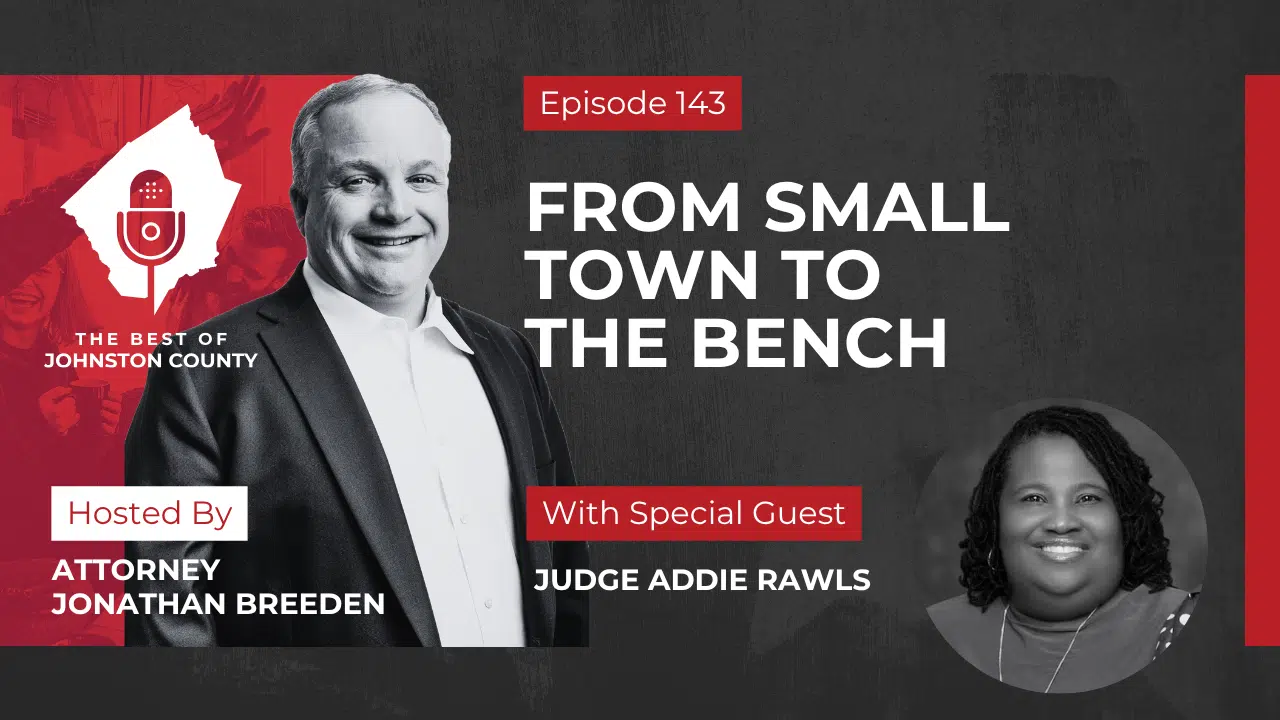
From Small Town to the Bench
Jonathan Breeden: [00:00:00] On this week’s episode of The Best of Johnston County podcast, our guest is Judge Addie Rawls, and this is the first of two episodes we did with her.
In this episode, we talk to her about her time growing up in Little Washington, how she took a Trailways bus to get to Wake Forest University, her time at North Carolina Central. She also clerked at the Court of Appeals, and when she was hired by Judge Tom Locke, who at that time was our DA, to be the 1st African American prosecutor in Johnston County history.
We also talked to her a little bit about her starting of New Generations Church and her Back to School Youth Explosion, where anybody that wants to can come get a haircut, a meal, and a backpack full of school supplies on August 9th at Clayton High School from 2:00 to 5:00. So listen in.
Welcome to another episode of Best of Johnston County, brought to you by Breeden Law Office. Our host, Jonathan Breeden, an experienced family lawyer with a deep connection to the community, is ready to take you on a [00:01:00] journey through the area that he has called home for over 20 years. Whether it’s a deep dive into the love locals have for the county or unraveling the complexities of family law, Best of Johnston County presents an authentic slice of this unique community.
Jonathan Breeden: Hello, and welcome to another edition of the Best of Johnston County Podcast. I’m your host, Jonathan Breeden, and on today’s episode, we have retired Judge Addie Rawls, who is now the pastor of New Generation Church in Smithfield, North Carolina. We’re gonna do two episodes with Judge Rawls.
One we’re gonna do today. This one we’re gonna talk a little bit about her growing up, her story of how she became an attorney and a lawyer and her, how she rose to become the first African American female judge in the history of Johnston County. And a little bit about what she’s doing at New Generation Church and her back-to-school youth explosion which is, I think, maybe in its, like, ninth or 10th year now where they give away free backpacks and haircuts to use for free in August of every [00:02:00] year.
And then we’ll do another episode that’s gonna run next week, where we’re gonna talk to her a little bit about what is district court? What does a district court judge do? I’m in district court with family law. Y’all hear me talk about family law all the time, but family law, domestic, is only one-seventh of what the district court actually does, and we’re gonna talk a little bit about that with her, and we’ll talk to her a little more about the church, how it got started, how it’s grown, and you know, some of the things it’s doing outside of just the back-to-school youth explosion.
But at this point, on this one, we’re gonna talk a little bit about what her story is. It’s gonna be a ton of fun. So if you’re interested in any of this listen to the rest of this episode. Anyway before we do that, I’d like you to ask you to Like, follow, and subscribe to this podcast wherever you see it, whether it be on Apple, Spotify, YouTube, TikTok, X, LinkedIn, or any of the other social media channels of the Best Johnston County Podcast.
The Best Johnston County Podcast comes out every single Monday and has now for over 30 months. So go back and listen to some of our previous episodes. We’ve had the vast majority of the county commissioners. [00:03:00] We’ve had just dog people. We’ve had Woody Bailey talking about IT services. We had recently we had Carolina Packers talking about hotdogs and bologna and all the things they do.
So if you love Johnston County as much as I do, this is the podcast for you. Welcome Judge Rawls.
Judge Addie Rawls: Good morning. Good to be here.
Jonathan Breeden: I’ve been wanting to do this since I started this- … and I’m glad you’ve been willing to come out here and do this and talk to us. So anyway state your name and what you do.
Judge Addie Rawls: Name is Addie M. Harris Rawls, and I’m a retired district court judge, full-time pastor of New Generation Christian Church, and community involver, I guess is the best way to put it.
Jonathan Breeden: All right, a connector for absolutely sure.
Judge Addie Rawls: Thank you.
Jonathan Breeden: You’ve definitely done a ton for the community. Let’s start with, I wanna do some of this episode about your story.
I, I’ve always found it fascinating. I think you grew up in Little Washington, North Carolina. Is that right?
Judge Addie Rawls: The original Washington
Jonathan Breeden: Yeah.
Judge Addie Rawls: As we call it, but certainly everyone else says Little Washington. I grew up there with a grandmother, my aunt, who took care of me as a young girl, and went to [00:04:00] schools there.
I was, ironically, I, I went to the Catholic school for the first three years of my school, and then that school closed. It was called Mother of Mercy Catholic School. I’ll never forget. And then I went to the public school and graduated from there, and headed off to Wake Forest.
Jonathan Breeden: So how does somebody from little Washington end up at Wake Forest?
Judge Addie Rawls: My guidance counselor became my friend in high school, and she had a nephew who attended Wake Forest, and he actually is a clinical psychologist. And he talked to me about Wake Forest, and believe it or not, that was the only school I applied to, early admission, and then I went back and received the George Foster Hankins scholarship, and the rest is history.
I spent four years there during the time when Muggsy Bogues was there.
Jonathan Breeden: Right.
Judge Addie Rawls: Alvis Rogers and all them were graduatin’. He was from Washington. So there was something floatin’ about that because we knew about it because of Alvis and [00:05:00] Muggsy Bogues. There was a young man named Michael Ramsey, he that were there and, and it was probably 130 minorities there at that time.
Jonathan Breeden: In the whole school?
Judge Addie Rawls: Yes.
Jonathan Breeden: I mean, yeah, and the school probably had what, about 4,000 students?
Judge Addie Rawls: Yeah.
Jonathan Breeden: This would’ve been in the ‘ 80s?
Judge Addie Rawls: The ’80s. The ’80s. 1982 to ’86. ’82 to ’86,
Jonathan Breeden: And so for y’all remember, Muggsy Bogues goes on to play in the NBA. He was a 5’3″ point guard. Absolutely a, a fascinating individual.
Judge Addie Rawls: Yes.
Jonathan Breeden: And has gone on to become a great leadership speaker and stuff now. And I was a big fan of Muggsy Bogues when I was a child because I was short, and I thought, “Well, if Muggsy Bogues can play in the ACC, Jonathan Breeden can play in the ACC.”
Judge Addie Rawls: That’s good.
Jonathan Breeden: But needless to say, There is- … I didn’t quite have athl- even though I’m 5’3″, 5’4″, didn’t quite have the athletic ability of, of Muggsy Bogues.
But I mean, I think, like, at one point, like, you didn’t have a car, so you had to take, like, a bus to go back and forth to Winston-Salem?
Judge Addie Rawls: I did. I rode Trailways. My uncle was a cab driver, and he would pick me up, and I’d go home during the summers, get ready to [00:06:00] go back to school. The first time, my guidance counselor took me with my grandmother.
The next times, we would go back and forth, or I’d catch family members and different ones there. And I remember he would check bags under the bus, and every time when I arrived in Winston-Salem, they would say Who do you know in Washington? Because there’s no way you got all these bags on the bus. And I was like, “I did. I remember my uncle knew the guy that loaded the bus, and back then they tipped too.”
So the bus got loaded with all my stuff. Of course, after a while, the dorms I remember had basements, and we could store stuff in the summers.
Jonathan Breeden: Okay.
Judge Addie Rawls: In the basements. So we would pull these big boxes from one dorm to the other dorm with all our stuff. Ironically enough, Laurie Burch was on my hall during my sophomore year. I was a residence counselor.
Jonathan Breeden: Okay.
Judge Addie Rawls: For there at school for two years. And it was historical for me. I tutored athletes, so that’s how I knew Muggsy and I were in classes together, but.
Jonathan Breeden: Right.
Judge Addie Rawls: [00:07:00] I knew all of them.
Jonathan Breeden: Right.
Judge Addie Rawls: Because I would tutor Western civilization. So they came up with an idea that it was cheaper to pay me. Back then it was like $39 an hour, which was good money.
Jonathan Breeden: That’s a lot of money.
Judge Addie Rawls: To tutor students in the class. So I would bring them all in the classroom, and I would tutor and go over, you know, things they needed to note and learn for their tests and stuff.
So I worked as a tutor, a residence counselor, and I was always doing two jobs. I think I even had some of the residence council work, but I recall working in the library at some point too.
Jonathan Breeden: Oh, gosh.
Judge Addie Rawls: So, weekends we were at school, so we
Jonathan Breeden: Yeah
Judge Addie Rawls: worked at school. I remember going to Wake Forest, you know, you had these big meal plans, but we would cancel the meal plan because then it made so that as I was an independent student in school.
Jonathan Breeden: Okay.
Judge Addie Rawls: So it would make it so I could really afford, because they considered that we should work during the summer and be able to contribute about $900 towards our education. I’ll never forget it. And I remember that to make it work, I would cancel a meal [00:08:00] plan, and there was a grocery store.
We could cut through the woods and buy food, and we… all the dorms had kitchens
Jonathan Breeden: Right
Judge Addie Rawls: and stuff. And the other thing that I remember is that then when students wanted to sell their meal plans, you would wait and you buy a little bit up front so you could go in the cafeteria and eat and stuff.
Jonathan Breeden: Right.
Judge Addie Rawls: And then later on what we would do, we would wait till the middle of the year when people got desperate, and you would get 50 for one.
Jonathan Breeden: Oh, that’s awesome. That’s awesome.
Judge Addie Rawls: So that’s what we would, we would-
Jonathan Breeden: I got you
Judge Addie Rawls: we would do that. And it, I mean, it… we made it work.
Jonathan Breeden: Right, right
Judge Addie Rawls: you know, I, I’ll never forget the…
And the athletes had their own kitchen.
Jonathan Breeden: Right.
Judge Addie Rawls: I was their tutor.
Jonathan Breeden: So they helped you out.
Judge Addie Rawls: Yes.
Jonathan Breeden: Yeah. That’s awesome. So you graduate Wake Forest, and then I think you go to law school at North Carolina Central.
Judge Addie Rawls: North Carolina Central.
Right. What made you wanna go to law school?
I was student teaching.
Jonathan Breeden: About that school?
Judge Addie Rawls: My last year, and I remember the last day the applications were due, I decided that I didn’t want to teach.
Jonathan Breeden: Okay.
Judge Addie Rawls: Then I sent my application in.
For law school. Always as a child, I argued, I talked. Back then I [00:09:00] remember Perry Mason.
Jonathan Breeden: Yeah.
Judge Addie Rawls: Ironside. I remember those things. And Matlock, you know?
Jonathan Breeden: Yeah.
Judge Addie Rawls: Those were things I remember. And I became fascinated in high school with African American civil rights leaders, and Brown versus Board of Education, and I became real fascinated with stuff like that. And so I thought if, you know, people like Thurgood Marshall could do it. Why couldn’t?
Jonathan Breeden: Why couldn’t you? I mean, you’d go from little Washington to Wake Forest, one of the most elite private schools in the United States. Now you go to a public school in North Carolina Central for law school. Did you have a scholarship to go to Central?
Judge Addie Rawls: I did. I actually, for Wake Forest, being the George Foster Hankins scholar, and actually back then when there were Pell Grants and all this stuff.
Jonathan Breeden: Yeah.
Judge Addie Rawls: You could get. I think I ended up only owing about $5,000 to Wake Forest when I graduated.
Jonathan Breeden: Oh, that’s awesome.
Judge Addie Rawls: And then.
Jonathan Breeden: That’s awesome.
Judge Addie Rawls: I ended up at Central as a Board of Governors scholar.
Jonathan Breeden: Okay.
Judge Addie Rawls: I didn’t get that until after I had taken the bar review course [00:10:00] during the summer, and my scores went up on the LSAT.
Jonathan Breeden: Okay.
Judge Addie Rawls: So then after that the dean called me in and says, “You know, you show real privilege. You know, I need you to come here, be ready to work hard.”
Jonathan Breeden: Right.
Judge Addie Rawls: “And we’re gonna give you a Board of Governor’s scholarship,” which was about $4,000
a year
Jonathan Breeden: Okay
Judge Addie Rawls: I believe It was
Back then law school was
only 800 and some dollars a semester
so
Jonathan Breeden: Right right right right
Yeah
Golly
Judge Addie Rawls: it worked out
now
Jonathan Breeden: it’s $50,000 a year or more.
Judge Addie Rawls: Yeah. Then you land great jobs in law school. So for instance.
Jonathan Breeden: Right.
Judge Addie Rawls: I worked for an attorney there and I also ran an English lab at the community college.
Jonathan Breeden: Oh, I didn’t know that.
Judge Addie Rawls: So I was paid to go sit there, and students who were learning how to read and stuff would come to the lab, and I would work with them on their English work.
Jonathan Breeden: Oh, cool.
Judge Addie Rawls: And so I would work… I’d go every day, like for two hours. So I got paid for like three or four days a week
Jonathan Breeden: Okay
Judge Addie Rawls: to sit out there and work with students. Then the lawyer, the position came open with the lawyer, and he wanted [00:11:00] me to quit the lab, but I wouldn’t quit the lab because I felt like the lab paid more than the lawyer paid.
So I didn’t quit the lab, but I worked that lab the whole three years I was in school.
Jonathan Breeden: Oh, that’s amazing.
Judge Addie Rawls: And I ended up working with the attorney, which allowed me to go into court, do some research in the background and stuff. And then Judge Sidney Eagles, who was our retired chief judge
Jonathan Breeden: Yep
Judge Addie Rawls: of the Court of Appeals, came to Central to recruit An African minority student
Jonathan Breeden: Okay
Judge Addie Rawls: For, to work with him as a clerk.
Jonathan Breeden: Okay
Judge Addie Rawls: And I met him in the summer of my second year, and he actually offered me the position to come work for him when I graduated my third year.
Jonathan Breeden: Okay. So you move… So you graduate, like, so like maybe ’89?
Judge Addie Rawls: Mm-hmm.
Jonathan Breeden: Right? All right. And you go clerk for Sydney Eagles and
Judge Addie Rawls: Two years
Jonathan Breeden: his daughter is Margaret Eagles, the current chief district court judge in Wake County.
Judge Addie Rawls: Yes.
Jonathan Breeden: Who graduated from Campbell with me in 2000, 26 years ago. So
Judge Addie Rawls: They were young when I was working.
Jonathan Breeden: Right. Her sister, who, who does, works with, does one of the [00:12:00] legislative internship programs now.
Judge Addie Rawls: Mm-hmm.
Jonathan Breeden: Very, very nice. Both really, really good people. So, so you, you clerked for a year,
Judge Addie Rawls: Two years
Jonathan Breeden: two years. So, what does a clerk do? They write opinions, I know.
Judge Addie Rawls: We draft opinions. Right. But the last hand it ever passed through was our judge’s.
Jonathan Breeden: Right.
Judge Addie Rawls: And that’s what Judge Eagle’s motto was, “The last hand an opinion will ever come through will be mine.”
Jonathan Breeden: Right.
Judge Addie Rawls: And he was awesome. He would have us over to his home.
We knew his children, his wife. Right. And ended up we were also all a part of the Disciples of Christ congregation as well. And so I maintained contact with him for a good, good amount of time.
Jonathan Breeden: Oh, man. That’s awesome. That’s awesome.
Judge Addie Rawls: Yeah. He was wonderful.
Have family law questions? Need guidance to navigate legal challenges? The compassionate team at Breeden Law Office is here to help. Visit us at www. breedenfirm. com for practical advice, resources, or to book a consultation. Remember, when life gets messy, you don’t have to face it [00:13:00] alone.
Jonathan Breeden: So now we’re up to like, I guess, ’91, and you end up at the DA’s office in Johnston County.
How does that happen?
Judge Addie Rawls: Judge Locke who was then district attorney Locke.
Jonathan Breeden: Thomas Locke, our current residential superior court judge.
Judge Addie Rawls: Made a promise when he ran for district attorney to integrate the office basically and bring in some minorities to the office, which had never been done.
Jonathan Breeden: Okay.
Judge Addie Rawls: I was looking for a job. An attorney had met him and he had approached her about working and she says, “No, I’m a private attorney. That’s what I’m gonna do.” But she says, “I know a young lady who I know.” Because back then Central was, you know, a nice size law school.
Jonathan Breeden: Right.
Judge Addie Rawls: But everybody stayed in contact.
Jonathan Breeden: Right.
Judge Addie Rawls: And so, she mentioned it to me and I reached out to Judge Locke then, Tom, my friend.
Jonathan Breeden: Yeah.
Judge Addie Rawls: And said to him. He interviewed me, offered me a job, but he needed me to go to work immediately, but he was too afraid to make a court of appeals judge mad by recruiting his [00:14:00] clerk. And so it went on for a while, but eventually in August of ’91 I came to work in Johnston County as the 1st African American assistant DA.
Jonathan Breeden: I didn’t know that part.
Judge Addie Rawls: Yeah.
Jonathan Breeden: I didn’t know that. 1st African how about that? All right. And you quickly rise through the ranks. You become a domestic violence sexual assault prosecutor. That’s what I remember you as when I get here in 2000. I’m sure you did other stuff before you got there, but.
Judge Addie Rawls: Juvenile was always my heart.
Jonathan Breeden: Juvenile, okay.
Judge Addie Rawls: So I actually prosecuted juvenile court in all three counties. I ended up teaching in new prosecutor school juvenile court to prosecutors and that was my heart. That was my heart then, that was my heart on the bench.
Jonathan Breeden: That’s true. That’s true.
Judge Addie Rawls: And still my heart.
Jonathan Breeden: Right. So juvenile criminal court is done in the district courts of North Carolina and that, at the time that she was prosecuting it, was any crime committed by somebody under the age of 16.
About 10 years ago the legislature raised the age to 18, so now most crimes that are [00:15:00] not serious felonies if you’re under 18 would go through the juvenile system.
And if it’s a serious felony, then they hold you over to adult court and so that, they still do that. So when you see these 16, 17-year-olds charged with murder and all of a sudden they’re in adult court, it starts in juvenile court but then juvenile court releases it to the adult court at the request of the prosecutor and judge approves it.
So, so you did that. I mean, but I mean you also did a lot of… When I got here you were doing a ton of rapes and
Judge Addie Rawls: I did
Jonathan Breeden: stuff like that. I, I mean, I know everybody had to do a little of everything.
Judge Addie Rawls: I did all of the sexual assaults. I did
Jonathan Breeden: Right
Judge Addie Rawls: misdemeanor appeals
Jonathan Breeden: Right …
Judge Addie Rawls: in that office. And then I also, would work court. I mean, I spent a lot of time doing disposition court and different things.
Jonathan Breeden: Yeah.
Judge Addie Rawls: I enjoyed trying cases.
Jonathan Breeden: Right.
Judge Addie Rawls: Working court. My reputation was cross-examination.
Jonathan Breeden: Yeah.
Judge Addie Rawls: And that’s what I did and, and it…
Jonathan Breeden: I remember trying a case with you and I think it was in juvenile court, and I thought I was doing pretty good. And you were just sitting there, and I’m like, “She’s not objecting,” and she’s just like. I’m thinking, “Man, I’m doing great.” I was a young attorney. And then you leaned back [00:16:00] up, and five questions later it was over. I mean, that’s all I remember. I thought I had it, and then it was over. You leaned back up in that chair, and that was it. I had lost the case. Franklin had found my client guilty, and that’s how it went. But anyway.
Judge Addie Rawls: Adjudicated him delinquent.
Jonathan Breeden: Adjudicated him delinquent. That’s true. No, actually, that
Judge Addie Rawls: Language is clear.
Jonathan Breeden: I understand that. So and then was it 2002 you become a judge?
Judge Addie Rawls: Yes.
Jonathan Breeden: Okay.
Is that right
Judge Addie Rawls: January of 2002
Jonathan Breeden: Okay
Judge Addie Rawls: I was appointed and then
ran that same year
ran that same year
Jonathan Breeden: How come about The bar call. I mean, I was there. Was there a bar vote or did the governor appoint? I don’t exactly remember that.
Judge Addie Rawls: It was a bar vote and then the governor. Unfortunately our very 1st African American was Judge Robert Anderson.
Jonathan Breeden: Yes.
Judge Addie Rawls: And he died very untimely for us, but he was an awesome judge and.
Jonathan Breeden: He was.
Judge Addie Rawls: Great mentor. And I felt like when the first position opened up, it was a new seat I embraced the love of Johnston County that determined that we needed some diversity.
Jonathan Breeden: Right.
Judge Addie Rawls: That’s the word. And so, at [00:17:00] his untimely death, I pursued the seat and received the top bar vote, and was actually chosen by the governor at that time, Governor Easley.
Jonathan Breeden: Governor Easley, yes.
Judge Addie Rawls: To serve in that position.
Jonathan Breeden: Yeah, and then you immediately had to run.
Judge Addie Rawls: And I had three opponents.
Jonathan Breeden: Right, ’cause the election was in November. You get appointed in January, and the election’s in November of ’20 of 2002, correct?
Judge Addie Rawls: And I had three opponents.
Jonathan Breeden: Right.
Judge Addie Rawls: And two are now gone, but we worked together back in the day.
Jonathan Breeden: Right.
Judge Addie Rawls: And one of them was a church member. And so, you start mixing all the lines. But it was hard work. I worked hard. I had a lot of love, had a lot of love across the district, three counties, Johnston, Harnett, Lee County.
Jonathan Breeden: Yeah, no doubt, no doubt. And I remember helping you on that campaign, and I know you’re gonna, you’re gonna find this funny. I think I still have one of the fundraising letters from one of the beginnings. I just stuck them in a drawer and I thought, “Well, if all these people are supporting Judge Rawls, if I ever decide to run, I probably need to know who their names were,” ’cause I was new [00:18:00] here. Now 24 years later, Jonathan Breeden hasn’t run for anything, but I think I still have one of those original letters from one of the fundraisers that I worked on in a drawer.
I’m pretty sure I could probably put my hands on it. And I’ll have to go look for it and I’ll have to send it to you because a lot of those people probably have passed on. A lot of those people are still around, but.
Judge Addie Rawls: Yes.
Jonathan Breeden: 24 years later, I just remembered, like I think I might still have that.
Judge Addie Rawls: I had a lot of supporters, a lot of grassroot efforts. I remember right out here in Cleveland where we are now, I had a big thing with the Band of Oz and they were singing, “Ooh baby, I wanna know will you be my judge?” And that was the song.
Jonathan Breeden: Oh my goodness.
Judge Addie Rawls: Yeah.
Jonathan Breeden: That’s great. And so you end up, you go on to serve as district court judge until 2024?
Judge Addie Rawls: 2022.
Jonathan Breeden: 2022. Golly, man, it goes fast, doesn’t it?
Judge Addie Rawls: I believe it was 2022.
Jonathan Breeden: ’22. Yeah. Man, time flies, doesn’t it?
Judge Addie Rawls: Let me get it straight, ’cause I’ve been retired five years.
Jonathan Breeden: Yeah.
Judge Addie Rawls: In January.
Jonathan Breeden: Yeah. Well, that January will be 27, so yeah. Golly, man, it’s hard to believe it goes by that fast, right?
Judge Addie Rawls: I didn’t know where the [00:19:00] 20 years went.
Jonathan Breeden: Right. Well, I don’t know where the last five years went that you’ve been retired that long.
Judge Addie Rawls: Yeah.
Jonathan Breeden: So that’s wild. That’s wild. Well, in the next episode we’ll talk about your time as district court judge and what a district court judge does.
Judge Addie Rawls: Okay.
Jonathan Breeden: But right now I wanna turn to what you’re doing now. You became the pastor at New Generation Church while you were still?
Judge Addie Rawls: 2010.
Jonathan Breeden: Right, 2010.
Judge Addie Rawls: We’re celebrating our 16th year this year.
Jonathan Breeden: Right. And you started that church.
Judge Addie Rawls: Yeah.
Jonathan Breeden: From scratch. I remember that.
Judge Addie Rawls: Yeah, I did. I did.
Jonathan Breeden: And you were still preaching, you were still a judge for the first 12 years.
Judge Addie Rawls: Right.
Jonathan Breeden: And I still don’t exactly know how you could be a preacher and a judge. Maybe you just didn’t sleep, but I mean, you did it.
Judge Addie Rawls: I slept. I did what I had to do. I had great supporters who worked. I worked my job, but I also worked the ministry and different people helping and we got to where we are now.
And one of my greatest helpers is my son, who a couple years ago I named my executive pastor at the church, and he kinda administrates everything.
Jonathan Breeden: Oh, that’s good.
Judge Addie Rawls: He keeps things moving along.
Jonathan Breeden: Oh, that’s good.
Judge Addie Rawls: And helps me in that endeavor. But a lot of people working together, doing a lot of stuff.
[00:20:00] Our vision of the church was a community church meeting the needs of the community, whatever those needs are.
Jonathan Breeden: Right.
Judge Addie Rawls: And, I don’t like the word no. I still don’t like the word no. I try not to deal with no’s in my life. I try to move forward with all the yeses I can. But we found out there are a lot of people in need, and certainly, I actually, in the midst of all those years, found time to go get a master in theological studies, and I’m currently working on my DMin.
Jonathan Breeden: Oh, man.
Judge Addie Rawls: My doctorate in ministry, so. And part of that is at a school in Lexington, Kentucky called Lexington Theological Seminary, 150-plus year seminary
Jonathan Breeden: Okay
Judge Addie Rawls: part of it is learning that we just don’t take it from the textbook, but we actually engage and put it in action in our communities.
Jonathan Breeden: Right
Judge Addie Rawls: And so a lot of stuff that I’ve done, my professor was talking to me a few weeks ago and she says, “You’re the only person I can know that during the pandemic you figured out how to get a tractor trailer to come through your town for several months every Monday dropping off [00:21:00] 1,100 boxes of food to distribute to people during their time of need.”
Jonathan Breeden: Yeah.
Judge Addie Rawls: And I said, “It worked.” And I actually found a man here who had a loading dock, and he would have his forklift operator come and help unload it, and we were able to get food into every area of the county and beyond during that time. People would bring trailers and trucks.
Jonathan Breeden: Awesome.
Judge Addie Rawls: And vans, and we were distributing food to people.
Jonathan Breeden: Well, that’s great. That’s great. Well, you’ve got your Back to School Youth Explosion coming up. It’s on August.
Judge Addie Rawls: 9th
Jonathan Breeden: August 9th this year.
Judge Addie Rawls: At Clayton High School from 2:00 to 5:00. Even in the midst of all of that construction that’s going on, we’re gonna have it there because that’s where we have it.
Jonathan Breeden: All right. And, is this the 9th year for it?
Judge Addie Rawls: 12th.
Jonathan Breeden: 12th. 12th. Oh, my goodness. Okay. Yeah, so and that’s where anybody.
Judge Addie Rawls: Anybody.
Jonathan Breeden: Regardless of.
Judge Addie Rawls: Where they live.
Jonathan Breeden: Race, income, whatever.
Judge Addie Rawls: Yes.
Jonathan Breeden: You can come get a haircut, a meal, and a backpack full of school supplies.
Judge Addie Rawls: Yes.
Jonathan Breeden: Is that right?
Judge Addie Rawls: That’s [00:22:00] right.
Jonathan Breeden: And I mean, y- how many kids came through it last year several hundred.
Judge Addie Rawls: Oh, over a thousand.
Jonathan Breeden: It was over a thousand.
Judge Addie Rawls: Yeah.
Jonathan Breeden: Oh, my goodness.
Judge Addie Rawls: Kids, they come through there.
Jonathan Breeden: That is unbelievable.
Judge Addie Rawls: It’s amazing to sit there. Last year I sat in the middle of the g- the gym where they were cutting hair, and just watched the children, and they would come in to get their backpacks, and just watched the kids come.
We had our DA was there. We had the superintendent of schools there. Just so many people who would come to be a part of that and, and just show that we’re not just who we are, we are people who are concerned about the citizens of this county.
Jonathan Breeden: No, it’s, it’s, it’s a tremendous thing and, and I’ve, I’ve, it’s, I’ve been happy to sponsor it for probably as long as it’s been going on.
Judge Addie Rawls: Yes.
Jonathan Breeden: And it just keeps growing and growing and growing every year. I mean, I can’t believe over a thousand kids went through it last year. That, that’s, that’s awesome. And I know y’all, y’all could use some more sponsorships. How can people reach out to you to help sponsor this free community event?
Judge Addie Rawls: New Generation Christian Church. Our number is [00:23:00] 919-209-0536. And Fathead Barbershop in Clayton, North Carolina, right on 70 Highway. And, They can reach out in those methods to us, and we’re, we’re ready and able to
Jonathan Breeden: All right
Judge Addie Rawls: to, to come and do. You mentioned you had Carolina Packer here.
Jonathan Breeden: Yeah.
Judge Addie Rawls: They’ve been a wonderful supporter of this event and for as long as we’ve been doing it.
Jonathan Breeden: Good. Right.
Judge Addie Rawls: And, and, and I appreciate that. the longstanding partnerships and all the Greek organizations, churches, and other community businesses have been engaged and involved with what we do.
And I mean, just whether it’s backpacks, school supplies or whatever they give it’s just been a blessing. During COVID, we had to go to a drive-through event.
Jonathan Breeden: Right. Right.
Judge Addie Rawls: But I remember a young lady who worked in the courthouse said to me, as a single parent, that she liked that, but she liked coming to the event because she said she saw the grace of God in action at the event.
Jonathan Breeden: Absolutely. Absolutely. Well, anyway, yeah, so we’d like to thank Judge Rawls for being [00:24:00] our guest on this episode of the Best of Johnston County podcast. If you’d like to support this community event on August 9th, please reach out to New Generation Church or Fathead Barbershop and they’ll take all types of donations.
And if you want to volunteer, reach out as well. It takes well over 100 volunteers at least to put it on every single year, and it is a tremendous event and it’ll bring tears to your eyes to see that many kids and all the stuff that, that they do to help children here in Johnston County.
As I mentioned earlier, please like, follow, subscribe to this podcast wherever you see it, whether on Apple, Spotify, YouTube, TikTok, LinkedIn, or X, so you’ll be aware of future episodes of Best Johnston County. And catch us next week. We’re gonna have another episode with Judge Rawls. We’re gonna talk a little bit about what does a district court judge do.
Until next time, I’m your host, Jonathan Breeden.
That’s the end of today’s episode of Best of Johnston County, a show brought to you by the trusted team at Breeden Law Office. We thank you for joining us today and we look forward to sharing more interesting facets of this [00:25:00] community next week. Every story, every viewpoint adds another thread to the rich tapestry of Johnston County.
If the legal aspects highlighted raised some questions, help is just around the corner at www. breedenfirm. com.
Judge Addie Rawls has spent decades serving Johnston County in the courtroom, in the community, and now through ministry. In this first of a two-part conversation, she joins Jonathan Breeden to share the experiences that shaped her career and the values that continue to guide her work today.
From navigating college on a limited budget to breaking barriers in North Carolina’s legal system, Judge Rawls’ story is one of determination, resilience, and an unwavering desire to help others succeed.
Growing Up with Big Dreams
Judge Rawls reflects on her childhood in Washington, North Carolina, where she was raised by her grandmother and aunt. Encouraged by a guidance counselor who recognized her potential, she applied to Wake Forest University, the only college she applied to, and earned the George Foster Hankins Scholarship.
She shares memorable stories of traveling to and from school by Trailways bus, working multiple campus jobs, tutoring student-athletes, and finding creative ways to stretch every dollar while earning her degree.
Finding Her Calling in Law
Although she initially planned to become a teacher, everything changed during her student teaching experience. On the final day law school applications were due, she made the decision to pursue a legal career instead.
Inspired by civil rights leaders, courtroom television shows, and a passion for advocacy, Judge Rawls attended North Carolina Central University School of Law as a Board of Governors Scholar. Throughout law school, she balanced academics with multiple jobs while gaining valuable courtroom experience working for a local attorney.
Opening Doors in Johnston County
After graduating, Judge Rawls spent two years clerking for Judge Sidney Eagles at the North Carolina Court of Appeals, learning firsthand how appellate opinions are researched, drafted, and refined.
Her career then took a historic turn when then-District Attorney Tom Locke recruited her to join the Johnston County District Attorney’s Office. In 1991, she became the first African American Assistant District Attorney in Johnston County history, helping fulfill a commitment to bring greater diversity to the office.
A Career Dedicated to Justice
Judge Rawls discusses her years prosecuting juvenile cases, sexual assault cases, misdemeanor appeals, and other criminal matters. While she handled a wide variety of cases, juvenile court always remained closest to her heart.
She also shares how her reputation for thoughtful courtroom preparation and effective cross-examination developed over years of trying cases across Johnston, Harnett, and Lee counties.
In 2002, following the passing of Judge Robert Anderson, she was appointed by Governor Mike Easley to serve as a District Court Judge after receiving the highest recommendation from the local bar. She later won election and became Johnston County’s first African American female District Court Judge.
Serving Beyond the Courtroom
Even while serving on the bench, Judge Rawls answered another calling by founding New Generation Christian Church in 2010.
Built around the vision of meeting the practical needs of the community, the church has grown into an organization known for serving families throughout Johnston County. During the COVID-19 pandemic, Judge Rawls helped coordinate the weekly distribution of more than 1,100 boxes of food to families in need while continuing her ministry and pursuing advanced theological education.
The Back to School Youth Explosion
One of New Generation Christian Church’s signature community events is the annual Back to School Youth Explosion, now in its twelfth year.
Held this year on August 9, from 2:00 PM to 5:00 PM at Clayton High School, the event welcomes every family regardless of income or where they live. Children receive free backpacks filled with school supplies, free haircuts, and a meal, all made possible through the generosity of volunteers, churches, businesses, civic organizations, and community sponsors.
Judge Rawls shares that more than 1,000 children attended last year’s event, demonstrating the impact that a united community can have on local families.
Closing Reflection
Judge Addie Rawls’ story is about much more than professional accomplishments. It is a testament to perseverance, servant leadership, and the belief that every opportunity creates another chance to lift others. From a young student riding a Trailways bus to Wake Forest, to making history in Johnston County, her journey reminds us that lasting impact comes from a commitment to serve wherever you are called.
Be sure to join us next week for Part 2, where Judge Rawls explains the role of a District Court Judge and shares more about the ongoing work of New Generation Christian Church.
AND MORE TOPICS COVERED IN THE FULL INTERVIEW!!! You can check that out and subscribe to YouTube.
Connect with Judge Addie Rawls:
- Website: https://newgenerationchristianchurch.org
- Phone: 919-209-0536
Connect with Jonathan Breeden:
- Website: https://www.breedenfirm.com/
- Phone Number: Call (919) 726-0578
- Podcast: https://breedenlawpodcast.com/
- YouTube: https://www.youtube.com/@BestofJoCoPodcast
Listen On