
January 12, 2026
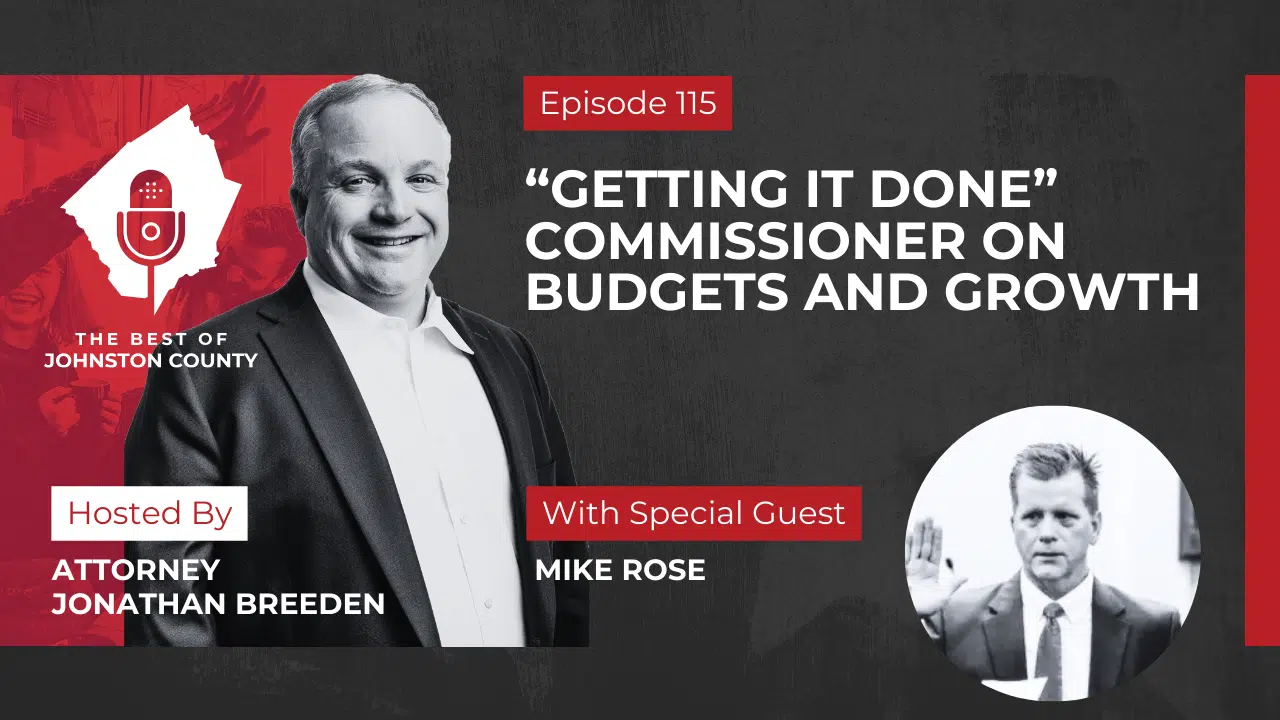
“Getting It Done”: Commissioner on Budgets and Growth
Jonathan Breeden: [00:00:00] On this week’s episode of The Best of Johnston County Podcast, our guest is County Commissioner Mike Rose. Mike was on with us back in March of 2025, and now he’s back as he is now running for reelection. We asked Mike, why does he want to be elected to a full four year term on the board of County Commissioners?
We asked him about the budget process last year, the reevaluation and how they came up, or they came up with the tax rate they set. We also talked to him a little bit about economic development and why he thinks he is the best candidate to be on the board for the next four years. So if you’re interested in any of these, listen in.
Welcome to another episode of Best of Johnston County, brought to you by Breeden Law Office. Our host, Jonathan Breeden, an experienced family lawyer with a deep connection to the community, is ready to take you on a journey through the area that he has called home for over 20 years. Whether it’s a deep dive into the love locals have for the county [00:01:00] or unraveling the complexities of family law, Best of Johnston County presents an authentic slice of this unique community.
Jonathan Breeden: Hello and welcome to another edition of The Best of Johnston County Podcast. I’m your host, Jonathan Breeden, and on today’s episode we have County Commissioner Mike Rose.
He’s back for his second visit on our podcast. This time he’s back to talk about his campaign to be elected to a full four year term to the board of commissioners, representing, I believe District three, which is like Princeton and Benson and that part of the county. He was appointed to the board to fill an unexpired term.
He’s been on the board now for a little over a year, so he is learned a lot. He came, he was with us back last March when we were in the middle of the reevaluation process. So we’re gonna talk to him a little bit about everything he’s learned in the last eight or nine months and why he thinks you should give him his own four year term on March 3rd, 2026. But before we do to that, before we get to that, I’d like to ask you to like, follow, [00:02:00] subscribe to this podcast whether you, wherever you see it, whether we’re on Apple, Spotify, YouTube, TikTok, LinkedIn X, or the other social media channels of The Best of Johnston County Podcast. The Best of Johnston County Podcast comes out every single Monday and has now for over two years.
So go back and listen some of our previous episodes, including the original one with Mike Rose Congressman Brad Knott when he was campaigning. Chris Johnson, economic Development Director. We had Adrian O’Neal, the current county Parks rec director twice. So a lot of great guests have been on over the years.
Well over a hundred episodes now. If you love Johnston County as much as I do, this is the podcast. You welcome back, Mike.
Mike Rose: All right, thanks lot for,
Jonathan Breeden: I appreciate you coming back. But for everybody that doesn’t listen to every episode which is like. Like three people. Yeah. Me, my wife and a neighbor friend of mine. What’s your name? What do you do?
Mike Rose: Yeah, my name’s Mike Rose. I am county commissioner for District three. I’m from Princeton. I was on the town council in Princeton before that and have been appointed last December to the county board of commissioners and [00:03:00] have been serving on as ex official member on the I 95 I 40 Alliance, which has done a lot of great things was very instrumental in in the workforce Development Center down in Four Oaks and also get bringing Vulcan to Johnston County serve on the Heritage Commission, which is completely different. But really nice to see how we are preserving our history here in Johnston County and also on sports council.
So, there’s a lot of duties. There’s been a lot of meetings this year. I think we’re. Well into a couple hundred meetings this, this year. Yeah.
Jonathan Breeden: You go to a lot of meetings. I know. I don’t think people understand how much work it takes to be a county commissioner because you have the regular commissioner meetings, which are four a month at least. There’s one in the morning and one in the evening, twice a month. And then there are the commissioner subcommittees, and then there are, you’re on all these other committees, whether it be the health Board, whether it be the community college board, whether it be I mean there’s tons of Heritage Commission, whether, you know, I mean, like you’re all on at least one or two other boards.
Other than [00:04:00] just being commissioner, it is a tremendous amount of work and you don’t get paid very much money to do it. But it’s back to your history, like you used to be a school teacher. Tell us a little bit about where you grew up.
Mike Rose: Yeah.
Jonathan Breeden: Where you went to school. I know you’re an NC State guy.
Mike Rose: Yeah. Yeah. So, if you’re from Johnston County, you would appreciate this. I started my first job was when I was 11 years old. I was born in tobacco. And it was one of those things where if you were a kid. You wanted some school money, you needed to go out and get a job. And so a lot of us, in fact, most everybody I worked with was 11, 12, 13 years old and stayed in the, the back of field until I was 17 and got a real job.
And outside of the back field, I say real job, but I’m kidding. So it was nice to get some air conditioning in that, in that first job when I was 17. But besides being growing up here in Johnston County, my first job after college was being a school teacher. Also had a little break in there and went out to Grifols, which was bare at that time.
Did a year out there. And worked in production in fractionation department in the [00:05:00] minus five, healthiest cold, cold temperatures. it’s a hard job, but very rewarding. Then started my own business and then 30 years of my own business now, and running a small business and being successful here in Johnston County can’t have its own challenges, and especially in a small town like Princeton, whereas if, you know, the entire town is just over a thousand population and, and we’ve, we’ve grown and, and made it through great recession in 09 and 010 or 2010 and made it through some hard times.
But like I said, 30 years this year. What’s the
Jonathan Breeden: name of the business? It’s T-shirt Business.
Mike Rose: Yeah. Quick shirts,
Jonathan Breeden: right? You make t-shirts and hats and pens.
Mike Rose: That’s right.
Jonathan Breeden: Anything you could brand for your business?
Mike Rose: Pretty much anything. Promotional items. Yeah. But wearables primarily like, embroidered items, corporate items for hats, polo shirts, jackets, and then screen printed t-shirts for five Ks and events and stuff like that.
Jonathan Breeden: Oh, that’s cool.
Mike Rose: Yeah. That’s cool.
Jonathan Breeden: Yeah. So how many employees do you have?
Mike Rose: Six. Six? Okay. Yeah, so I know,
Jonathan Breeden: I know they largely run it now. ’cause you’re mainly accounting commissioner.
Mike Rose: It has been it has, it’s [00:06:00] taken a lot of time away. In fact, I added a deploy an employee last year when I got this because I was having to be gone.
So much. So it is a, a situation where, you know, a lot of people may think that we’ve got it made here being a commissioner, but I, I literally have to hire an extra person because I’m gone so much. So it actually costs me money to, to be in this position. but yeah, besides the teaching I went over to Afghanistan for a year after the big recession in 09 and 2010.
It was two were hard and there were a lot of bills to pay. And there was a, a job I took over in Afghanistan for to kind of catch up for a year. And it was very rewarding. Worked as a army contractor on a arm, on a base right outside of Cobble for a year. So that was very interesting. And yeah, then was came back, was on Princeton Town Board for 11 years before I got this position with the county.
So I think that if you’re rolled out all up, my, my resume has a, has a lot of things that people can resonate with in the county and realize, you know, that I, [00:07:00] I’m not a, I’m not in it for any other reason than just because I love Johnston County and, and have a good life experience to, to draw from.
Jonathan Breeden: Well, and you’ve earned what you’ve earned and you’ve got a lot of great experiences
Mike Rose: Mm-hmm
Jonathan Breeden: being a small business owner and an elected official for many years of the Princeton Town Board. I know, you were very happy and had a big smile on your face at the ribbon cutting of the new library there.
Mike Rose: Yeah,
Jonathan Breeden: the community building.
Mike Rose: That’s right.
Jonathan Breeden: I mean, I know you worked hard on that for many years.
Mike Rose: We did, we did. We started that project before COVID and at that time we had purchased that building from, of the Lions Club years ago for a fraction of what we paid, I think about $17,000. They owed some money basically and just wanted to get out from under. So we took it and we’re planning on putting some paint, maybe some new sheet rock and fixing it up a little bit.
And our vision kind of grew and it grew ’cause it was not a very attractive building. And we decided we needed a home for our public library that was sharing a space in the Princeton High School. And so, the vision grew, but so did the budget [00:08:00] and it had eventually became seemingly unattainable.
And we were able to get some grant funds from, from the state and a lot of local. People donated money and we wound up kind of scaling back our grand idea, simplifying it a little bit, but come up with a great building that serves the community and we’re able to do it for, with no financing.
So that was a big plus ’cause we, even on the town board, I think all of us agreed that we. We wanted something great, but we didn’t want to put our taxpayers at a burden for, you know, a long-term debt. So we were able to do that.
Jonathan Breeden: Well, that’s good. That’s good. And I know that the taxpayers in Princeton, you were not on there, but they.
They didn’t get a budget, neutral budget this year. And, and probably it was a significant tax increase, much more significant for the Princeton town payers
Mike Rose: mm-hmm
Jonathan Breeden: than, than what the county did. I know that wasn’t, you weren’t on that board then. But you know, I, I’d love to have the mayor come on and talk about that.
Mike Rose: Yeah.
Jonathan Breeden: But, but anyway, ’cause I mean, they, they really left the rate close to the same as it was, and the taxable income in Princeton went up about [00:09:00] 70%. Selma also kept the rate the same as did Benson, which caused. Basically a hundred percent tax increases for them. I think Princeton kept it almost the same, so close to a hundred percent tax increase for the citizens there in Princeton.
Which I, I think is a lot. I’m not elected in these places.
Mike Rose: Mm-hmm.
Jonathan Breeden: It is what it is.
But let’s talk about what the County. You did vote for the County budget.
Mike Rose: Yep.
Jonathan Breeden: The county budget essentially created a 20% tax increase for most of us. You know, they, yeah, the tax rate was cut significantly. The taxable income had gone up 70% and the budget ended up being about 20% more than the previous year. Explain that process. You were in the middle of it last time, why you thought that was a good budget? Why we needed that extra money. And where we go from here.
Mike Rose: Okay. So, yeah, I would have to say that this was the hardest budget ever I’ve ever had to work with in any of the town budget was difficult a lot of times, but when you take away two zeros, you know, every dollar counts. I mean, in the, and it does in the County as well, I should say. But when you’re looking at, [00:10:00] a budget of in the town was a little over $3 million and now we’re looking, you know, north of $400 million with the county.
It’s a lot, but we did go through it and we looked very hard at everything that we could and in this situation when you had a reval, so I kept thinking about my parents and other older people that I knew around the County and how it was gonna affect them. And unfortunately. There was no tax rate that we could set that was gonna affect everybody equally.
And I actually did a little bit of math today, so I brought, brought a few, few, little bit of cheat sheet here with me. So I had a couple, my parents for example, I went, used their. Their value their, their house before the reval was $147,000 and afterwards three 50. Okay.
Right. That was significant. Alright, so if we had have been able to set a the tax rate before that was 67 cents for them to keep a, a revenue neutral, a same tax rate, we’d had to drop it 28 cents. So to keep, to keep them paying the same. And at that, [00:11:00] at that rate, 28 cents, we would’ve had a shortfall in the county government over a hundred million dollars.
So you see what we’re coming up with we’re the problem. We have. We had I had another family member that their house went from $47,000 tax value to $179,000 tax value, and you couldn’t, she couldn’t really argue that that was not accurate because that’s how much she paid for the house. So, you know, in that, in that situation I think that we would’ve had to get the tax rate down to 17.60 cents for her not to have seen a tax increase.
So when people say that there was, we, we increased the tax, yes, the overall number did go up there. There were about, according to our, our tax office, about 10% of the people in the county did see a decrease, an actual decrease. And I would like to remind everybody too, that our county commissioners.
Including me pay more. I pay more this year. My, I think my, my taxes because of Princeton’s and the counties together a lot about $1,500. So, so it, it’s significant. And I, and I get that, but [00:12:00] what we saw in 2019, well before I was on the board, is he had a revaluation that pretty much hit the western part of the county and it didn’t really affect the eastern part of the county, which is my district.
And, and now that growth is, is gone that way. All the. We can say it was the tax office that assigned that, that value to the house. It was, and you and I know both know it was the market that assigned that value and that the tax value just put the number on it. But, but the market, that was what, what drove that?
And, and anybody, I urge anyone who feels like the number that they, that there was, that was assigned to their house was. Not accurate to appeal and, and get it right.
Jonathan Breeden: Yeah, I, I did appeal mine.
Mike Rose: Yeah. Yeah.
Jonathan Breeden: And I won.
Mike Rose: Yeah.
Jonathan Breeden: Shockingly enough I won
Mike Rose: Oh, good.
Jonathan Breeden: The appeal. But I was very fortunate. Yeah. I had gotten an appraisal.
Mike Rose: Mm-hmm.
Jonathan Breeden: I think I told you this last time. To get a refi to get up, like a home equity loan on my house. So I just sent ’em the appraisal and they agreed with it, but I only say it only went down like $25,000. It was close. Yeah. You know what I mean? [00:13:00] Yeah. But, and I saved. Like 50 bucks or something every, you know, but hey, every, every little bit helps.
You know what I’m saying? Yeah, yeah. But I mean, you know, the, the county budget has gone up from 2019 to now it went from 240 million to 420 million.
Mike Rose: Mm-hmm.
Jonathan Breeden: I don’t know if people realize that, but like it’s gone up $160 million in six years or something. Some of that’s inflation, some of that’s growth, but I mean, that’s what I mean.
That’s a lot.
Mike Rose: I have more paperwork here. Yeah. So. Of course I wasn’t on the board. I’m not not throwing shade on any, any, any board prior. But I will also say in the 2019 to 2024, the tax rate also went down. So in 2024 you paid less out-of-pocket money. Than you did in 2019. ’cause the, the county commissioners, because of the growth in the county, were able to, to were able to lower that rate.
So it went from 76 cents to 67 cents during that amount of time. So that seems, that seems to be forgotten a [00:14:00] lot of time, right? That people were actually paying less each year. And so there was a kind of a correction, but a lot of that correction was due to just some failing infrastructure, some buildings.
For example, our courthouse hasn’t been updated in about 50 years. You can imagine how many court cases are going through the court system now compared to 50 years ago.
Jonathan Breeden: I, I, I know. I, I’ve been here for 25 years. Yeah. And I think the courthouse edition was built in the early nineties.
Mike Rose: Mm-hmm.
Jonathan Breeden: And nothing really has been done.
With that since it was built, and you think about how much bigger Johnston County is now.
Mike Rose: Yep.
Jonathan Breeden: You know, and the original courthouse goes back to the 18 hundreds. Yeah. You know, you know, and so it’s a lot. No, you’re right. And, and look, the county has a billion with a B. Building needs. Not counting schools.
Mike Rose: Mm-hmm.
Jonathan Breeden: All people realize listen to this. Yes. Yeah. It’s a billion with a B. DSS needs a building.
Mike Rose: Mm-hmm.
Jonathan Breeden: We just got a new jail.
Mike Rose: Mm-hmm.
Jonathan Breeden: We need a county administrative building. The tax office needs more room.
Mike Rose: Mm-hmm.
Jonathan Breeden: We need more court rooms.
Mike Rose: Mm-hmm.
Jonathan Breeden: Believe me, we need more [00:15:00] courtrooms. The district attorney needs more space. We have a brand new public defender. She needs more space. Yeah. We need more judges, but part of the reason. We can’t get more judges from the legislature is we don’t have the courtrooms for them to hold court. To do the work. If they were give the court was to, if the legislature was to give us more judges, so, and
Mike Rose: they can’t pass a budget.
Jonathan Breeden: Right. I mean, and the, and the legislature at this point is not passed a budget. Yeah. So, and now you’ve got, you know, as you were just at a County Commissioner meeting where the County clerk of court is there asking for county money to fund state positions in the clerk’s office. Because the court, the legislature hadn’t passed a budget and she’s got all this growth and she’s trying to deal with it.
So, I mean, it’s just, we had the same problem with the DA’s a few years ago.
Mike Rose: Mm-hmm.
Jonathan Breeden: So it’s a lot, tell the public some of the things that are in that billion with a “B” buildings that the county needs today that it’s gonna have to build over the next 10 years.
Mike Rose: Yeah. So on that before, before I go there the Michelle Ball came to us today was [00:16:00] requesting 11 positions and those positions would be roughly a million dollars roughly for per year. And she doesn’t want ’em all at one time. She wants to phase it in, but that’s a million dollars that should, that we’re paying state taxes. That should be coming from Raleigh.
Jonathan Breeden: Correct.
Mike Rose: So for the County to fund that, what we have to do is look and see, you know, at the end of the day, we wanna serve our constituents. We are in customer service business. We want our customers, which are our county citizens to have the best possible service that they can. So do we have to pick up the slack sometimes when the state drops the ball?
In the past we had to do it with the DA’s office. And so, you know, right now it’s, no vote was taken today, but it is under advisement and we’re considering. But back to the buildings. Yeah, when you look at the courthouse now that it is packed with administration, with tax office, with so many things that aren’t court related. And they desperately need space. In fact, we were being threatened with lawsuits if we don’t give ’em some more space.
So, part of the, [00:17:00] part of that building process is gonna be to build some more court space. So we’ve acquired a property next to us, which was known as the old mast building. And so there’ll be in the, in the foreseeable future, some court space built up there, maybe a three or four story building, and a lot of details to be ironed out there.
DSS right now is packed to the gills in five separate buildings, a few that we’re leasing and we’re trying to get all that centralized into one location. That’s another huge, I would imagine the two of those together, just off the top of my head, or probably a quarter of that billion. And then you’ve got the school needs that you were talking about, right? You know, Clayton High School is coming up and they, they was chosen in previous boards not to have a bond referendum random. But that goes back to one of your questions about why is the budget having to be increased? Well, part of it is because voters passed bond referendums. For schools and, and, and buildings.
And now that that debt services come and due over the next couple years, right? It hasn’t been paid yet. And so those, as those debts are coming to fruition, we’ll [00:18:00] have to have money in the budget to pay those debts back that the voters approved. And so, another thing that often will come up is about the fund balance.
Why is there so much money in the fund balance?
Jonathan Breeden: I agree.
Mike Rose: I’ve heard that. I agree. Say that You’ve heard me talk about that. Yeah. And so, I had somebody ask me that the other day who, who was actually a, a supporter and said, and I have to ask you about the fund balance. And so, it’s kind of like this, if you, if you were going to buy a house and you went to buy it, and they said, how much money do you have in the bank?
And you said, well, I don’t have any money in the bank. They’re not gonna loan you the money for that house, you know? And so in our situation, there’s gonna be a lot of needs. And like you said, when it’s nearly a billion dollars in needs over time, we’re not trying to do this all at once. You’ve gotta have some money to start off with because credit agencies, the LG C’s gonna look at you and say, do you have the ability to pay this loan back if you’re borrowing $130 million, for example?
And so. Having money in the fund, balance number one gives you seed money to start up so that you’ve got money to actually put into the project. And then also after that. If you we, we just sold a [00:19:00] bond recently and we got a $9 million bonus, basically money back because, because with AAA rating that we just received last year, because of our strong financial situation, we’re able to borrow money at a lower interest rate than than municipalities or counties that don’t have that lower interest rate.
Plus, we actually, people are, are competing to loan us the money and gave us $9 million back that we can put toward debt service. So. The county’s in a, in a really good financial situation. But, but over time, and this is what Sbit don’t see you a lot of times, maybe we should do a better job, is when you look at a 10 year projection, a 10 year model, you see that fund balance dropping down because it’s going into these capital needs projects.
And that’s why the money has kind of been put there for these. Needs that, that need to be done. And so if you, if you started these projects with a, with a low number, and LGC will send you a nasty letter once your, once your fund balance starts dropping below, you know, 20, 25%. And so we see that, that number dropping, but but still to a [00:20:00] healthy healthy number and back.
And that ties back into that rate we set. We were trying to pick a rate that was as low as possible, that would be as painless as possible. To, to our citizens, to grandma that, you know, has been here for 50 years that doesn’t want anybody to move here. We, we get that. There’s those, those people. And so we, we need to try to set a rate.
That could be just as low as possible, but could still fund the government, the, the county government provide the services, the schools, the sheriff’s department, everything at a, at a quality level. And, and I am praying that this year when it comes budget time, that that number can either stay the same or go down.
But we, we didn’t want to shoot too low. ’cause if we shot too low and then had to go up next year, that would be horrible. And so I think that the number right now, as, as, as the revenue’s coming in is, is, is looking like a pretty solid number.
Jonathan Breeden: Well, that’s good. That’s good. And you know, I, I’ve always thought the fund balance, I mean, it was like, was it 40%?
Mike Rose: It was yeah. Closer to 50. [00:21:00] Yeah.
Jonathan Breeden: Right, right. I right, I, I I just thought it was too high.
Mike Rose: Mm-hmm.
Jonathan Breeden: I, I, I understand the AAA bond rating. I understand. Need to have savings. We all like to have savings. I’m a small business owner. You’re a small business owner. I get it. But I just thought it was, I thought it was too high.
Given what else we were trying to do. I don’t have a vote. I’m not in there.
Mike Rose: Yeah.
Jonathan Breeden: You know, but I mean, I am happy with some of the things y’all have been able to do and some of the projects that are coming.
Have family law questions? Need guidance to navigate legal challenges? The compassionate team at Breeden Law Office is here to help. Visit us at www. breedenfirm. com for practical advice, resources, or to book a consultation. Remember, when life gets messy, you don’t have to face it alone.
Jonathan Breeden: So why should the voters give you another four years? I mean, why do you wanna do this another four years? I mean, you’re 14 months into it.
Mike Rose: Yeah. Yeah.
Jonathan Breeden: You know, it’s 2, 3, 4 meetings a week.
Mike Rose: Yeah.
Jonathan Breeden: You gotta come out here and talk to people like me.
Mike Rose: Yeah.
Jonathan Breeden: You know, you’re in parades and fire departments. I mean.
Mike Rose: Yeah.
Jonathan Breeden: You’re everywhere. Why do you wanna do [00:22:00] this for another four years?
Mike Rose: So that’s a good question and I think it, I was thinking about, somebody else asked me that question recently, and I think it’s kind of the satisfaction of seeing things completed and seeing things done. It’s like, if you’ve ever bought furniture from IKEA, putting it together is no fun. But when it’s all done and you can look at it and go, I did that, I completed a task, I made this thing a little bit better.
That’s the satisfaction that you get out of it. There’s a personal satisfaction of, you know, you see the people who sit on the sideline and they gripe about everything and then there’s some that just wanna roll up their sleeves and try to get it get it done. And that’s me, I just feel like with the town background that I had and like I said, my life experiences. I just wanna make, I have a good common sense Johnston County approach that, you know, we’re gonna try to make our county as quality of life friendly as possible. And, and so that’s, that’s why I run for it.
Jonathan Breeden: Well, I mean, so. Everybody wants to talk about the growth, right?
Mike Rose: Mm-hmm.
Jonathan Breeden: You know, we’ve, we’ve got the different, you got the different factions you got me that wants to see as much [00:23:00] growth as possible. I understand that there are housing shortages in this area because I’m dealing with people that have to find housing because their marriages are falling apart or their relationship falling apart.
And I know how hard the housing can be, and I know how expensive housing is, and I think we need more housing because we’ve got too many people. There’s the other side that thinks we shouldn’t have any more houses. So the Draw Bridge, I’m here, the Draw Bridge. Nobody comes here. You know what I mean?
You know, I know Bill Stovall is in that camp. He’s on the board of Commissioners. but like. where are you at on that? Like, because I mean, we’re getting ready to get a new uniform development ordinance at UDO that’s been in development for years. Hell, it was in development before you got there.
We’ve, now it looks like it’s about ready to be passed in the next 60 days.
Mike Rose: Presented.
Jonathan Breeden: Presented, yeah. Like, so, I mean, where are you at on that?
Mike Rose: Yeah, good question. So growing up in Johnston County, you know, I grew up in a time where we would ride on the back of the tailgate. I can remember as a kid us meeting at a little league park in Princeton and getting on the back of [00:24:00] a one of our dad’s pickup truck and riding all the way to Corinth holders to play little league in the back of a pickup truck. You know, it was all of us. And then parents would drop you off and you’d get on there, you’d take your glove and because there was like two team bats, you know, it wasn’t like today everybody’s got a bat bag and everything.
It was like two bats and one glove. And so, you know, so I’ve seen the growth. I grew up, like I said, born in tobacco and riding the rural roads And it does hurt your soul to see just how this popped up in those fields and the kind of growth that is happening in some of those places.
But having said that, I’m a realist and I understand that there’s a balance between what government should do and what private owners should be able to do with their land. And so it is not the County to me or the county government who is who’s making houses appear, or you know, businesses appear, private owners have land and they’re willing to sell it.
And so we have to work with those owners so that we can guide our county and make sure that we’ve got infrastructure to cover these things. And that we’ve got you know, [00:25:00] of course we don’t do roads, but we do work with DOT to try to make sure when there are issues that they’re worked out and schools in place and, and those things.
So. Where I’m at on that is I’m a realist. I realize that the, the, the county is gonna grow. And so I just wanna be a part of trying to make sure that it grows in a proper way and that we’re not some people will say unbridled growth or something like that, that that’s not the case. That there’s, there’s growth, but it’s responsible growth and it’s, it’s grown in a smart direction.
Jonathan Breeden: Well, and I, and I think we, we’ve done a pretty good job of it, I believe. And, you know, as a county, I mean, it’s a very you know, a very good place to live.
Mike Rose: Mm-hmm.
Jonathan Breeden: People want to be here. You, you know what I mean? I go back to what you were talking about, talking a little bit about economic development and I mean, sort of the last question. You know, the commissioners have been very proactive in economic development.
Mike Rose: Mm-hmm.
Jonathan Breeden: I was on the Economic Development Advisory Board from 2020 to 2022. One of the projects I worked a lot on was the building that was gonna be that spec building in Benson, [00:26:00] that’s now gonna be Volcan.
Mike Rose: Mm.
Jonathan Breeden: You talk about getting pride, right? Yeah, absolutely. Like, like, like here I am I’m in these meetings, I can’t tell anybody.
Mike Rose: Mm-hmm.
Jonathan Breeden: We don’t know what it’s gonna be, but I’m like, we gotta try to get this space because it could be anything.
Mike Rose: Mm-hmm.
Jonathan Breeden: And who, who knew?
Mike Rose: Yeah.
Jonathan Breeden: It would become amazing. One of the leading, I mean, you’re talking about national safety, right?
Like we about Vulcan and, and precious metals and what China’s trying to do. Yeah. Yeah. In Benson. And I get to now say. I had a very small part in it on that board with Chris Johnson and Ed Aldridge and all of them. And, and getting that project to where that building is there, and now Volcan can move into it.
So I know what you’re talking about, but talk about what the commissioners do from an economic available standpoint and understand that these grants and stuff are not the County giving money.
Mike Rose: Yeah.
Jonathan Breeden: Away like I used to think they were. And what you think the county can do to get more economic development? And if you’re re-elected.
Mike Rose: Yeah. Yeah. So,
Jonathan Breeden: Or elected for a four year term.
Mike Rose: Sure. So, yeah, ED Grants, economic development incentive grants is what [00:27:00] they’re called. And those eds come to us from time to time and there are specific parameters that a developer or an industry has to meet to get the grant?
Well, the grant, it is a grant, but technically it is only a portion of the tax that’s paid in. So we had a constituent that had read the budget and saw several million dollars in the budget for, you know, ED Grants. And so they were quizzing us about that, and rightly so, it does look, it’s in the budget, millions of dollars going out.
But what you gotta look on the revenue side and see that was way more millions coming in. And so it kind of begs the old question of like, would you have rather have 50% of something or all of nothing? And that’s the way ED Grants work. So if you’ve got a company that’s coming in and they’re gonna build a hundred million dollar facility.
So, a lot of times we’re competing, we’re competing with Ohio, just like in Vulcan. We were competing with other states for these positions and they’re looking for the best deal ’cause they’re bottom line, they’re trying to make a profit. But we’re not incentivizing in that your property tax [00:28:00] dollars or my property tax dollars are paying for that.
When they come, they pay their full amount based on whatever their property value is and they have to meet. And if they don’t meet their employment goals and they don’t meet other goals, then they don’t get that grant back. And so that grant could be 50%, it could be 35%, it could be different amounts based on, on, on what our economic development, team de decides would be the best to get that project on board, but. But yeah, I just want everybody to understand that it is not your tax dollars. It is literally the, the a portion of the property tax of that new company going back to them as a grant. And it stops usually after a short period of time, four, five years.
And then over the next 40, 50, 60, 70 years, they’re paying that full amount for them, for them ever.
Jonathan Breeden: Well, that was the part I used to forget, and I used to give the commissioners grief about these incentives. ’cause I, I didn’t completely understand them and I think they ended up putting me on that board, so I would leave them alone.
Mike Rose: Yeah, yeah.
Jonathan Breeden: But, but I did [00:29:00] begin to understand that you do, sometimes the grants can be up to seven years in Johnston County, but you do, you do get the building forever. You get the jobs, you get the equipment that’s in it. You know, they’re usually not getting tax breaks on that. So, so it is a good thing and it does bring more jobs and we’re trying to turn these cars around.
Mike Rose: Yeah.
Jonathan Breeden: As Chris Johnson says.
Mike Rose: That’s right.
Jonathan Breeden: And have more jobs in Johnston County instead of having everybody so many people going to Wake County. And then these industries, of course, build the tax base. They don’t, you know, the buildings don’t go to school and the buildings don’t need DSS
Mike Rose: Exactly.
Jonathan Breeden: The buildings don’t go to the courthouse. And, and that’s how you can do it. And I know. Houses are, can be a losing money proposition the way county government is structured in North Carolina. But, but that is how you get more commercial.
Mike Rose: Mm-hmm.
Jonathan Breeden: That is how you get more buildings. It is how you get more of the restaurants people want
Mike Rose: mm-hmm.
Jonathan Breeden: And stuff like that.
Mike Rose: Mm-hmm.
Jonathan Breeden: Is you gotta have, you gotta have rooftops and have rooftops, you gotta have jobs. I mean, it’s, it’s a complicated mess, but I can tell you what. The vast majority of counties would give their right arm to have the problems that you deal with every day. The fact that we [00:30:00] have to come up with all this and we’re managing this growth because there are places like I’m from in Scotland County that are closing schools because they don’t have kids to go to ’em
Mike Rose: mm-hmm.
Jonathan Breeden: That are, that are having to lay off staff. They’re having to, that they clerk’s office is getting smaller
Mike Rose: mm-hmm.
Jonathan Breeden: Because they have fewer filings at the courthouse. Like, like, like these are all. Good problems to have
Mike Rose: yeah
Jonathan Breeden: in my opinion.
Mike Rose: I agree. I agree. I, I’ve been in a lot of meetings over this past year with commissioners from other counties and to hear those things, like if we lose four more kids, we’re having to close the school or our hospital’s closed and now we’ve gotta drive, you know, an hour and a half to go to the nearest hospital.
Those, those are the kind of problems we don’t want to have and we’re not having thankfully. So, we say that all the time. We’re thankful to live in Johnston County. Yes, we have problems. Yes, we’re working on ’em, but we’ll take our problems over their problems.
Jonathan Breeden: Well, no doubt about it. No doubt about it. Well, last question I ask everybody, what you love most about Johnston County?
Mike Rose: Well, of course everyone says the people and, and that’s the easy, that’s the easy answer. But it’s, it is true. It’s true. The, the thing that I have done, that’s [00:31:00] probably the most enjoyable this year is just meet so many people from around the county.
And and, and I love to, I love not only people, but I do love its proximity to, to. Everything from, from our, our farms that are still here in the county. I, I love to, to our amenities, to where our areas are growing up. Our municipalities are growing up and you know, like a lot, I’ve heard a lot of people say, you know, why can’t we have nice things?
Well, we’re we’re getting those nice things. And, and I, and I like to see those. And the more that we can get those nice things, those shopping centers, those things. That’s sales tax revenue. Sales tax revenue displaces property tax revenue. So the more we can get those things tourism dollars. Sales tax money coming and being generated, and we’re not driving to Wake County to spend money across the line and Garner and so forth.
And we can spend it right here. That sales tax money, 2% of that sales tax money comes back to Johnston County and stays right here.
Jonathan Breeden: You’re absolutely right. You’re absolutely right. And the growth, and we’re getting more commercial growth. I mean, you just look at what it Venture Development’s doing there in Selma with all the new restaurants and the Target and the new Chick-fil-A [00:32:00] there and everything.
It’s really, really good. And now we’re gonna get the new, the big commercial development in Clayton with the probably is gonna be a Costco, they’re near the ABC store on 70.
Mike Rose: Mm-hmm.
Jonathan Breeden: And all of that stuff. I mean, it’s, it’s coming. I mean, if you, if you’ve been waiting for restaurants and stuff like that and waiting for some of these big box stores, there’s now targeted in Selma, like, like it’s coming to Johnston County.
And it’s coming there because we now have the rooftops and the average income levels to support that.
Mike Rose: Mm-hmm.
Jonathan Breeden: And you know, a lot of that’s been due to good planning and stuff by the commissioners. But anyway, but Mike Rose will be on your republican primary ballot on March 3rd early voting starts February 12th, 2026.
There’s three people running for this seat. Chad Stewart, Adam Caldwell, Mike Rose. They will be in the Republican primary. There is no Democrat, so if you’re an independent or Republican, you can vote in this primary this will be the election. There are no Democrats running against them, so whoever wins his primary will be elected for another four years. Whether Mike wins this election or not, he will be your county [00:33:00] commissioner till December, the South 2026. As he fi he’s gonna fill the unexpired term that he was appointed to in December of 24. Well, how can people reach out to you?
Mike Rose: Yeah, go to electmikerose.com and from there we’ll have links to our social media. And phone number and emails and all that kind of stuff. So just go to electmikerose.com.
Jonathan Breeden: Alright, electmikerose.com.
Mike Rose: Mm-hmm.
Jonathan Breeden: Until next time, I’m your host, Jonathan Breeden.
That’s the end of today’s episode of Best of Johnston County, a show brought to you by the trusted team at Breeden Law Office. We thank you for joining us today and we look forward to sharing more interesting facets of this community next week. Every story, every viewpoint adds another thread to the rich tapestry of Johnston County.
If the legal aspects highlighted raised some questions, help is just around the corner at www. breedenfirm. com.
I welcomed Commissioner Mike Rose back to The Best of Johnston County Podcast to talk about his run for a full four-year term representing District 3. Mike was appointed to finish an unexpired term and, a little over a year in, he has strong views on the revaluation year, our billion-dollar building needs, how incentives actually work, and what responsible growth should look like.
Who Mike is, in his own words
Mike’s story is classic Johnston County. He started working in tobacco at 11, taught school after college, spent a year at Grifols in cold-room production, and built a small business that has now hit 30 years: Quick Shirts. They do wearables and promotional items, with six employees. The commissioner workload has been heavy enough that he hired an extra person because he is away so much. He served 11 years on the Princeton Town Board and sits on the Heritage Commission and Sports Council. As an ex officio member of the I-95/I-40 Alliance, he points to support for the Workforce Development Center in Four Oaks and helping bring Vulcan to Johnston County. After the 2009–2010 recession, he spent a year as an Army contractor on a base outside Kabul to catch up on bills. It was hard and rewarding.
There have been a lot of meetings. His words, not mine: well into a couple hundred this year.
The revaluation year and the hardest budget he has worked on
Values climbed, we cut the rate, and the overall county budget still rose. I noted that from 2019 to now, the county budget moved from about 240 million to about 420 million. Mike called 2024 the hardest budget he has handled.
He brought examples to show why one rate cannot hold everyone harmless. His parents’ home rose from 147,000 to 350,000. To keep their bill flat, the county would have had to drop the rate by 28 cents, which would have left us more than 100 million short. A family member’s home rose from 47,000 to 179,000, and a flat bill there would have required a rate near 17.60 cents. About 10 percent of taxpayers did see a decrease. Commissioners, including Mike, are paying more. I mentioned I appealed my own value using a recent appraisal and won a small adjustment. Mike encouraged anyone who thinks their value is wrong to appeal.
He also reminded listeners that from 2019 to 2024 the board lowered the rate from 76 cents to 67 cents. People were paying less each year before this correction collided with needs that cannot wait.
What the money must buy
We walked through the backlog. Not counting schools, county building needs total nearly a billion dollars. The courthouse addition from the early 1990s has not kept pace with caseloads. The county acquired the former Mast property beside the courthouse and intends to build a multi-story courts facility there. DSS is spread across five buildings, several of them leased, and needs to be consolidated.
Pressure is immediate. Clerk of Court Michelle Ball asked the board for 11 positions, phased in, because the legislature has not passed a budget. Those are state roles, but the county may have to bridge the gap to keep service levels acceptable. School projects are coming due as well, including Clayton High School, and voters have already approved debt that is entering repayment.
Fund balance: why it is high and why it will step down
I pressed on fund balance. Mike explained the counterpoint. A strong fund balance is a down payment that proves creditworthiness to the Local Government Commission and ratings agencies, and it seeds capital projects. The AAA rating helped generate about a 9 million premium on a recent bond sale that can go to debt service. Long-range models show the fund balance stepping down as it is deployed, and Mike noted that LGC scrutiny intensifies if it drops below roughly 20 to 25 percent. The board aimed to set a rate as low as possible that still funds quality services and avoids cutting so far that we would have to hike next year.
Growth, reality, and the coming UDO
Growth is a flashpoint. Some want more rooftops to ease housing pressures. Others want no more houses at all. Our Uniform Development Ordinance predates Mike’s tenure and is slated to be presented soon.
Mike calls himself a realist. Private owners sell land. The county cannot stop growth, but it can guide it. The goal is responsible growth supported by schools, coordination with DOT, and the services people expect. He shared a Little League memory that hit home for me too: kids riding in the back of a pickup to Corinth Holders with two team bats and one glove. Change is personal when you grew up here.
I contrasted the county’s approach with several towns. Princeton, Selma, and Benson left municipal rates close to prior levels after revaluation, which led to near-100 percent increases for many town taxpayers. At the county level, the board tried to set one rate that funded needs while softening the impact as much as possible across very different revaluation outcomes west and east. Mike noted that the 2019 revaluation largely hit the western side, while recent market shifts affected the eastern side, including his district.
How incentives really work
This comes up a lot. Economic development grants here are a share of the new project’s property tax returned for a limited period if job and investment targets are met. The project first pays its full assessment. If targets are not met, there is no grant. Typical terms are around four to five years and can run up to seven in Johnston County. We compete with other states. A portion of something beats all of nothing, and when the term ends the full tax stream remains for decades along with jobs and equipment on the rolls.
Why he wants four more years
I asked why he wants to keep doing this. He used an IKEA image. Putting the thing together is not fun. Finishing it is satisfying. He wants to finish what has been started, from courts and DSS consolidation to debt service voters already approved and a UDO ready to guide what comes next. Roll up your sleeves, get it done, make Johnston County a place people are proud to call home.
What we both love most about Johnston County
We both said it. The people. For Mike, meeting residents across the county has been the best part of the year. He also appreciates the blend that defines this place. Farms still shape identity, while municipalities add amenities. New restaurants and retail are arriving because rooftops and incomes now support them. I pointed to live examples: the Venture Development project in Selma with new restaurants, Target, and a new Chick-fil-A, and the likely Costco in Clayton near the ABC store. Capturing sales tax locally helps ease pressure on property taxes.
Here are the election details we shared on the show. The Republican primary for this seat is March 3, 2026, with early voting beginning February 12. Three candidates are running: Chad Stewart, Adam Caldwell, and Mike Rose. There is no Democrat in the race, so the primary will decide the seat. Independents and Republicans can vote. Regardless of outcome, Mike will serve through December 2026 as the appointee finishing the unexpired term.
If you want to reach the candidate, visit electmikerose.com.
The Best of Johnston County Podcast is brought to you by Breeden Law Office. If this episode raised legal questions, visit breedenfirm.com for resources or to schedule a consultation.
AND MORE TOPICS COVERED IN THE FULL INTERVIEW!!! You can check that out and subscribe to YouTube.
Connect with Mike Rose:
- Website: https://electmikerose.com/
- Facebook: https://www.facebook.com/electmikerose
- Instagram: https://www.instagram.com/elect_mikerose/
Connect with Jonathan Breeden:
- Website: https://www.breedenfirm.com/
- Phone Number: Call (919) 726-0578
- Podcast: https://breedenlawpodcast.com/
- YouTube: https://www.youtube.com/@BestofJoCoPodcast
Listen On