
August 3, 2026
Judge, Pastor, Community Leader
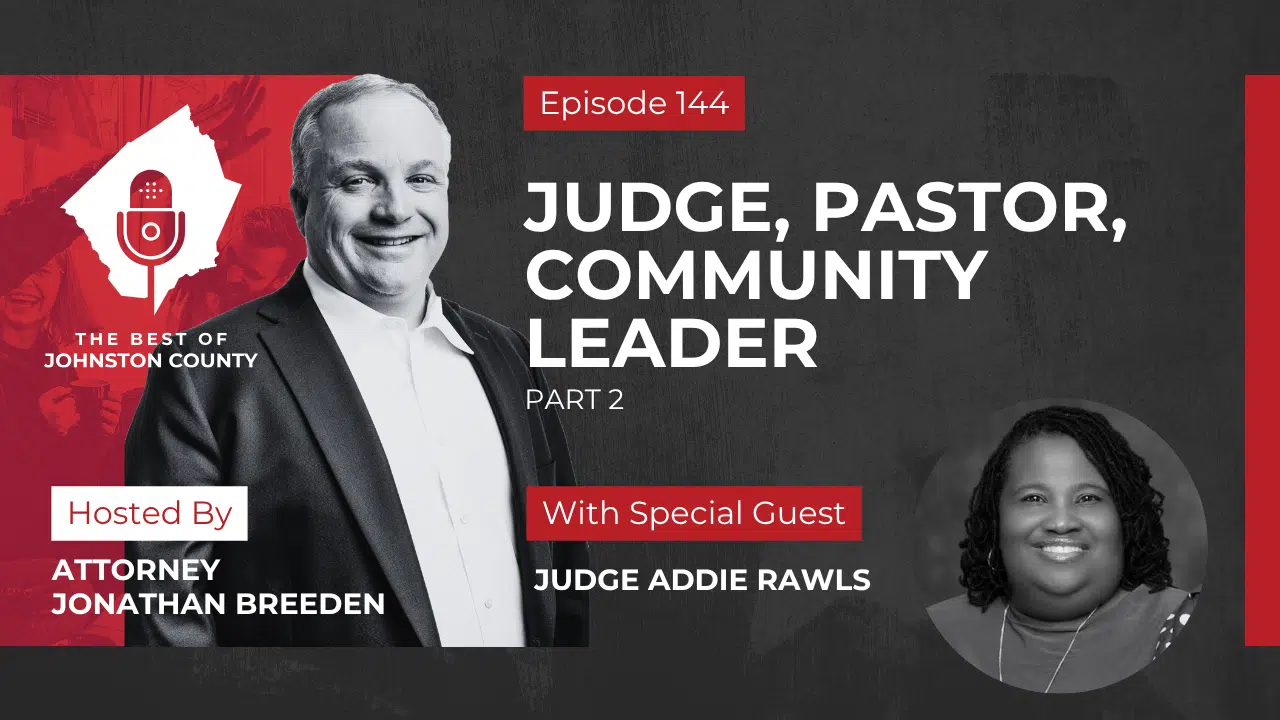
Jonathan Breeden: [00:00:00] On this week’s episode of The Best of Johnston County, we have our 2nd episode with retired district court Judge Addie Rawls. In this episode, we talk to her a little bit about her time as a district court judge, what a district court judge does, how she approached the very difficult decisions that district court judges had to make her time as a pastor at New Generation Church, and we talk to her a little bit more about her back to school youth explosion on August the 9th at Clayton High School from 2:00 to 5:00, where anybody that wants to can come get a meal, a haircut, and a backpack full of supplies.
So listen in.
Welcome to another episode of Best of Johnston County, brought to you by Breeden Law Office. Our host, Jonathan Breeden, an experienced family lawyer with a deep connection to the community, is ready to take you on a journey through the area that he has called home for over 20 years. Whether it’s a deep dive into the love locals have for the county or unraveling the complexities of family law, Best of Johnston County presents an authentic [00:01:00] slice of this unique community.
Jonathan Breeden: Hello, and welcome to another edition of the Best of Johnston County podcast. I’m your host, Jonathan Breeden, and on today’s episode, we have our second episode with retired district court judge, Addie Rawls, now pastor of New Generation Christian Church, and they have their big back to school youth explosion coming on August the 9th at Clayton High School from 2:00 to 5:00.
Anybody, regardless of race, age, income, whatever, is free to come get a meal, a haircut, and a backpack full of school supplies. So we’re gonna talk to her a little bit about that. And we’re also gonna talk to her a little bit about, in this episode, her time as a district court judge. So we sort of did her life up until her time as a district court judge in the episode that ran last week, so go back and listen to that.
But this week we’re gonna start when she becomes a district court judge in January of 2002, and what does a district court judge do, and what she learned while she was a district court judge, and we’ll talk a little bit more about the back to school youth explosion as well. But before we get to that, I’d like to ask you to like, [00:02:00] follow, subscribe to the podcast where- wherever you see it, whether on Apple, Spotify, YouTube, TikTok, X, LinkedIn, or any of the other social media channels of the Best Johnston County podcast.
The Best Johnston County podcast comes out every single Monday, and has now for well over 30 months. So go back and listen to our previous episodes. We’ve had Carolina Packers, we’ve had people from JoCo Grows Agriculture, we’ve had the majority of the county commissioners, we had our county manager, Rick Hester.
If you love Johnston County as much as I do, this is the podcast for you. Welcome, Judge Rawls.
Judge Addie Rawls: Good morning. Thank you for having me.
Jonathan Breeden: No problem. No problem. This is the second one of these, so not everybody listens to all of them, so we’ll start with what’s your name, what do you do?
Judge Addie Rawls: My name is Addie M.
Harris Rawls. I am a retired district court judge and pastor of New Generation Christian Church, and I guess community engager.
Jonathan Breeden: That’s true. That’s true. You, you definitely do a lot of that. So, you became a district court judge in, in ’22. We, we talked on the last episode, you grew up in Little Washington, took a [00:03:00] Trailways bus to Wake Forest University.
You worked several jobs while you were there to get through Wake Forest, and then you moved on to North Carolina Central, where you received a substantial scholarship as well. And then you went to clerk for Sid Eagles on the North Carolina Court of Appeals for two years, and then Judge Tom Locke hires you to be a prosecutor.
You become the first African American female prosecutor in the history of, of our district, which is Johnston, Harnett, and Lee, and you do that for 10 years. And then Governor Easley appoints you district court judge. So that is a very fast version of the first 30 years of your life, but or 35 years of your life.
But we do this whole story on the previous episode, so go back and listen to that one. So why did you wanna become a district court judge?
Judge Addie Rawls: I felt like it was a great opportunity to serve the citizens of the county to embrace what justice looked like and become a part of the process and not the one that always point the fingers and say what’s wrong with it.
I just felt like, it was a great way to serve in a [00:04:00] different way the people of our counties. And I’d met a lot of people and I saw a lot of things, and my experiences in court was those experiences were great. And I saw some things, not a lot, I would say bad things, but because I was part of the process, but I felt like it was a great opportunity to give back in a different kind of way.
Jonathan Breeden: All right. And well, was it what you thought it was going to be? Because everybody says they think it’s gonna be one way, and then when they put that robe on, it’s not always what they thought, because it’s a much different perspective when you’re actually deciding versus arguing for one side or the other, and there’s a tremendous weight in the decisions that are made there.
Judge Addie Rawls: Sure. My motto when I ran for judge was, “A judge who stands for justice does more than sit on a bench.” That’s what compelled me to do the things that I did. That question strikes me, I was working on something in seminary and the professor [00:05:00] says, I was talking about justice and food scarcity and how do you handle that.
And she was saying, “Well, I need to know how did you feel as a judge with justice versus how do you feel as a pastor, community engager with justice?” And I finally had to convince her that I didn’t have multiple personalities. I’m the same person whether I put on the black robe for the bench or I put on my black robe to minister in the pulpit on Sunday morning.
It didn’t necessarily change my perspective on what justice was, but I felt like we all are part of that process of getting to what is the truth, and I think I was compelled more to that. When I was a, a prosecutor, Tom Locke once asked me, “Do you pray to win cases?” “No,” I said, “I pray that truth is revealed.”
And I think that’s the type of attitude I took to the bench, too. What is the truth of the matter? Sorta like the four-way test of the Rotary Club.
Jonathan Breeden: Yep, I got that hanging up in
Judge Addie Rawls: Okay
Jonathan Breeden: one of the offices [00:06:00] here. I do.
Judge Addie Rawls: Yeah. I’m a Paul Harris Fellow from that.
Jonathan Breeden: Oh, that’s awesome.
Judge Addie Rawls: So
Jonathan Breeden: That’s… My grandfather gave me that.
Judge Addie Rawls: Wow.
Jonathan Breeden: And it’s hanging up in one of our conference rooms.
Judge Addie Rawls: Wow. So y- I understand that. I really believe that justice is, is not necessarily who comes out the winner, and I know you’re a defense attorney. But it, it does look at the perspective of where is the truth and, and how do you work it. And that’s just the way I am.
Right. That’s, that’s the perspective I bring.
Jonathan Breeden: Right. So the district courts of North Carolina, they cover criminal misdemeanors
Judge Addie Rawls: Mm-hmm
Jonathan Breeden: and they’re also there to decide whether there’s probable cause, whether a felony was committed
to bind people to superior court.
Judge Addie Rawls: Mm-hmm
Jonathan Breeden: and the superior court is where they try the felonies and the jury trials and the high-end civil cases where you see people win a million dollars ’cause they were hurt or whatever but the majority of the cases are in district court. I think 80% of criminal cases, I think, are district court.
Judge Addie Rawls: Right.
Jonathan Breeden: I mean, just talk a little bit about that process and how it sort of works?
Judge Addie Rawls: Okay. We also had juvenile [00:07:00] court, mental health court.
Jonathan Breeden: Right.
Judge Addie Rawls: And civil district court as well as your domestic court.
Jonathan Breeden: Right.
Judge Addie Rawls: And so we had all of those factors blended in and juvenile. In looking at it I call it the, it’s almost like you’re in the big arena. The district court is actually the largest arena. It may not be considered by some to be the most important court, but I really believe in many ways.
Jonathan Breeden: It is.
Judge Addie Rawls: It’s the most important court, and what we do there impacts and makes a difference in the things you do. For me it was a big learning curve because I had clerked, so I knew the law. Of course, I was licensed as an attorney. I knew the law. But when you go into a district courtroom and you actually become a part of it, I left from doing prosecution into all these other different kinds of courts, especially domestic court and even civil district, learning how do you handle those types of disputes that happen.
So it was a big, big task.
Jonathan Breeden: [00:08:00] Right.
Judge Addie Rawls: You rely upon your courthouse staff, whether you’re dealing with the judge’s staff or the clerk of court staff. A lot of it comes through that. And certainly attorneys, if they do their job, they help make our job a lot easier as advocates of their clients in those arenas.
So I think it really becomes a serious task and you really think about, “Am I making the right decisions?”
Jonathan Breeden: Right.
Judge Addie Rawls: Y- somebody’s telling the truth in there. And somebody’s not. So you have to ask yourself, I mean, the, the, you know, are we, are we making? And, and that becomes the first question, and then the other task comes.
Sometimes you have a tendency to wanna fix some stuff, but you can’t necessarily fix it if you follow the law. You have to do what you do, then there may be other ways that you can sort it and do it. To me, one of the hardest cases I ever had was a domestic case not domestic, but basically juvenile court case in abuse, [00:09:00] neglect, dependency of termination of parental rights That was hard.
Jonathan Breeden: Yeah.
Judge Addie Rawls: It’s, you always ask yourself, “Is it that bad that you violate a person’s constitutionally protected right as a parent to cease all involvement?”
Jonathan Breeden: Right.
Judge Addie Rawls: That’s hard.
Jonathan Breeden: I understand. One of my best friends is Roy Wijewickrama who was he was the chief district court judge in the 30th Judicial District. Now he’s the resident superior court judge in Haywood and Jackson County, and he was a district court judge for many years, and he said basically a TPR, a termination of parental rights, is the death penalty for a district court judge. And now as a superior court judge, he actually has real death penalty cases.
But yeah, those are hard. And that’s the part a lot of people don’t see. So, you know, and when the Department of Social Services involved and children are put into foster care they go into the neglect dependency court, which you talked about, and that’s also where a district court judge is.
And those are some of the hardest decisions I think to have to make, because in regular domestic court, you’re [00:10:00] often trying to decide what’s the visitation. It’s gonna be fairly close to even. Everybody’s gonna be involved. Child might be more one parent than the other. In DSS court, there’s, every case is a safety issue.
How, you know, you gotta weigh the safety of the child with the right of the parents to parent the child, and they might not be parenting the children the way you would’ve parented them but they still have a right to parent them. So how did you go about trying to make those decisions? Because those would be the ones that keep me up at night if I ever became district court judge.
Judge Addie Rawls: It became a little easier, I think, when I look at my history, I was not involved in the system. However, I came in a non-traditional home setting, so I understood what it is to not have your parents actually be the ones taking care of you, but to have loved ones who step into place to do it.
So, often I would say to them in court, ” Well, wrong judge, wrong day.” You know, I realize that you don’t have to have a [00:11:00] car to be able to make it. Doesn’t necessarily even have to have your own beds, even though that’s the rule a lot of times with how you do it, children must have the bed. I remember sleeping with my grandmama and I was safe with my grandmama.
And so then you don’t lose those experiences. You take your ordinary common sense and experiences there with you. So I could adjust a little differently than other people, you know, because of the way I came up.
Jonathan Breeden: Right.
Judge Addie Rawls: However, you still have to remove you from it.
Jonathan Breeden: Right.
Judge Addie Rawls: Review the facts, but it still gave me a little bit of latitude, I think, more so than others in dealing with it.
But it still was not easy because I thought about those people that may have come up through ordinary ways, you know, extraordinary- Right … things may have happened to them. So, It, it still, you know, you always ask yourself, “Did you make the right decision?” Right. Same thing in, in, in custody. The next one [00:12:00] is custody to me ab- above that.
Jonathan Breeden: Right.
Judge Addie Rawls: And I remember always saying, “Did I make it?” Because sometimes you talk to kids and you can clearly see they were coached or they’ve been talked to, and then sometimes I’ve served long enough to see some of those children come back a little older sometimes, and see that there was conflict between the parent and the child that got the child, and wonder, did you really make the right decision even though the other parent was off and way off and just pushed every button to make the buttons be pushed?
But then you have to question, did I do it the right way?
Jonathan Breeden: Yeah. Well that’s true, that’s true.
Have family law questions? Need guidance to navigate legal challenges? The compassionate team at Breeden Law Office is here to help. Visit us at www. breedenfirm. com for practical advice, resources, or to book a consultation. Remember, when life gets messy, you don’t have to face it [00:13:00] alone.
Jonathan Breeden: The other thing that a lot of people don’t realize district court judges do is they do these mental health hearings, and we do have a facility here in Johnston County. It is a locked facility, and you can be involuntarily committed to it if somebody believes, or if a magistrate, I think, believes that you are a danger to yourself or others, and they do the best they can to try to stabilize people.
But after 7 to 10 days, the person’s entitled to a hearing because they are being held against their will, almost. It’s not prison, but they can’t leave. And you know, and it’s the district court judge has to decide, looking at all the evidence, are they a danger to their self or others, and should they be released?
How did you go about making those decisions? Because you have to weigh the constitutional rights of a person who’s not committed a crime, plus the safety to themselves and to other people that they may harm. So what went into those decisions?
Judge Addie Rawls: And we went into those same rooms with those people when we had those hearings too? Same type of thing. I remember one day I had a difficult [00:14:00] case because it involved a lawyer who was a minister, I was a minister, a counselor who was a minister, and a client who says, “I hear the voice of God talking to me.” And they wanted us to commit this person based upon them hearing the voice of God.
And I’m thinking the whole time, “Well, how many times did we proclaim that we hear the voice of God?”
Jonathan Breeden: Right.
Judge Addie Rawls: It was the counselor that, that got to the point of it wasn’t the hearing of the voice, but it was the ambivalence by which they were, of what they were hearing. They were going back and forth like, “I’m having Jesus’s baby.
I’m doing this and doing that.” And so that cleared up this thing of saying you hear a voice to looking at what the other factors were that affected it, because that was gonna be a serious dilemma because I’m thinking to myself- A lot of us, whether we call it [00:15:00] something, universe, voice of God, spirit, we say those things.
So how do you resolve it? And that, you know, that person just, they were back and forth in a way that they needed some help and, and you could do it. Again, that’s hard still because you’re really dealing with a person’s thoughts. Many times they think they’re gonna harm themselves. Sometimes they come in with harm for others.
So you have to weigh all of those to see if they’re a danger to themselves or a danger to others, and how can you best get the person help that they need. And with the decentralization of mental health services, it became more prevalent. Things began to happen that were more, and we saw just how serious that court was.
And-
Jonathan Breeden: Yeah, no, it’s, it’s, it’s… Yeah, you’re right. And, and, and those are always, those are always tough hearings. I, you know, I’ve not spent a ton of time in it, but it seemed to me from the outside, and this is a very probably not great opinion, that if the person [00:16:00] was really mentally ill, they would recommend that they be let go.
And if the person was on drugs or alcohol, they’d keep them and sort of detox them. I– that’s probably not what it is, but it sure as heck looked like that from the outside a few times
Judge Addie Rawls: Mm-hmm
Jonathan Breeden: with some of the clients I’ve had go in where I’m like, “This person really needs help,” and then they’re out, and then somebody comes in and they’re, they’re a drug addict, they’re an alcoholic, and then they keep them 30 days.
They sort of dry them out. Did you see that or am I just misreading what I thought I saw? I think you
Judge Addie Rawls: may have misread it a little bit.
Jonathan Breeden: Okay. All right. I mean, it just-
Judge Addie Rawls: We, we, we would… It would be based upon available placement of stabilization of medications and stuff that would recommend if they were responsive to medications and stuff like that, then we could do it a little differently.
But these things are serious. I remember I had to work at, the last week of working court period, I had to go into one and I saw a lady that I knew who I was like, “Oh wow, why are you here?” And it was because they had had a domestic situation, their [00:17:00] license to be a nurse had been taken, and they couldn’t find a job because they were waiting for an expungement to happen And th- it’s real stuff that happened.
Right And, and you understand, if I do this, this happens. If I do that… So I was always one that thought about the consequences of what happens and what needs to be done. And the person was able to get some help and get out, but it was a lot of other circumstances outside of their control that affected what they were doing.
Jonathan Breeden: All right. All right. Well, cool, cool. So you retired being a district court judge at December of well, January 1st, 2022.
Judge Addie Rawls: January 31st of 2022.
Jonathan Breeden: January 31 okay, of 2022. Okay, I got you. So you’ve been retired five years, but you started a church, we talked about this last podcast, we’re talking about it again, New Generation Church in 2010 while you were still a judge.
I remember that, and the first things y’all did that I remember was going to the Thanksgiving meal. And you’d do it on Wednesday, I think, at [00:18:00] lunch. And anybody could go, and that was the best Thanksgiving meal I would have every Thanksgiving.
Judge Addie Rawls: We would go to my old church, they’d serve that meal. Now one of my partners has a meal on Thanksgiving Day that he really gives out to mostly homeless people, but he’s doing thousands of meals between Johnston, Wake, and other Counties. And it’s amazing to see the volunteers just walking around in these circles. Last year was at Fellowship Baptist Church in Clayton.
Just watching all that, I mean, just seeing he starts cooking turkeys the first of the week. He had these freezer trucks, and then they’d get that stuff out and heat it up the next day, and just make sure people get meals, and it’s amazing.
Jonathan Breeden: Is that Coach Fred?
Judge Addie Rawls: Coach Fred.
Jonathan Breeden: Yeah, Coach Fred. He was on- Yeah,
Judge Addie Rawls: Coach Fred.
So you know
Jonathan Breeden: that … yes, no, he was on our podcast about a year ago.
Judge Addie Rawls: Yeah.
Jonathan Breeden: So you can go back and listen to Coach Fred talk about that. That was fascinating. He’s one of the most fascinating people we’ve had on this podcast. My job was to
Judge Addie Rawls: close the plates.
Jonathan Breeden: Oh my goodness. Yo, Coach Fred’s great. He was on [00:19:00] our podcast.
Great guy, great guy. Yeah, yeah. Love Coach Fred. but yeah, so, so yeah, and he does that on Thanksgiving Day now. He does. I think it’s like 1,000 people or something. It’s crazy.
Judge Addie Rawls: No, it’s thousands.
Jonathan Breeden: More than 1,000, yeah. Yeah,
Judge Addie Rawls: it was like six… It was 6 or 7,000
Jonathan Breeden: last year. Well, and I think he’s now partnered with Serve the Need in Johnston County. They’re helping with that as well. New Generation Church helps him as well. But you also have your back to school Youth Explosion. That’s y’all’s big event.
Judge Addie Rawls: That’s my biggest event.
Jonathan Breeden: It’s coming up August 9th. Tell us a little bit about that.
Judge Addie Rawls: That’s the biggest event August the 9th to Johnston County and beyond. It’s what we say. People have come from, they have come from every place to come receive these backpacks with school supplies, notebook paper, all kinds of things are in these bags that will get a child through school. And we also have a meal. We have hotdogs and other things. Sometimes they get the taco truck and then they cut hair, braid young ladies’ hairs, braid young men hair.
They used to be we couldn’t say that. They you know, they braid hair, cut straight, [00:20:00] kinky, all kinds of hair. Barbers, we need barbers, we need stylists, we need people to come. They try to, you know, do basic types of things and somebody said, “Well, you’re doing it August the 9th, but school doesn’t start till two weeks later.”
Well, people are volunteering their time, and you get your volunteers while you get them prepared and help as many as you can. And there’s a good rapport between other events that go on. So for instance, if people do something on a Saturday, they ran out, they said, “I need y’all to go to Clayton High on tomorrow to the Back to School Explosion.”
They’ll be there, and people have come and said, “We heard about this yesterday at your, at the other event,” so we’re grateful for that opportunity.
Jonathan Breeden: No, it’s tremendous. It’s tremendous.
You get a meal, you can get a haircut, and a backpack full of supplies. You had over 1,000 kids come through there last year.
Judge Addie Rawls: Yes.
Jonathan Breeden: Expecting more than 1,000 children this year. You have over 100 volunteers to put this on every year. And it’s part of the outreach of New Generation Church in Smithfield, right?
Judge Addie Rawls: New Generation and other [00:21:00] churches. Several churches were doing events at their church, and they said, “We didn’t have the children to come get it. Why can’t we partner and do it?” So at least 15, 20 churches partnered.
All the Greek organizations are there, motorcycle clubs. We need somebody to control the traffic in the parking lots, and they have been great with that. Just People have been part… They come and, and when we do it even down to borrowing somebody’s box truck to commute.
And God rest his soul, Gina from Regina’s Bail Bonds, her dad used to drive the truck with all our book bags and stuff on it, transport it from the church to the school and stuff.
Jonathan Breeden: Right. And y’all still pack everything at new Generation Church?
Judge Addie Rawls: We still pack it at New Generation.
Jonathan Breeden: Like a couple days before?
Judge Addie Rawls: The week, the week before.
Jonathan Breeden: Right.
Judge Addie Rawls: On Mondays, we have youth there. So what they do is they take all the pencil pouches and they put the pencils, the markers, the erasers, any kind of stuff we wanna put in, words to encourage the students in school, whatever. They pack those, and then they have pizza and fellowship, community service opportunity for our young people, [00:22:00] especially the high school students who need it for National Honor Society and other different clubs within the school.
And then on Monday night, we have two organizations come. They pack the K through two. The next night we have the three to five pack, and the next night we pack the six through 12. And then we have people like Jonathan and several of his colleagues that might, would come then on Friday night, and they’re picking up these boxes of book bags, loading them on the box truck, going to the school.
Some of the school football teams have helped unload it at the school, and then Sunday evening, same type of people come to load whatever might be left. Hopefully, I don’t wanna run out.
Jonathan Breeden: Right.
Judge Addie Rawls: But I want us to give out.
Jonathan Breeden: You wanna give out. Right, right. Yeah. That’s tremendous. It’s tremendous. Yeah. I mean, where did you get the idea?
I mean, this’ll be the 12th year of it.
Judge Addie Rawls: Okay.
Jonathan Breeden: I mean, what… How did it, how did it, how did it come to be?
Judge Addie Rawls: Darren Robinson and his wife Teresa Fatheadz, they used to do it. They did it with another church in Clayton, and I heard about it and I, and I was doing something on, on my own [00:23:00] and we kinda just joined together as a group.
And, and then the people that I knew, ’cause I used to go to a lot of churches and, and speak to youth, getting ready to go back to school, get them prepared for school, and same thing happened. So it just kinda revolved itself. Even on that day, there’ll be some people out there from the health department, some of our youth serving agencies.
I didn’t mention I serve on the Juvenile Crime Prevention Council. I’ve been the chair forever. And we have programs who need volunteers, like our teen court program and some other programs to engage and involve. We’ll have the Head Start out there recruiting children to go into the Head Start program.
So all those kind of people will be out there that day just kinda wrapping services around people and letting them know what is out here in them community.
Jonathan Breeden: Oh, that’s great. That’s great. That’s great. And if people wanna g- you need sponsorship, you need money to pay for all this stuff, you don’t charge anybody that walks through that door a single dime.
No. You don’t ask them who they are, where they’re from or anything. If they want a meal- And they get to pick their own book bag … if they want a haircut or they get a book bag. How can people reach out and, and g- and give money?
Judge Addie Rawls: They can contact [00:24:00] us at New Generation Christian Church 919-209-0536, $NewGChurch, capital N- Okay
little EW, big G, big C, H-U-R-C-H. They’ll see the logo of the church, and they can donate through that method there. All of that money will go towards that event.
Jonathan Breeden: And they can also reach out to, to Fatheadz- Fatheadz … the barber in Clayton.
Judge Addie Rawls: Yes.
Jonathan Breeden: Right. He, he still help you? Yeah. That’s great.
Judge Addie Rawls: Yes. That’s great.
He’s still there with us working. Okay. We’re working hand-in-hand.
Jonathan Breeden: That’s awesome. Well, I’d like to thank Judge Rawls for being our, our guest on this episode of The Best of Johnston County. As I mentioned earlier, go back and listen to the… If you wanna hear her story, how, how she got to being a district court judge and a little bit more about New Generation Church and its founding-
go back and listen to the episode that ran last week. We do appreciate her coming on and doing a sep- a second episode with us. Like I said before, please like, follow, and subscribe to this podcast wherever you see it, whether it be on Apple, Spotify, YouTube, TikTok, X, LinkedIn, or any of the other social media channels, the Best of Johnston County podcast.
If you’d be so kind as to leave us a five-star review down below, that would be great. And [00:25:00] if you’d also tag us in your Instagram stories Best of Johnston County, it’ll help us get our visibility out to more and more people so we can continue to bring this podcast to you. I forgot to ask you, what do you love most about Johnston County?
Judge Addie Rawls: I love the people of Johnston County And I feel like I’m a part of Johnston County now I’ve been here. I’ve never seen people who bind together any greater. We made it through a couple hurricanes. We made it through COVID. We’ve made it through some things that have been very impactful within our community, and I’m grateful for that opportunity.
Jonathan Breeden: That’s, yeah, it is, it is the people. That’s what almost everybody says. It’s great. All right. Till next time, I’m your host, Jonathan Breeden.
That’s the end of today’s episode of Best of Johnston County, a show brought to you by the trusted team at Breeden Law Office. We thank you for joining us today and we look forward to sharing more interesting facets of this community next week. Every story, every [00:26:00] viewpoint adds another thread to the rich tapestry of Johnston County.
If the legal aspects highlighted raised some questions, help is just around the corner at www. breedenfirm. com.
Justice Beyond the Bench
For nearly two decades, Judge Addie Rawls served as a District Court Judge with one guiding belief:
“A judge who stands for justice does more than sit on a bench.”
That philosophy shaped every decision she made. After serving as a prosecutor for ten years, she viewed becoming a judge as an opportunity to serve her community from a different perspective. Instead of advocating for one side, she became responsible for weighing every fact, every argument, and every consequence before reaching a decision.
The Weight of Difficult Decisions
District Court handles far more than criminal misdemeanors. Judge Rawls discusses the wide range of cases judges oversee, including:
- Juvenile Court
- Domestic Court
- Civil District Court
- Mental Health Court
- Abuse, Neglect, and Dependency cases
- Termination of Parental Rights hearings
She explains that some of the hardest decisions involved children and families, where judges must balance a parent’s constitutional rights with the safety and well-being of a child.
Drawing from her own upbringing in a nontraditional family, Judge Rawls shares how personal experience gave her perspective, while reminding herself that every decision still had to be grounded in the law and the facts before the court.
Truth Above Winning
One of the most memorable moments of the conversation comes when Judge Rawls recalls advice from former District Attorney Tom Locke.
When asked whether she prayed to win cases as a prosecutor, her answer was simple.
“I pray that truth is revealed.”
That same mindset followed her throughout her judicial career. Rather than focusing on winners and losers, she believed justice required discovering the truth and applying the law fairly, regardless of the outcome.
Serving People Beyond the Courtroom
Judge Rawls also discusses the unique challenges of mental health court, where judges must carefully balance an individual’s constitutional rights with public safety and access to treatment.
She explains that every hearing involved real people facing complex circumstances, often requiring thoughtful consideration of medical recommendations, family situations, and the long-term impact of each decision.
Throughout the conversation, one theme remains consistent: compassion must exist alongside accountability.
Back to School Youth Explosion
Although Judge Rawls retired from the bench in 2022, her service to Johnston County continues through New Generation Christian Church.
Each year, the church partners with numerous community organizations, churches, businesses, volunteers, and civic groups to host the Back to School Youth Explosion at Clayton High School.
Families receive:
- Free backpacks filled with school supplies
- Free haircuts and hair styling
- A free meal
- Access to local community resources
- Information from youth-serving organizations
More than 1,000 students attended last year’s event, and volunteers from across Johnston County work together to prepare thousands of backpacks in the weeks leading up to the event. Judge Rawls emphasizes that the outreach is open to everyone, regardless of background or income, because the goal is simple: help children begin the school year with confidence.
The Strength of Johnston County
As the episode closes, Jonathan Breeden asks the signature question:
What do you love most about Johnston County?
For Judge Rawls, the answer is clear.
She loves the people.
She reflects on how neighbors have supported one another through hurricanes, the COVID pandemic, and countless community challenges. That spirit of working together continues to inspire her ministry and her ongoing commitment to serving others.
Closing Reflection
Judge Addie Rawls has served Johnston County in many roles: prosecutor, District Court judge, pastor, mentor, and community leader. While the titles have changed over the years, her purpose has remained remarkably consistent.
Whether presiding over difficult courtroom decisions or organizing one of the county’s largest community outreach events, she continues to demonstrate that leadership begins with service, compassion, and a commitment to doing what is right.
This conversation offers a thoughtful look at the responsibilities carried by those entrusted with justice and the lasting impact one person can make by investing in a community long after leaving public office.
AND MORE TOPICS COVERED IN THE FULL INTERVIEW!!! You can check that out and subscribe to YouTube.
Connect with Judge Addie Rawls:
- Website: https://newgenerationchristianchurch.org
- Phone: 919-209-0536
Connect with Jonathan Breeden:
- Website: https://www.breedenfirm.com/
- Phone Number: Call (919) 726-0578
- Podcast: https://breedenlawpodcast.com/
- YouTube: https://www.youtube.com/@BestofJoCoPodcast
Listen On