
December 1, 2025
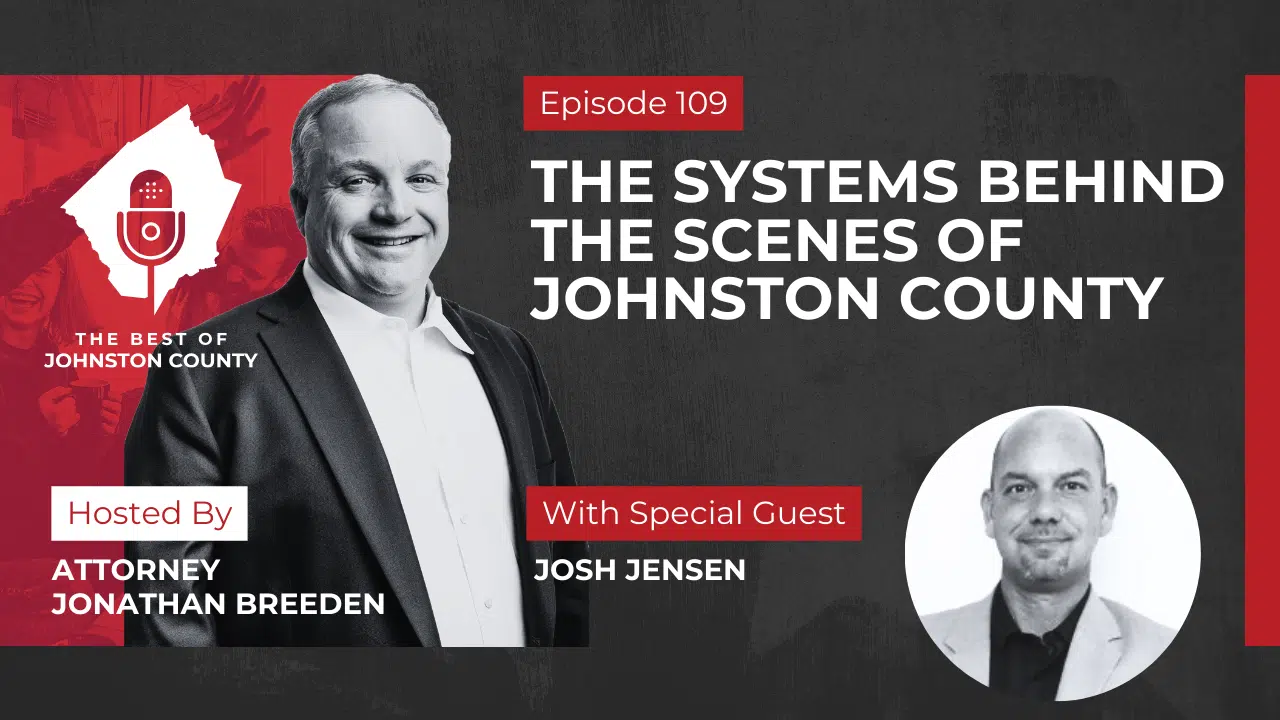
The Systems Behind the Scenes of Johnston County
Jonathan Breeden: [00:00:00] On this week’s episode of The Best of Johnston County Podcast.
Our guest is Josh Jensen, the executive director of Johnston County Community and Senior Services. We talked to Josh a little bit about his background in healthcare administration and how he ended up working with seniors. He really enjoys seniors and he found his career. Moving towards helping seniors stay out of nursing homes, which is what led him to Johnston County.
We also talked to him a little bit about all the different things that, that the senior that his programs do, including JCATS Quick Ride, which is like an Uber for Smithfield and Selma, as well as Meals on Wheels of Johnston County. So if you’re interested in helping seniors or how the county can help seniors or how to just get around, even if you’re not a senior, listen in.
Welcome to another episode of Best of Johnston County, brought to you by Breeden Law Office. Our host, Jonathan Breeden, an [00:01:00] experienced family lawyer with a deep connection to the community, is ready to take you on a journey through the area that he has called home for over 20 years. Whether it’s a deep dive into the love locals have for the county or unraveling the complexities of family law, Best of Johnston County presents an authentic slice of this unique community.
Jonathan Breeden: Hello and welcome to another edition of The Best of Johnston County Podcast. I’m your host, Jonathan Breeden, and on today’s episode we have Josh Jensen, the Executive Director of Community and Senior Services for Johnston County.
Man, I hope I got that title right. If not, he’s gonna, he’s gonna help get it straight. He’s here to talk to us a little bit about. What his office does, and it does so much that I had no idea. And when I heard him speak at a state of the region Chamber of Commerce breakfast in early September of 2025, I was like, I’ve gotta have him come on this podcast.
One of the things we’re gonna talk to him about is the JCATS Bus system here in Johnston County. [00:02:00] It’s the only public transportation that we really have, and he is in charge of that. And that is where a bus will take you to a non-emergency medical appointment if you call and make an appointment. And one secret.
You don’t have to be poor. It’s for anybody who would like a ride to a medical appointment. We’re also gonna talk to him about his new program, Quick Rides, which is like Uber for Smithfield and Selma, and how he might be trying to expand it into Clayton. And we’re also gonna talk to him about Meals on Wheels.
He’s in charge of that as well. So I don’t know when he sleeps, but we’re gonna talk to him a little bit about all the different things he does. He has a $14 million budget and they do tons and tons and tons for seniors in this community. Before we get to that, I’d like you to like, follow, subscribe to this podcast.
Wherever you’re seeing it, whether it be on Apple, Spotify, YouTube, TikTok, LinkedIn X, or any of the other social media channels of The Best Johnston County Podcast, The Best of Johnston County Podcast comes out every single Monday. It has now for over two years, [00:03:00] so go back and listen to some of our previous guests.
We’ve had the vast majority of the county commissioners. We’ve had many local, local business owners like Realtor Donald O’Meara, financial advisors like Chris Key. We have Woody Bailey talking about computer IT for your office. We’ve had all types of great guests so go back and listen to some of them.
If you love Johnston County as much as I do, this is the podcast for you. Welcome, Josh.
Josh Jensen: Thank you for having me. Appreciate it.
Jonathan Breeden: No problem. Did I mess up your title?
Josh Jensen: It’s community and senior services of Johnston County.
Jonathan Breeden: Alright. Community and Senior Services of Johnston County Semantics. Alright, so you’re the executive director of that.
You’ve been on that job for two and a half years. Before we get to that, let’s talk about like your biography. Where, where’d you grow up? You know, where’d you go to school?
Josh Jensen: So I was born and raised in southeastern South. Okay. South of Sioux Falls, if anybody’s familiar with the Midwest, I grew up in a town of 900 people, but a half hour from a city of 200,000.
So we had a little, I could, I can survive in a rural climate and in an urban climate. I’m well adjusted [00:04:00] to both.
Jonathan Breeden: Oh, that’s awesome. That’s awesome.
Josh Jensen: I, I went to the University of South Dakota for healthcare Administration, so my degree is in hospital. Administration.
Jonathan Breeden: Okay.
Josh Jensen: And following that, I fell into long-term care. So my first role outta college, I was a nursing home administrator.
Jonathan Breeden: Okay.
Josh Jensen: And following a few years in that I was promoted up the ranks and became a regional vice president of operations for a for-profit nursing home chain. And then my first child was born and I got sick of being on a plane all the time.
So I could imagine around 2005. I became the CEO of a not-for-profit senior campus that had a nursing home, Alzheimer’s unit, assisted living home health, meals on Wheels. We did everything on a 30 acre campus.
Jonathan Breeden: Okay.
Josh Jensen: And I was there for 13 years.
Jonathan Breeden: Okay.
Josh Jensen: And by that role. When you’re doing everything in the community and everything inside of a nursing home, you get conflicted sometimes because you have nursing home staff wanting to [00:05:00] build occupancy and I had my home health staff wanting to keep people out and it was, and it was always, you know, a little bit of a battle.
And I had a recruiter reach out to me about an opportunity in Florida, and that was keeping people out of. Nursing homes and I started to feel myself gravitating towards that previously Anyway. Okay, so my family and I, we moved to Brevard County, Florida near Cocoa Beach, and I ran the organization that provided or coordinated all of the services to keep people out of nursing homes.
So Meals on Wheels, home health, home improvement, transportation, all those types of things. And I was there. Almost six years and we decided we wanted to be closer to family, but didn’t want to go back to Midwest winter.
Jonathan Breeden: It’s cold in the Midwest in the winter.
Josh Jensen: Yes.
Jonathan Breeden: Very cold. Especially in south of North Dakota.
Josh Jensen: And my wife has family in Durham. And when this opportunity [00:06:00] came up, I was like, this may work. And so instead of being nine hours away from my wife’s family, we’re an hour now and we’re really enjoying it.
Jonathan Breeden: Oh, that’s awesome. That’s awesome. So you came to Johnston County to take over this position, I think two and a half years ago.
Josh Jensen: Mm-hmm.
Jonathan Breeden: So early in 2023.
Josh Jensen: Mm-hmm.
Jonathan Breeden: What did they tell you the job was and what did you find out the job was when you got here? Because there’s always two sides of that.
Josh Jensen: Well, the community and senior service side of what I do is almost identical to what I was doing in Florida. And that’s, I think, where the connection was made between myself and the board of directors ’cause I, I know that I, they did not let onto me how big of a role I was gonna run in, be in JCATS, the Johnston County Area Transit System, and right now it’s probably taking 60 to 65% of my time is focusing on JCATS. But fortunately I have an incredible team. So, the CSS side there, they can, that allows me to focus on the changes going on with [00:07:00] JCATS.
Jonathan Breeden: Okay. So. Who do you work for? Because you don’t work for the county?
Josh Jensen: No.
Jonathan Breeden: I thought you worked for the county and answered to Rick Hester, but you do not.
Josh Jensen: I do not.
Jonathan Breeden: Who do you work for?
Josh Jensen: I answered to Rick Hester, but I do not work for him.
Jonathan Breeden: Okay. Alright. So Rick Hester’s the Johnston County manager for anybody knowing, I thought really it was another county department, but that it is not really.
Josh Jensen: No, it’s not.
Jonathan Breeden: Okay.
Josh Jensen: We are not-for-profit 501(c)(3) and I report to a volunteer board of directors.
Jonathan Breeden: Oh, okay. And what is that? Not-for-profit call.
Josh Jensen: Community and senior services.
Jonathan Breeden: Okay. Alright.
Josh Jensen: And what the other things we do are, so for example, we consider JCATS a division of community and senior services.
Jonathan Breeden: Okay.
Josh Jensen: We have other divisions and we actually have multiple corporations because we also operate 140 units of hud, senior apartments around the county as well.
Jonathan Breeden: Okay. So now is this not for profit, just Johnston County? Is it a regional one?
Josh Jensen: It is just Johnston County.
Jonathan Breeden: Okay.
Josh Jensen: The Johnston County residents are on the board. The only [00:08:00] caveat to that is for some unknown reason, we manage 30 units of senior housing and carry.
Jonathan Breeden: Okay.
Josh Jensen: And nobody can tell me how we got ahold of those, but we,
Jonathan Breeden: Okay. So you managed 30 senior housing units in Cary.
Josh Jensen: Everything else is Johnston County.
Jonathan Breeden: Everything’s in Johnston County. So how is your board selected?
Josh Jensen: There’s an application process. People can apply on the board of directors, review the application, make sure that they’re a good fit for our mission and vision. And not just that, but also demographically and geographically. ’cause we want representation of the whole county. Okay. And we, we make the decision like we don’t want 10 people from Clayton, one from Smithfield, none from Princeton, you know?
Right. We want, we want a good mix of board members.
Jonathan Breeden: Okay. So your budget is $14 million.
Josh Jensen: Between all of our programs around that.
Jonathan Breeden: Okay. And JCATS is just one of it.
Josh Jensen: JCATS is about half.
Jonathan Breeden: JCATS is about [00:09:00] half. Okay. Alright. Let’s start with JCATS. What is it? How could it help people?
Josh Jensen: So, JCATS primary purpose is non-medical transportation for anybody. We do a lot of dialysis trips each and every morning Monday through Saturday, but it’s mostly for people that aren’t able to drive to get to those types of appointments. There are some other programs where we can bring people to go get their pharmacy and different things. There was some changes in Medicaid managed care around a year ago.
That allow them to pay for services, like to go to the pharmacy and just to do those other different things that’ll be covered under their health plan, just to make it more usable for the patient.
Jonathan Breeden: Okay. So now, and JCATS, is it free? Do you have to pay?
Josh Jensen: There’s a number of different programs that can cover a lot of times cover the fare. If they don’t fall into one of those, it’s a $6. It’s a $6 fare if they don’t fit into one of the plans.
Jonathan Breeden: Okay. So $6 each way.
Josh Jensen: Mm-hmm.
Jonathan Breeden: [00:10:00] $12 round trip?
Josh Jensen: Yes.
Jonathan Breeden: Okay. But what, what, what are some of the things, most of the trips. Or paid for, not by the person they’re paid for by one of these other entities. What are some of the things that qualify to get a free ride from JCATS?
Josh Jensen: Well, if you’re over the age of 60, you can get free medical transportation through several different programs.
Jonathan Breeden: Okay.
Josh Jensen: There are also some state programs that will allow us to cover those medical trips if they’re under the age of 60.
Jonathan Breeden: Okay.
Josh Jensen: The most of ’em, the other ones. There’s some work related trips. So we actually have different routes. So we, we have one bus particular, for example, I think I brought it up at the breakfast the other day. We have a bus that goes around that picks up people for a variety of reasons.
Some are going to work, some are going to medical appointments, some are, you know, they’re going just different reasons. And it’s almost a ride share on our buses.
Jonathan Breeden: Okay.
Josh Jensen: And we have the technology to be able to sort out who needs to pay what. And it’s a good service for those.
Jonathan Breeden: Okay.
Josh Jensen: Who can’t [00:11:00] drive.
Jonathan Breeden: Right. Well, and the thing you pointed out at the breakfast that got me, was it’s open to everybody.
It’s open to all it even if I don’t qualify for any of the financial help, if I’m willing to pay $12, you will come pick me up. Now, does the appointment have to be in Johnston County?
Josh Jensen: No.
Jonathan Breeden: Or will you drive me to Raleigh?
Josh Jensen: We go to six other counties.
Jonathan Breeden: Okay.
Josh Jensen: We do frequently, we do trips to the VA in Durham to Chapel Hill, to UNC to around different hospitals.
But the trip has to originate in Johnston County.
Jonathan Breeden: Okay. I didn’t know that. Well, we got the new VA in Garner. Is it open yet?
Josh Jensen: I don’t believe so.
Jonathan Breeden: Okay. All right. Well, it’s gonna open by the time this broadcast runs, it might be open, so that’ll be good. Maybe we’ll be able to, it’s a lot closer than those other VAs.
So maybe some of the Johnston residents will start going to the new VA hospital or. Va outpatient clinic. I don’t guess it’s really a hospital on Highway 50 in Garner, right before you get to timber Drive. It’s, it’s a beautiful facility being built there. And anyway, so hopefully it’ll be open here real [00:12:00] soon. So, so, alright, so, so the, the appointment doesn’t have to be in, you can take ’em to Durham or Chapel Hill or Raleigh. The trip just has to originate in Johnston County. Okay. How do I request a ride?
Josh Jensen: You, you call into our scheduler. She’ll see if we, what, what buses are going where, what day, and how we can fit you in.
And, you know, it is public transportation, so it’s not, you know, door to door concierge service. You may be picked up at six in the morning for an appointment at nine 30 and then not, maybe not get picked up again till one. It’s, it’s public transportation. You have to take the, the good with the bad. And sometimes some people have some long days if they’re going say to Chapel Hill because those buses are running to the different clinics and outpatient things around up and down I 40. And sometimes there’s a a wait before and after.
Jonathan Breeden: Okay. Alright. I mean, it makes sense. I didn’t even really think about it that way, but it does make sense because you’re trying to. Maximize the ridership on every single bus that you have going out there.
Josh Jensen: We wouldn’t be in business if we were taking one [00:13:00] person to Chapel Hill at a time, you know, it just, it’s just too far.
And for a 25 foot bus that gets about eight miles to a gallon, that’s not that’s not a winning proposal.
Jonathan Breeden: I gotcha. I gotcha. So, so I mean, so how many, I mean, I mean how many trips did JCATS do last year?
Josh Jensen: Last year we did just under 125,000 trips.
Jonathan Breeden: Okay.
Josh Jensen: That’s up from 99,000 in 2023. Right? That’s up 20 22, 20 23.
That’s a big jump and we’ve seen it in the growth and the demand in our buses for the first time that I can remember. And my predecessor can remember. If you go to JCATS at eight in the morning, there are no buses. Usually there’s one or two. We usually had the, you know, capacity to have a couple extra buses just in case.
And we don’t right now, if, if a bus breaks down we’re scrambling, man. Alright, so the majority of your funding comes from the federal government? That’s correct. Is that correct? That is correct. And what part of the federal government is it under? Is it under the FTA Federal Transportation Administration.
Jonathan Breeden: Okay.
Josh Jensen: [00:14:00] Provides 80% of our funding. Okay. The rest of it is, it’s, it depends on the program. Sometimes it’s 10% times, times it’s 50% state, and then sometimes it’s 5% or 10%. Local match is required with the grants.
Jonathan Breeden: Okay. Right. And I know the county. Commissioners give you about a million dollars a year.
Josh Jensen: Mm-hmm.
Jonathan Breeden: And before I met you, I thought the county commissioners paid for almost all of what you do.
Josh Jensen: Mm-hmm.
Jonathan Breeden: So I’ve learned that if, you know, I really didn’t realize it was largely federal funding.
Josh Jensen: Mm-hmm.
Jonathan Breeden: That covers this, which is, which I think is great. I mean, I think these people need to go and, and if you, you know, if you’re listening to this and you have a relative at your house and you’re at work and they need to go to the doctor during the day, you can call JCATS and they will come and pick up. Your, your mother or your aunt, your uncle, and they’ll take, take ’em so you can stay at work. I mean, it’s I think it’s a, it’s tremendous service that’s provided. And I don’t think there’s a lot of awareness, which is one of the reasons I wanted to have Josh come on here. Now you started this thing [00:15:00] I didn’t know about until last week called Quick Rides.
What is that and how is it a part of JCATS?
Josh Jensen: So it is a part of JCATS. What it does, it’s simply it’s the public transportation’s version of Uber. I think I share that at the breakfast. We have an app, it’s on demand. Usually we can come get you within 20 minutes if you’re within the Smithfield Selma zone.
But what it does when you’re running in public transfer, if you’re running a bus route and say it’s going up down 301 in Smithfield. There’s no houses on 301 in Smithfield, so people are walking, you know, could have maybe walk 3, 4, 5 blocks and then wait for a bus. This is much more flexible.
It’s door to door, and it’s much more cost effective than it is to actually run a giant bus and not knowing what the fare and fare ridership are gonna be.
Jonathan Breeden: Okay.
Josh Jensen: You know what you’re getting.
Jonathan Breeden: Okay. Are these done in individual cars like Uber?
Josh Jensen: We have handicap accessible vans. All of our [00:16:00] vehicles are ADA accessible.
Jonathan Breeden: Okay.
Josh Jensen: And they’re seven passenger.
Jonathan Breeden: Okay. And so you, and you take me from point A to point B, and it can be. It doesn’t have to be medical on quick rides. No, no. I You take me to my friend’s house.
Josh Jensen: Yes.
Jonathan Breeden: Okay. As long as I’m in the Smithfield Selma zone.
Josh Jensen: Yes, that is correct.
Jonathan Breeden: Alright. And it’s also $6 one way,
Josh Jensen: $6 one way, whether you have one person or five people, it’s six bucks.
Jonathan Breeden: Okay. And where does the funding from that come from? Is it the same as the sort of the federal funding for the medical transport?
Josh Jensen: No in, in. In rural counties, which Johnston mostly is, there really isn’t a funding stream for it. Okay. So the budget for Quick Ride consists of fares and then County support because the county commissioners have seen the value in the program.
Jonathan Breeden: Alright. And you’re thinking about, you mentioned that the breakfast expanding quick rides into Clayton and Flowers. When would that take place and what would [00:17:00] that look like?
Josh Jensen: So there’s several different things to go into making that a reality. The first one is hopefully going to be resolved in the near future.
Clayton and Flowers are now considered urban by the federal government. They’re a small urban area, so that does qualify for federal funds funding, unlike Smithfield and Selma. So we are working with the federal government and the state to be able to find ways to draw down those funds. The funds have been awarded, we just haven’t been able to draw them down yet.
Jonathan Breeden: Okay.
Josh Jensen: The second piece of it is I need vehicles. And I have been awarded 10 expansion vehicles, and you get public transit in North Carolina, you get based on a formula and your size, three to five, seven replacement vehicles every year based on the age of the bus, the miles, you know, those types of things.
Expansion is a whole different process. And fortunately at the state level, they realized the growth in, in Johnston and have awarded us [00:18:00] five expansion vehicles for buses for this coming year. And I successfully wrote a grant for five electric vans.
Jonathan Breeden: Oh man. That’s great. So you’re gonna get 10 new vehicles?
Josh Jensen: Yes.
Jonathan Breeden: Oh, that’s awesome.
Josh Jensen: The downs and the other part of it, the supply chain issues. I have replacement buses that I ordered last January that I haven’t received yet.
Jonathan Breeden: Oh, okay. So that’s eight months or 18 months. We’re recording this at the end of September, 2025.
Josh Jensen: So it’s been been about nine months since I ordered.
Jonathan Breeden: Nine months since you ordered ’em. Okay. Alright. So when do you think you might get ’em?
Josh Jensen: They keep putting it off. I don’t know.
Jonathan Breeden: Okay, I gotcha.
Josh Jensen: So, and I have ordered the vehicles for the expansion vehicles, but it’s. Not up to me when they come. And, and unfortunately, and if you, when you look at some of our vans the chassis’s identical to Amazon’s, so we’re fighting with Amazon over chassis.
Jonathan Breeden: Oh, I never thought about that. So anyway, well hopefully you’ll get those vehicles here maybe by the end of the [00:19:00] year.
Have family law questions? Need guidance to navigate legal challenges? The compassionate team at Breeden Law Office is here to help. Visit us at www. breedenfirm. com for practical advice, resources, or to book a consultation. Remember, when life gets messy, you don’t have to face it alone.
Jonathan Breeden: So, alright, so we have JCATS. For the non-emergency medical transport, we have quick rides at Smithfield of Selma, which is like Uber or Lyft. For taking you from Point A to Point B $6 each way.
You also oversee Meals on Wheels. Let’s talk about that. What is Meals on Wheels? Who qualifies? How do you go about doing that?
Josh Jensen: So, the community and senior services side of what we do we are the provider that helps coordinate all the home and community based programs in Johnston County. So Meals on Wheels is one of ’em.
We do home health, we have congregate dining sites around. So the definition for Meals on Wheels is you have to be over the age of 60 and home [00:20:00] bound. You cannot drive yourself to get somewhere and then you qualify for a meal. The congregate dining. And we have four, five sites for congregate dining.
They’re the same criteria except they have the ability to get to the dining site, and that’s more about socialization and just, and trying to avoid isolation and you know, keeping people active.
Jonathan Breeden: Okay.
Josh Jensen: We also have a home improvement program, so we’ll do wheelchair ramps, so grab bars and home modifications to make sure that people can stay in their homes versus having to go to an assisted living or a nursing home.
We have senior centers that we operate and have different programming in, in. Clayton, Smithfield and Selma and Benson that we provide daily programming for people. Just again to avoid isolation and help with their socialization.
Jonathan Breeden: Well, I’m definitely familiar with the senior centers, particularly the one in Clayton. They do a ton of great things there for sure. So where do you cook the food for the Meals on Wheels?
Josh Jensen: So we contract with, it used to be Meals on Wheels of Wake [00:21:00] County, and they have their own kitchen and they split into two entities. So what’s formerly the Meals on Wheels? Wake County Kitchen is now called Food Runners and we contract with them to get the food out.
So every morning we, they truck the food in containers that just keep it hot and cold and they bring it out to the different distribution sites when then the Meals on Wheels. Drivers come distribute the meals each day and come back and we do it again tomorrow.
Jonathan Breeden: So how many meals do you distribute each day in Johnston County?
Josh Jensen: I had JCATS on my brain.
Jonathan Breeden: Okay.
Josh Jensen: What did we,
Jonathan Breeden: it could be an approximate number. It doesn’t have to be exact.
Josh Jensen: I’m just trying to do the, we do about a hundred a day.
Jonathan Breeden: A hundred a day, okay.
Josh Jensen: Because we have about 300, we have about 300 clients.
Jonathan Breeden: Okay. And, and they get a meal every day. Every other day,
Josh Jensen: Monday through Friday, they get meals. Unfortunately, Johnston County is so big we cannot get to everybody and make sure that the temperature on the food is. In the proper temp when we, okay, so those people, they get the same meals, but they’re [00:22:00] frozen and they get week supply at a time.
Oh, okay. ’cause we don’t want anybody to go without a meal, but with the rules and regulations when it comes to food temperatures, food safety, you know, foodborne illnesses, we, there’s, there’s limits to how far we, we can, we can get out in the county.
Jonathan Breeden: Okay. So where are the congregate dining sites?
Josh Jensen: We have congregate dining sites at all of our senior centers.
Okay. Which is Selma, Smithfield, Benson, Clayton. And then we also have one in Kenley.
Jonathan Breeden: Okay. Do you serve a meal there every day?
Josh Jensen: Yes. They’re the same meals that go out to the meals and meals clients.
Jonathan Breeden: Okay. And so you serve those five days a week?
Josh Jensen: Yes.
Jonathan Breeden: Okay. Well that’s really good. That’s really good. Well, that’s great for them to I mean, you’re right about the isolation, right? They get to see each other. Mm-hmm. Tell stories, show pictures of grandkids. I think they play games. I know with the Clayton one, they, they, I’ve known ’em to play bingo. Mm-hmm. And card games and, and that kind of stuff. They’re always looking for volunteers.
Right. At these community centers. So one to volunteer, who would they contact? [00:23:00]
Josh Jensen: You call Sarah at our main office in Smithfield.
Jonathan Breeden: Okay. Because I mean, they always need more volunteers. I’ve mm-hmm. Done some of that. Over the years, you know, it’s a ton of fun.
Josh Jensen: Mm-hmm. We do have a waiting list right now for Meals on Wheels, and part of it is funding. Part of it is just a lack of drivers in some of some areas.
Jonathan Breeden: Okay. And then the drivers are volunteers?
Josh Jensen: Yes, that’s correct.
Jonathan Breeden: I’ve done that before. The problem was, as I was telling you before we started recording, I would get off of off of my route because I’d start talking and then I was gonna be late. And I know anybody that knows me, it’s like I cannot believe. Jonathan Breeden got to talking to where he didn’t, he wasn’t able to get, he was trying to get, to get his other meals delivered because I was having too much fun talking to people and meeting people and, and, and I, and I recognized that was the only person they might even see that day.
Josh Jensen: Mm-hmm.
Jonathan Breeden: But I also realized. That the supervisor was like, you gotta get the meals to the people because there gotta be a certain temperature and all that stuff. So it’s, anyway, I may not have been the best volunteer, but I [00:24:00] did really enjoy it.
Josh Jensen: Well, if I had a dollar for everybody that’s told me that story it, it’s really fulfilling to do a Meals on Wheels route. And the other important part of it, it is, you know, the isolation, but you know, we work closely with EMS and law enforcement too. ’cause it’s also a wellness check on that person. And we have had instances where people knock on a door and nobody answers and something’s happened. So, you know, it’s, it’s a, it’s an important service in a, not a different ways.
Jonathan Breeden: Right. That, that’s true. That’s true. So. I’m almost afraid to ask what else is under CCS. I mean, we’ve done Meals on Wheels, we’ve done quick rods, we’ve done jake hats. Is there anything else you’re responsible for?
Josh Jensen: Said, we have about 140 senior apartments run. I managed through hud, the Housing Urban Development that we have apartments in Smithfield. We have apartments in two places in Clayton, Princeton, Kinley and Cary.
Jonathan Breeden: So are these like section eight income state departments? You have to have a bill over certain income, right. That kind of stuff. Okay, I [00:25:00] got you. And so does that mean you own them, you have property managers, you lease them? What does, what does, what does that exactly mean?
Josh Jensen: Through the, through the federal government’s eyes, were the property managers until 40 years as it. Passed on since the initial BU of the building, and then we become the owners of the property.
Jonathan Breeden: Okay, I got you. So, and then people, you have to be a certain age to live in these? Mm-hmm. How old do you have to be 60. You have to be 60. Okay. And there’s an income level. You have to be sliding scale. Okay.
Josh Jensen: It’s sliding scale and it’s X amount above the poverty line is what you qualify for. And then your rent goes up or down depending on where you, where you land. Okay. And it’s income based, not asset based. So you can have, you know, a savings account, but if you’re drawing very little interest off of that, that’s really not gonna count against you.
Jonathan Breeden: Okay. All right. So some people pay some nominal amount and some people don’t pay anything at all.
Josh Jensen: Correct.
Okay. And, I know there’s rules that you have to stay there. Like you’re not [00:26:00] supposed to have adult children living there. Mm-hmm. Being a family lawyer, I have run into this many times mm-hmm.
Where you have adult children staying in these homes where they’re not supposed to be. And often if you’re gonna have trouble, it’s from the adult children and their kids, not from the actual resident.
Right.
Jonathan Breeden: So what do y’all do to, to make sure that these places are safe?
Josh Jensen: Well, we have security cameras through all the properties and we have.
We have people on that live in, they live on site, but they also act as kind of a, also a manager to make sure things are in line and if there’s a light bulb that they can change that and those types of things. And then our property manager does, you know, frequent visits and maintenance guys are there almost every other day at one of the properties.
Okay. Just to keep an eye on things
Jonathan Breeden: so you know what’s going on. I mean. You know, if you got a problem, somebody’s gonna come tell you or your property managers about it, and, and that’s, that’s gonna be important. Do you have a lot of incidents?
Josh Jensen: It’s nothing. Nothing serious. Serious. Okay. Well that’s good there.
Incidents pop, just like any [00:27:00] apartment, right? Any apartment
Jonathan Breeden: cowboys got incidents.
Josh Jensen: I mean, we’ve, we’ve had some crazy things happen, but for the most part it’s, you know, pretty quiet. Just neighbors not liking each other, those types of things, you know? Well, that could happen sometimes too. I won’t say which town, but my very, when I first started here, we had a tenant pull a sword on another tenant.
Oh. A sort that, that was, that was, that was the extreme one since I’ve been there, but usually it’s, oh my goodness. Okay. Usually it’s just bickering or, you know, you took my parking spot kind of stuff.
Jonathan Breeden: Okay. I gotcha. Well, that’s cool. That’s cool. Well, that’s great. That’s great. Is there anything else, the public, that listen as podcast, eat and know about CSS and all the things y’all do?
Josh Jensen: Oh, we’re a, we’d like to be less of a secret. I don’t think people, a lot of people know what we, what we do. We had, I had a lady reach out to me about renting one of our buses ’cause she saw it and didn’t know what it was and just called to ask what, you know, she could borrow it and no, that’s not how this works.
She can’t borrow the bus. So it’s, you know, and it’s, it’s also [00:28:00] when I’ve. The, the stigma a little bit on our larger buses, not quick ride. We logoed, we branded quick ride differently to make sure it stood out and it wasn’t, didn’t have the stigmas of the previous buses where it’s just only old people ride those.
Right, right. And that’s really not the case. And we have, we work with Johnston County Industries to bring a lot, some of their people onto their campus. I had a meeting a couple weeks ago at Johnston Community College about working, looking at a partnership to get those. Challenge students that can’t, don’t have Right.
Transportation. Try to get them onto campus. Right. And I actually have a meeting next week with Amazon right now. We take through Quick Ride, we bring seven or eight of their, their staff to work every morning and then back and after their shift and after the breakfast actually the general manager of the plant came up to me and said, I have at least 25 people that struggle to get here that aren’t in your.
Quick red zone, what can we do?
Jonathan Breeden: Oh, that’s great. That’s great. Well, I mean, look, and, and I gotta give it to you. [00:29:00] I mean, Josh, I mean, you’ve, you’ve done more in just. Couple of years to promote what’s going on that had been promoted before you come on this podcast, you spoke to 300 people at a breakfast, like, like you’re doing your part.
And I, and that’s part of the reason I’m doing this podcast. Mm-hmm. I mean, you’re doing that like really, I think people need to know about it. I’ve worked with JCATS over the years. I’ve been a family lawyer in Johnston County for 25 years. I’ve had all different types of clients that need to get places, young people, old places.
Mm-hmm. Old, older people and stuff. So I was very familiar with it. I’ve just learned about Quick Rides. I’ve done Meals on Wheels, but I didn’t realize it was under your program. I just volunteered and helped y you know what I mean? I didn’t know. I went here, I took, took meals around. I didn’t understand where the meals came from.
I just was riding around talking to people. So, I mean, I appreciate you doing coming out and. And talking to us and speaking to the breakfast. And, and, and you’ll go speak to any church or community group or somebody on your staff? Will I do If, if they reach out, right? If you, if you wanna know how to be involved, I’ll volunteer.
What’s the best way to get in touch with you?
Josh Jensen: Well, it’s easy. We [00:30:00] can reach out through our website, which is johnston county.org or CSS johnston.org, excuse me. And our direct line in Smithfield is 9 1 9 9 3 4 6 0 6 6. There’s a lot of stuff that we do in the community and as this county continues to become more urban, there’s gonna be a lot of new things coming down the coming down the pipe.
Jonathan Breeden: Well, and I, and you’re absolutely right, and I appreciate what you’re saying about John Community College. I was on the board of Johnston Community College from 2015 to 2019, and we had the same issues with students being able to get to class and from class then that they have now.
I don’t think people realize that. I think you spoke at the breakfast you said. 18% of the households in Johns county have no vehicle or only one vehicle.
Josh Jensen: Mm-hmm. That’s correct.
Jonathan Breeden: I don’t think a lot of people realize that as well. And, and that’s a lot of a county of, you know, 275,000 people. There’s a lot of households that, that are, that, that have problems with transportation.
Mm-hmm. And they include you know, community college students. And I remember we had a fund through [00:31:00] the Johnston College Foundation where we could help. If they were getting near graduation and their car broke down or something like that, we could help get the car fixed so that they could get to get finish coming so they could graduate.
Right. We also started a food bank while I was on the board of Johnston Community College, which I think they still have. So these are all things I think people lose track, right? You live out here in Cleveland, like me, you go to Raleigh every day. I think people can lose track of. Of, of, of some of the poverty that we do have in this county.
Mm-hmm. And some of the ways that our citizens are challenged just like any other citizens. Mm-hmm. And so you’re doing a lot to help seniors and, and, and anybody through your program and, and, and that we’re very appreciative of that and all the work you and your team are doing. The last question we ask everybody on this podcast, you’ve been here two and a half years, what do you love most about Johnston County?
Josh Jensen: So far? It’s the, the people. As a. Kind of an outsider. You never know what you know, how you’re gonna be received, especially when you’re kind of in a public facing position like I am. And the community has been so [00:32:00] welcoming to my wife and my family we’re very appreciative of it.
Jonathan Breeden: Oh,
Josh Jensen: that’s great.
Jonathan Breeden: That’s great. Well, we’d like to thank Josh Jensen, who’s executive director of community Services Senior and Community Services. I’m gonna get that wrong every time for being our guest on this week’s episode of The Best of Johnston County Podcast. As we mentioned earlier feel free to like, subscribe to this podcast wherever you’re seeing it.
So you’d be made, made aware. A future episode of The Best of Johnston County would also be great if you give us a five star review down below so that we’ll know what you like or maybe dislike about The Best of Johnston County Podcast. And if you’d be so kind as to share. The social media clips that you see and tag us in your Instagram stories.
Best of Johnston County that will help more people learn about this podcast and learn why you love Johnston County as much as we love Johnston County. And that’s why we bring this podcast to you every week. Until next time, I’m your host, Jonathan Breeden.
That’s the end of today’s episode of Best of Johnston County, a show brought to you by the trusted team at Breeden Law Office. We thank you for joining us today and [00:33:00] we look forward to sharing more interesting facets of this community next week. Every story, every viewpoint adds another thread to the rich tapestry of Johnston County.
If the legal aspects highlighted raised some questions, help is just around the corner at www. breedenfirm. com.
When I walked into the State of the Region Chamber breakfast back in early September of 2025, I had no idea I would end up inviting the speaker onto the podcast a few days later. But when I listened to Josh Jensen talk about the sheer scale of what Community and Senior Services does, I knew I had to get him in front of the people of Johnston County.
Most folks around here have no clue just how much his organization is doing behind the scenes, and I’ll be honest, I didn’t either. I’ve lived here over twenty years, built a career in this county, raised a family here, and I still learned things in that room that I had never heard before.
So I brought him onto the show. And the conversation opened my eyes even more.
How Josh Ended Up Here
Josh didn’t grow up anywhere near Johnston County. He’s originally from southeastern South Dakota, in a town of about 900 people, with a city of around 200,000 just a half hour away. That gave him a blend of rural experience and exposure to bigger systems early on.
He went to the University of South Dakota and studied healthcare administration. His degree was actually in hospital administration, but his career took him straight into long term care. He worked his way up from nursing home administrator to a regional vice president of operations for a for profit nursing home chain.
Then life happened. His first child was born, and he decided he didn’t want to spend his life on airplanes. That led him to running a nonprofit senior campus that operated everything from assisted living to an Alzheimer’s unit to Meals on Wheels.
But that job made something clear. Inside the nursing home, the goal was filling beds. Outside, through home health, the goal was keeping people out of them. He kept feeling a pull toward helping people stay where they wanted to be — at home.
A recruiter reached out about an opportunity in Florida that focused on exactly that, so Josh and his family moved to Brevard County near Cocoa Beach. He spent almost six years running the organization that coordinated all the services keeping people out of nursing homes: Meals on Wheels, home health, home improvement, transportation — everything.
Eventually, they wanted to be closer to family in Durham, but without the punishment of a Midwest winter. That’s when the Johnston County job came up. They moved here two and a half years ago, and Josh says the thing that’s stood out most is how welcoming people have been to him and his family.
Community and Senior Services Is Not a County Department (Even Though I Thought It Was)
Before talking to Josh, I assumed Community and Senior Services was just another county department that answered to the county manager. That’s not the case at all.
Josh doesn’t work for the county.
Community and Senior Services is a standalone nonprofit — a 501(c)(3). Josh reports to a volunteer board of directors made up of Johnston County residents who apply and are selected based on fit, mission alignment, and geographic representation. They want people from all over the county, not just one or two towns.
JCATS, the Johnston County Area Transit System, is actually just one division of this nonprofit, and the whole organization runs on a $14 million budget.
One nonprofit. Fourteen million dollars in services. And half of that is JCATS alone.
I told him on the show that I had always thought the county commissioners paid for almost everything. Turns out almost 80 percent of the transportation funding comes from the Federal Transit Administration. The county contributes about a million dollars each year, but the real foundation is federal.
JCATS: The Only Public Transit We’ve Got
JCATS is something many people know by name but don’t understand in practice.
First, let me say this clearly:
JCATS is open to everyone.
You do not have to be poor. You do not have to be elderly. If you need a ride to a medical appointment, you can call and schedule one.
If you qualify through programs for seniors or certain state programs, your ride may be free. If not, the cost is six dollars each way — twelve dollars round trip.
The trip just has to start in Johnston County.
And these aren’t short hauls. JCATS routinely travels to:
- The VA in Durham
- UNC in Chapel Hill
- Hospitals in Raleigh
- Clinics along I-40
Dialysis patients use it constantly. Seniors rely on it for medical appointments. And some people use it for work related trips.
But here’s the thing that stuck with me:
It’s not door-to-door concierge service. It’s public transportation.
You might get picked up at six in the morning for a 9:30 appointment. You may not get picked up until one in the afternoon to come home. That’s the reality when a bus might be carrying riders going to several destinations.
Last year, JCATS completed just under 125,000 rides — a huge jump from 99,000 rides the year before. Josh told me that for the first time he can remember, if you stop by JCATS at 8 AM, you won’t see any buses in the yard. They’re all out. If one breaks down, they’re scrambling.
Federal funding covers most of this, but it doesn’t happen without the county stepping in to cover their part. And the demand is only growing.
Quick Ride: Public Transportation’s Version of Uber
This one blew my mind. I didn’t even know it existed until a week before our recording.
Quick Ride is like Uber for Smithfield and Selma. It’s part of JCATS, but it’s on-demand. You use an app, and they typically pick you up within twenty minutes.
It’s not limited to medical transportation. You can ride to a friend’s house, work, or anywhere within the Smithfield–Selma zone.
It costs six dollars each way — even if five people are riding together.
Instead of sending a big bus down a route with no houses on it, Quick Ride uses smaller seven-passenger ADA accessible vans. It’s far more efficient and much more flexible.
But here’s a key difference from JCATS:
There is no regular federal funding stream for on demand transit in rural counties.
Quick Ride exists because of three things:
- Rider fares
- County support
- The commissioners recognizing its value
Josh is looking ahead to expanding it into Clayton and the Flowers area, which are now considered “small urban” by the federal government. Federal funds have been awarded to support expansion, but they’re still working out how to draw that money down.
He’s also secured ten expansion vehicles — five buses and five electric vans — but supply chain delays are holding everything up. He ordered replacement buses last January and still hadn’t received them by the time we spoke. The vans use the same chassis Amazon uses, and they’re literally competing for the same equipment.
Meanwhile, Quick Ride is already taking seven or eight Amazon employees to work every morning. After Josh spoke at the chamber breakfast, the Amazon general manager told him he has at least 25 more employees who struggle to get to work because they aren’t in the Quick Ride zone.
So yes — this is not just about seniors. It’s about workforce transportation too.
Meals on Wheels: Food, Friendship, and a Wellness Check
Community and Senior Services doesn’t just transport people. They also make sure seniors are eating.
Josh oversees Meals on Wheels of Johnston County. To qualify, you must be over 60 and homebound, meaning you cannot drive. They have about 300 clients and deliver around 100 meals per day, Monday through Friday.
Some people get hot meals daily. Others get frozen meals weekly because they live so far out that hot food wouldn’t stay in the proper temperature range.
The meals are prepared and delivered to distribution sites by a kitchen operation that used to be tied to Meals on Wheels of Wake County, now called Food Runners. Volunteers deliver the meals from there.
Community and Senior Services also operates congregate dining sites at senior centers in:
- Smithfield
- Selma
- Clayton
- Benson
- Kenly
These sites serve the same meals but offer something just as important — social connection. People gather, talk, play games, and keep from feeling isolated.
I’ve volunteered for Meals on Wheels before, and I admitted on the show that I was not always the best volunteer because I got caught up talking too long at each stop. But those conversations matter. Josh said that in some cases Meals on Wheels volunteers have discovered emergencies when a client didn’t answer the door.
It’s food — and it’s a wellness check.
There’s currently a waiting list. Part of that is funding. Part is the number of available volunteer drivers.
Senior Housing: 140 Places to Call Home
Josh’s organization also manages about 140 HUD-regulated senior apartment units across Johnston County, plus 30 units in Cary.
Residents must be 60 or older, and rent is income based. Savings don’t count against them — it’s about what they live on, not what they’ve stored away.
The organization acts as property manager, with on site staff, maintenance workers, and security cameras. Most issues are everyday neighbor disagreements. Occasionally, something surprising happens — like the time a tenant pulled a sword on another tenant shortly after Josh arrived. Thankfully, situations like that are rare.
Their housing isn’t just about a place to sleep. It’s about letting seniors live independently and safely.
The Part That Surprised Me Most
During the breakfast where I first heard Josh speak, he shared something I didn’t know.
Eighteen percent of households in Johnston County either have no vehicle or only one vehicle.
That number has stayed with me.
A county of about 275,000 people — and a large number of them are struggling to get to class, work, medical care, or even the grocery store.
When I served on the board of Johnston Community College from 2015 to 2019, we had the same problems. We created a fund to help students get their cars fixed so they could finish school. We started a food bank on campus. Students dealing with transportation and food insecurity is not new. It’s still happening.
Josh and his team are stepping into those gaps every day.
Why I Wanted Josh on the Show
Josh said something during our conversation that really struck me:
He wants Community and Senior Services to be less of a secret.
And he’s doing his part — speaking at events, answering questions, coming on this podcast, meeting with companies like Amazon and organizations like Johnston Community College.
But after listening to everything he’s responsible for — transportation, Meals on Wheels, senior housing, senior centers, home improvements — it became obvious why he doesn’t sleep much.
This county is changing. It’s growing fast. It’s becoming more urban. And the systems Josh manages are about to matter even more.
If you want to learn more, volunteer, or get connected, here’s how to reach his team:
- Website: cssjohnston.org
- Phone: 919-934-6066
Whether you’ve lived here your whole life or just got here last week, knowing what supports exist around you matters. And after my conversation with Josh Jensen, I can tell you this:
A lot more is being done to help your neighbors — and possibly even you — than most people realize.
AND MORE TOPICS COVERED IN THE FULL INTERVIEW!!! You can check that out and subscribe to YouTube.
Connect with Josh Jensen:
- Website: https://www.cssjohnston.org
- Phone: 919-934-6066
Connect with Jonathan Breeden:
- Website: https://www.breedenfirm.com/
- Phone Number: Call (919) 726-0578
- Podcast: https://breedenlawpodcast.com/
- YouTube: https://www.youtube.com/@BestofJoCoPodcast
Listen On